


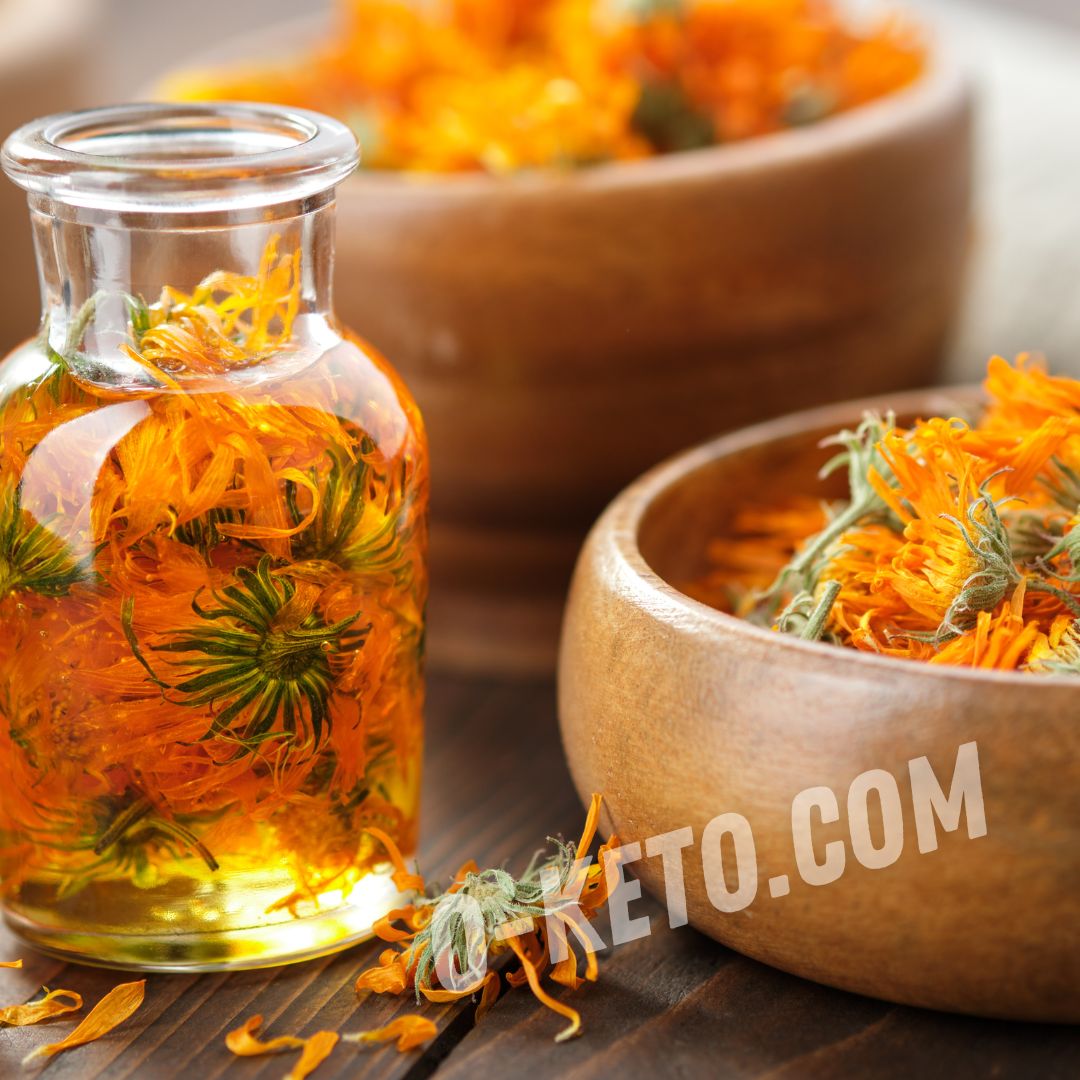

Calendula oil is an oil infusion of Calendula officinalis flowers, most often in sunflower, olive, almond, or another carrier oil. The flowers give the oil carotenoids, aromatic compounds, and some plant substances, so the finished product usually has a yellow-orange shade and a mild herbal smell.
This oil is used mainly externally: for care of dry, sensitive, wind-exposed, or irritated skin, in massage blends, balms, creams, hand masks, and after-sun products. It is not a cooking oil and not a frying product. If the producer does not specify food use, it should not be taken internally.
What it contains
The composition depends on the base. If the flowers were infused in olive oil, the product will be denser and have a stronger oil aroma. A sunflower base is usually lighter and more neutral. Almond or apricot kernel bases are more common in cosmetic blends. So the label should be checked not only for calendula, but also for the carrier oil.
Calendula flowers contain carotenoids, flavonoids, triterpene compounds, and essential components. In the finished oil they are present in a gentle form, but concentration differs greatly between producers: a homemade macerate, a cosmetic oil, and a pharmacy blend may be very different products.
Relation to keto
For keto and LCHF, calendula oil has almost no dietary role because it is usually not consumed internally. Carbohydrates do not need to be counted for external use. If the product is specifically a food-grade oil infusion, then the carrier oil and real portion should be counted, but such products are much less common.
The practical connection with low-carb life is mostly skin care. On keto, some people change their food, care routine, water, salt, and household habits, but calendula oil does not solve these questions by itself. It is better viewed as a cosmetic oil with a mild plant profile.
How to use it
Apply a thin layer to clean dry or slightly damp skin. For the face, one or two drops are usually enough; for hands and body, use a small amount spread over the skin. It can be mixed with a neutral cream, added to massage oil, applied to cuticles, or used as part of a homemade balm.
For the scalp, use it carefully: it can weigh hair down and be hard to rinse. In that case, apply it locally or mix it with a lighter base. Homemade oils are better not applied to deep fresh cuts, wet damaged areas, or unclear skin lesions without professional assessment.
Where it appears
Calendula oil is often found in lip balms, hand creams, after-sun products, massage oils, baby creams, cuticle care, and blends for dry skin areas. In a finished cream, it is usually only one part of the formula; in a pure bottle, it is a separate oily base. These forms feel different: a cream spreads more easily and absorbs faster, while a macerate leaves a more noticeable film.
If the product is needed for homemade cosmetics, an oil without strong fragrance and without a complex active blend is easier to work with. That makes it simpler to understand how the skin reacts to the carrier and calendula itself, not to perfume composition or essential oils.
How to choose
A good oil should have a clear ingredient list: carrier oil and calendula flowers or calendula extract. Ideally, the label states the Latin plant name, extraction method, date, and storage conditions. A very strong perfume smell may point to added fragrance rather than the plant itself.
For sensitive skin, choose a product without essential oils, dyes, and strong fragrances. If the oil is intended for the face, consider the carrier oil: heavy oils may not suit skin prone to clogged pores.
Limitations
Calendula belongs to the Asteraceae family, so people who react to chamomile, ragweed, arnica, chrysanthemums, or similar plants should be especially cautious. Before first use, it is reasonable to apply a drop to a small skin area and wait a day.
If burning, rash, itching, swelling, or stronger irritation appears, wash the oil off and stop using it. For infants, pregnant women, and people with pronounced skin problems, ready-made products with clear instructions are better than homemade blends of unknown concentration.
How to store it
Keep the oil infusion tightly closed, away from light and heat. Dark glass is preferable, or store the bottle in a cupboard. Rancid smell, sharp bitterness, cloudiness with flakes, or color change means the product has lost quality. Do not scoop oil with wet fingers so water does not enter the bottle.
What can replace it?
For gentle care, jojoba oil, almond oil, olive oil, squalane, apricot kernel oil, or a ready cream without strong fragrance can work. If a plant note is needed in a balm, chamomile macerate, St. John’s wort oil, or sea buckthorn oil may play a similar role, but each has its own limitations and color.


