


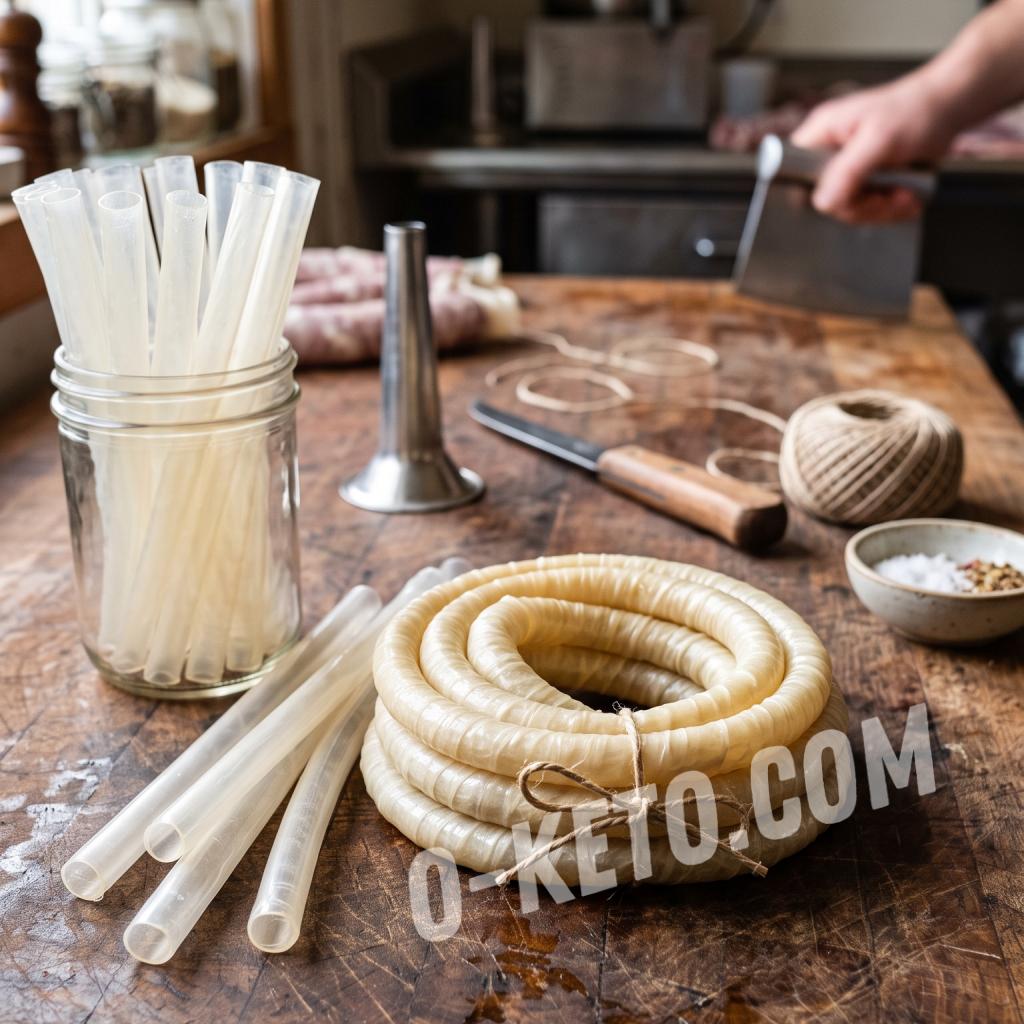

Collagen casing is a sausage casing made from processed collagen, a protein derived from animal connective tissue. It is used when the goal is a neat, even sausage shape, predictable caliber, and easier stuffing without the sorting and cleaning routine required for natural casings. This is not a finished food product and not a stand-alone ingredient for everyday meals. It is a technical material for home sausage making and small-batch production, and its main value is consistency, handling comfort, and cleaner presentation of the final product.
What It Is
Collagen casings are sold as tubes or shirred sleeves in different diameters. Compared with polyamide casings, collagen is closer to food-contact raw material and is commonly intended for direct contact with the filling during heat treatment. Compared with natural hog or sheep casings, collagen is far more uniform in thickness, length, and diameter, which makes it easier to produce sausages with a repeatable look and slice. That predictability is one of the main reasons many home cooks and craft producers choose it for routine batches.
How It Is Used
Collagen casing can be used for cooked sausages, semi-smoked products, cooked-smoked items, and in some cases dry-cured styles, but the exact application depends on the specific casing type. Manufacturers usually state whether the casing is suitable for boiling, baking, smoking, drying, or frying. The casing helps hold the filling together, supports a cleaner surface, and makes portioning more consistent. It is often used for pork sausages, poultry sausages, fish sausages, frankfurter-style products, and other shaped forcemeat preparations where a stable result matters.
How To Choose
The first point to check is caliber. Thin snack sticks and hot-dog style sausages require one range, while larger luncheon loaves and cured sausages need another. It is also useful to confirm whether the casing needs soaking, how long preparation takes, and how elastic the wall becomes before stuffing. A casing that is too fragile may split under pressure, while one that is too firm may be uncomfortable to use on a small home stuffer. If smoking is planned, smoke permeability matters. If the product will be poached, baked, or steamed, heat tolerance is more important.
Practical Handling
Preparation should follow the producer instructions rather than guesswork. Some collagen casings are used almost immediately, while others benefit from a short soak to improve flexibility. During stuffing, excessive pressure should be avoided because overfilling increases the risk of tearing and uneven links. After filling, the sausage is formed, tied or twisted as needed, and then cooked according to the chosen recipe. It is also worth checking whether the specific casing is marketed as edible, because this can vary by product line and by intended sausage style.
What Matters Nutritionally
Collagen casing does not meaningfully define the nutrition profile of the finished dish. In practical cooking, calories, protein, fat, and micronutrients are evaluated from the meat or fish filling, not from the casing itself. It should also not be treated as a universal substitute for every other casing. Natural casings, polyamide casings, fibrous materials, and collagen all behave differently during stuffing, heating, drying, and storage. If the priority is traditional character, natural casings may still be preferable. If the priority is convenience and a more repeatable result, collagen casing is often the more practical choice.


