


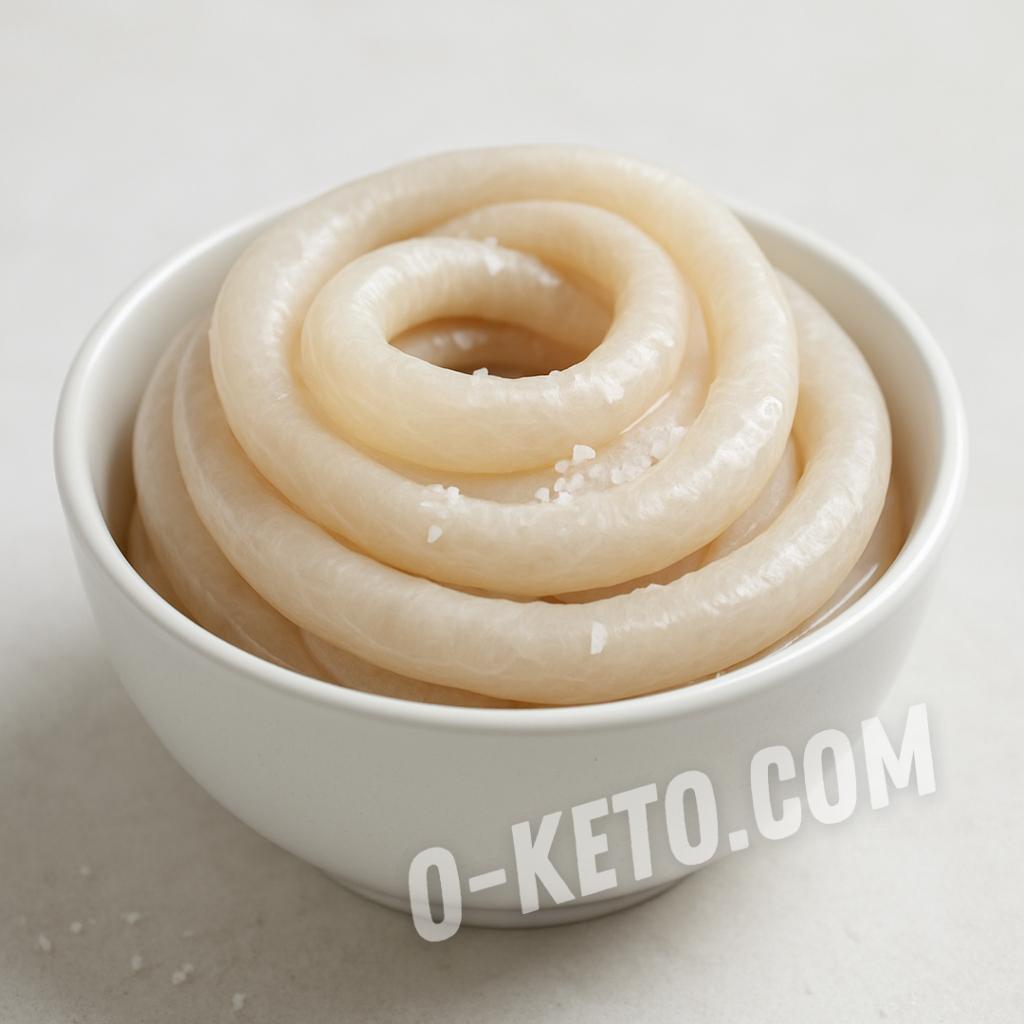

Natural casings are edible sausage casings made from cleaned animal intestines, most often hog, sheep, or beef. The useful layer is a collagen-rich tissue that can hold ground meat, survive stuffing and cooking, and give traditional sausages their characteristic snap.
In cooking, natural casings are a technical ingredient rather than a standalone food. They shape sausages, hot dogs, bratwurst, blood sausage, dry-cured sausages, and many homemade meat products. In recipes, their amount depends on length and diameter, not on spoon or piece measurements.
What They Are
Natural casings consist mainly of collagen-rich connective tissue. After processing, they are cleaned, sorted by diameter, and stored in salt or brine. Before use, they are usually soaked, rinsed, and threaded onto a sausage stuffer or grinder attachment.
The main types differ by animal source and size:
- sheep casings are used for thin sausages and small links;
- hog casings are common for homemade sausages, bratwurst, and similar products;
- beef casings are used for larger sausages and wider products;
- special natural casings are used for particular traditional sausage styles;
- salted casings need soaking and rinsing before stuffing.
Nutrition Profile
The nutrition profile depends on animal source, moisture, and residual salt after soaking. Per 100 g, natural casings are mostly collagen protein with little fat and almost no carbohydrate. In a real serving of sausage, the amount of casing is usually very small compared with the meat filling.
The most important nutrition points are:
- natural casings contain almost no digestible carbohydrates;
- their protein is mostly collagen, not complete muscle protein;
- collagen has a very low PDCAAS, so casings should not be marked as complete protein;
- sodium varies widely because many casings are stored in salt;
- the casing contributes little to the final macros of a normal sausage portion.
Keto and LCHF
Natural casings fit keto and LCHF because they are very low in carbohydrates and used in small amounts. The main nutritional impact comes from the sausage filling: meat, fat, salt, spices, nitrite salt, sugar, starch, or other additives.
For low-carb cooking, check the full recipe rather than the casing alone:
- the filling should avoid sugar, breadcrumbs, starch, and cheap fillers;
- salt and nitrite salt should be calculated for the whole batch;
- fat content should be chosen based on the sausage style and diet goal;
- homemade sausages are easier to keep low-carb than many store-bought products.
How to Choose
A good natural casing should be clean, elastic, and matched to the sausage diameter you want. Too narrow a casing can split during stuffing, while too wide a casing changes the product format and texture.
When buying casings, check these points:
- animal source: sheep, hog, beef, or another natural casing;
- caliber in millimeters, because it determines sausage diameter;
- storage format: dry salted, brined, or tubed;
- no rotten smell, mold, or obvious damage;
- clear storage instructions and shelf life.
Preparation and Safety
Before stuffing, natural casings usually need rinsing and soaking. Salt protects them during storage, but too much salt and stiffness are not desirable in the finished sausage. The casing should stay moist until stuffing to prevent tearing.
Basic preparation usually includes:
- removing the needed length and rinsing off excess salt;
- soaking in cool water according to the producer’s instructions;
- running water through the inside of the casing;
- keeping it moist until stuffing;
- stuffing without excessive pressure, leaving room for twisting and cooking.
When Not to Use
Do not use casings with a rotten smell that remains after rinsing, visible mold, slime, unusual color, brittleness, or many tears. Because this is an animal product, clean tools, refrigeration, and safe handling around raw meat are important.
Stuffing and Caliber in Practice
Caliber affects both texture and cooking time. Thin sheep casings suit small sausages that cook quickly and have a delicate snap. Hog casings are more forgiving for homemade sausages because they tolerate a little more handling. Wider beef casings need a different filling texture and slower cooking so the center heats evenly.
During stuffing, the casing should be filled firmly but not stretched to the limit. Overfilled links burst during twisting, smoking or frying; underfilled links wrinkle and cook unevenly. Air pockets can be pricked with a clean needle, but many holes weaken the casing. For keto, the casing is rarely the issue: the low-carb result depends on meat, fat, salt, spices and the absence of bread, starch and sugar in the filling.


