


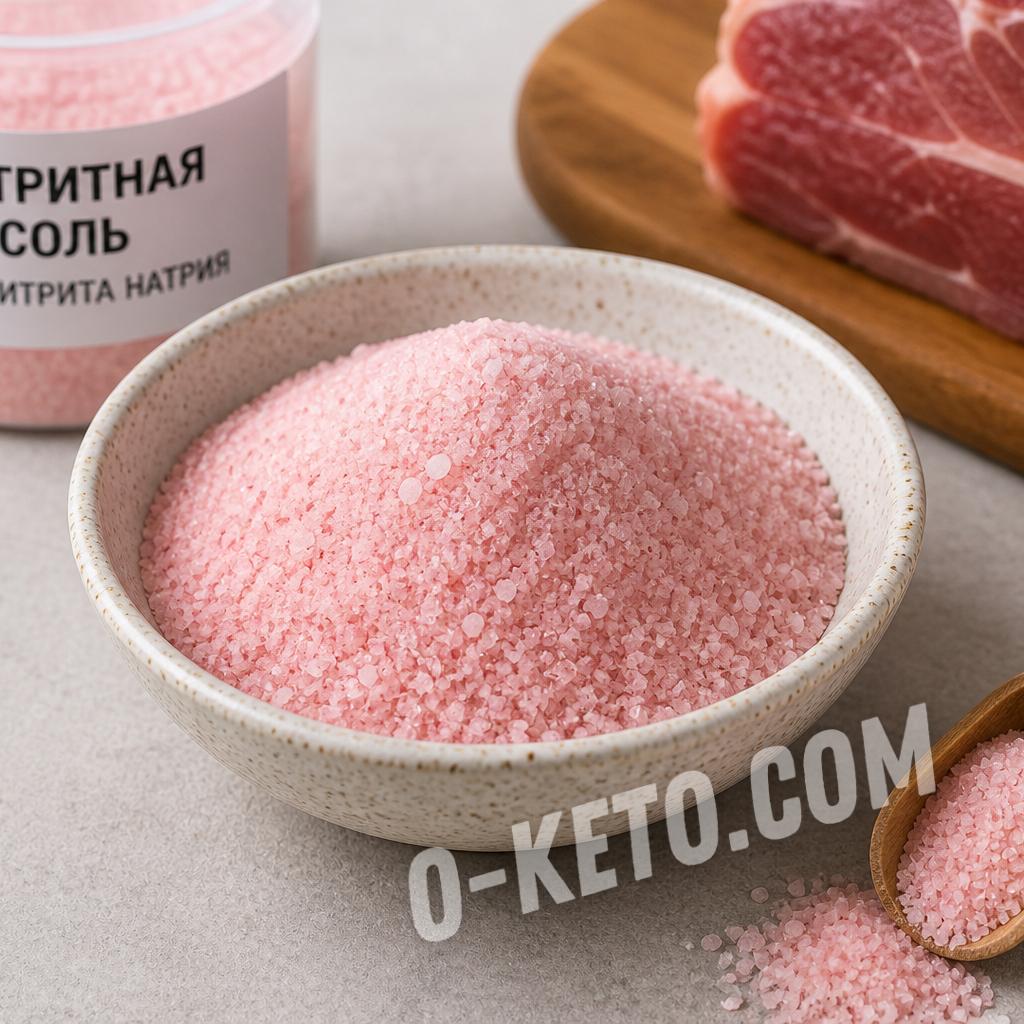

Nitrite salt is a technological mixture of table salt and a small amount of sodium nitrite. It is used for sausages, ham, bacon, brisket, dry-cured, and smoked meat. It is not a seasoning for ordinary salting at the table, but a special ingredient for meat preparations where color, flavor, shelf life, and control of dangerous bacteria matter.
In home cooking, nitrite salt requires especially careful handling. It cannot be added “to taste” like regular salt. The dose is calculated by meat weight and by the nitrite concentration in the specific mix. Composition may differ by country and producer, so there is no universal spoon measure.
Composition and role
Most often, nitrite salt consists of ordinary salt and sodium nitrite in a strictly defined share. Mixes with different concentrations may be sold, so the package must be read. Nitrite helps form the stable pink color of cured meats, the characteristic ham and sausage flavor, and reduces the risk of growth of some dangerous microorganisms when the method is correct.
Nitrite salt by itself does not make a product good. Proper temperature, clean equipment, exact salting, curing time, drying, cooling, and storage are needed. If the method is broken, salt alone will not save the preparation. This ingredient should therefore be used together with a recipe, scales, and a clear process.
Nutrition
Like ordinary salt, nitrite salt provides almost no calories, protein, fat, or carbohydrates. For keto and LCHF, its significance is not in macronutrients but in the meat products where it appears: sausages, bacon, ham, frankfurters, and homemade cured meats. Carbohydrates in such products usually come not from nitrite salt, but from sugar, starch, flour, milk powder, syrups, and fillers.
If choosing a ready meat product for keto, read the whole ingredient list. The presence of nitrite salt does not mean the product is low-carb, nor does it automatically make it unsuitable. The meat base, additives, carbohydrates per 100 g, salt amount, and frequency of processed meat consumption matter.
How to use
Nitrite salt is used only in recipes that state exact meat weight, mix concentration, and curing conditions. Accurate kitchen scales are required because an error of a few grams may be significant. Dry curing, brine, ham, sausages, and bacon may use different amounts.
It is not used for salads, soups, eggs, vegetables, or ordinary salting of a plate. It also should not replace all salt in a recipe unless the recipe author states that clearly. Often part of the salt is nitrite salt and part is ordinary salt, so the nitrite dose and saltiness are both correct.
Heating and ready products
Strong heating of meat products with nitrite may form unwanted compounds, especially when the product is fried to a dark crust. Bacon, brisket, and sausage products are therefore better not charred. Gentler heat treatment, temperature control, and avoiding burning reduce unnecessary risks.
In ready products, look not only at nitrite but at the whole profile: salt, sugar, starch, smoking, fat, and flavor enhancers. Even when carbohydrates are low, processed meat is better kept as an addition to the diet rather than the main food every day.
How to choose
The package should state composition, sodium nitrite percentage, dosage instructions, shelf life, and intended use. The mix is often tinted slightly pink so it is not confused with ordinary salt. If concentration is not shown or the package looks improvised, do not use it.
Buy only food-grade nitrite salt. Technical reagents, unknown mixes, and products poured into unlabeled bags are not suitable for the kitchen. For homemade sausage, a small package from a producer that gives clear amounts per kilogram of raw material is more convenient.
Limits
Nitrite salt requires accuracy and is not suitable for free use. Keep it separate from ordinary salt, labeled, and away from children. People advised to limit salt or processed meat should consider not only nitrite but also total sodium in the diet.
Pregnant people, children, and people with special medical restrictions are better not making processed meat a frequent food. In a keto menu, simple meat, fish, eggs, and poultry without curing additives can be chosen, while bacon, ham, and sausages remain for selected dishes.
Storage and substitutes
Store nitrite salt in a dry dark place, in a tightly closed container, separately from ordinary salt and spices. The jar should be clearly labeled. Moisture damages flow and makes dosing harder, so a wet spoon is not acceptable.
In sausage and ham recipes, ordinary salt cannot replace nitrite salt without changing the method: color, flavor, and storage conditions will change. If nitrite is not used, choose recipes for fresh meat that is cooked and eaten quickly: steaks, patties, stews, roasted poultry, or homemade roast pork for short storage.
Curing salt is not ordinary seasoning
Curing salt is intended for meat products and contains a measured amount of sodium nitrite. It helps control unwanted microorganisms and creates the characteristic colour and flavour of cured meat, but it must not be substituted for table salt by guesswork. Exact recipes, labeling and the manufacturer’s instructions matter.


