


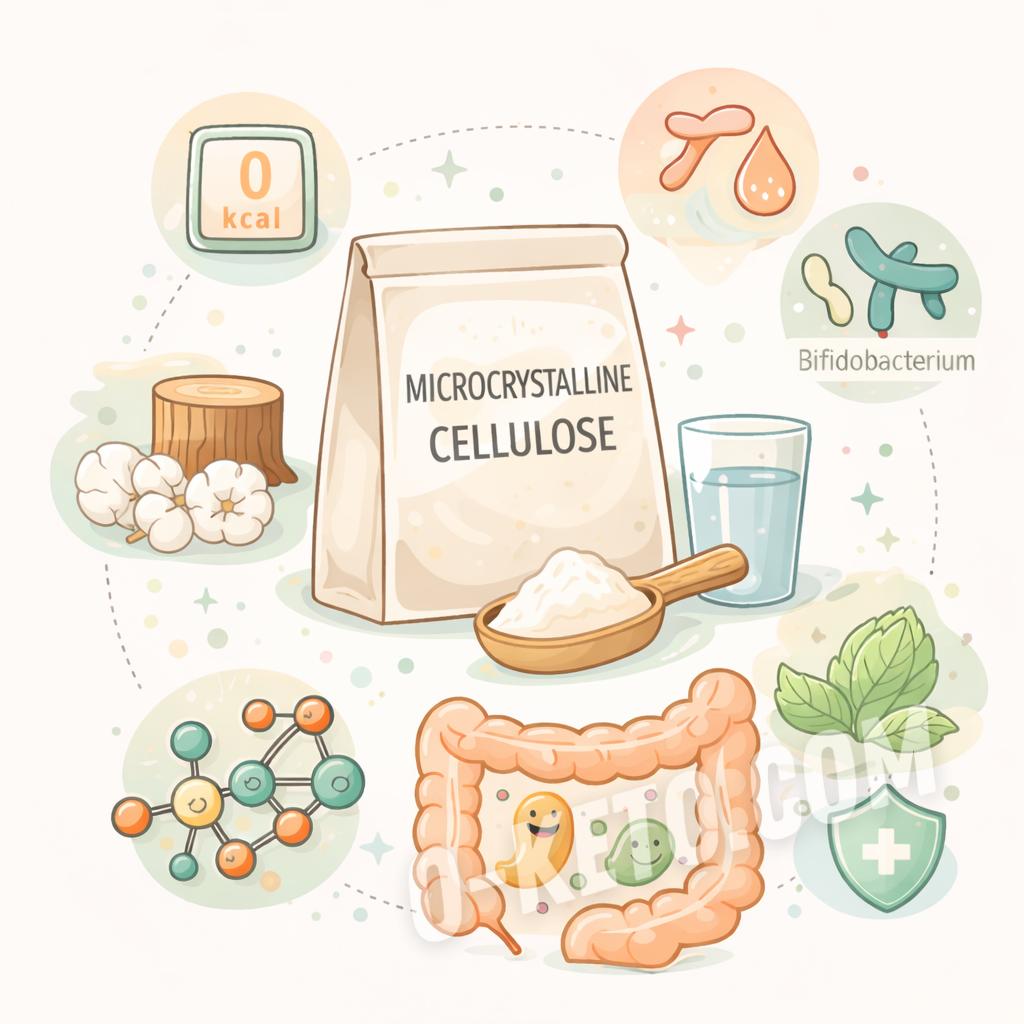

Microcrystalline cellulose is a purified form of plant cellulose, most often made from wood pulp or cotton pulp. In foods and supplements it appears as E460(i) or MCC. It is a white powder with little taste or smell, used as a filler, stabilizer, anti-caking ingredient, and carrier in tablets, capsules, powdered mixes, and some low-calorie products.
Unlike flour, starch, or sugar, this ingredient adds almost no flavor and does not act as a nourishing base. Its role is technical: it adds volume, binds some moisture, keeps powders more free-flowing, helps tablets hold shape, or slightly changes the texture of a mixture. It is therefore best seen as a fiber additive, not as a food on its own.
The name sounds laboratory-like, but cellulose itself is a normal structural material of plants. For the microcrystalline form, the raw material is purified and processed to produce small stable particles with predictable behavior in manufacturing.
Nutritional value
Microcrystalline cellulose belongs to insoluble dietary fibers. Human enzymes do not break it down like starch, protein, or fat. In usual amounts it adds almost no calories and is not a source of digestible carbohydrates.
On labels it may be included in total fiber or listed as a technical additive. It is important not to confuse pure MCC with ready-made mixes: the same product may also contain sugar, maltodextrin, flour, milk powder, flavorings, or other ingredients that do carry nutritional load.
Is it suitable for keto?
For keto and LCHF, microcrystalline cellulose is usually neutral in carbohydrate terms. It does not sweeten a mixture and does not replace starch nutritionally. It is used in low-carb powders, tablets, capsules, dry mixes, and sometimes in nut-flour baking when volume is needed without sugar.
Still, MCC alone does not make a product keto-friendly. If it is present in a cookie, bar, or drink together with syrup, starch, and sweet coating, the whole ingredient list matters. In home cooking it is used rarely; psyllium, xanthan, guar, gelatin, eggs, or nut flour are often more practical.
How to use it
In food products, microcrystalline cellulose helps control density, flow, and moisture. In powders it reduces clumping, in tablets it gives shape, and in sauces or fillings it may help stabilize the mass slightly. In low-calorie products it is sometimes used as a bulking ingredient.
For home use, do not expect it to behave like ordinary flour. It does not provide gluten, does not brown like grain flour, and does not create elastic dough. Too much can make the texture dry, chalky, or coarse. It is better to start with very small amounts and test on a small batch.
How to choose
For food and supplements, choose food-grade or pharmaceutical-grade material with clear labeling: E460(i), microcrystalline cellulose, or MCC, plus date and storage conditions. Technical powders made for other uses should not be used in food. The powder should be dry, uniform, and free of moldy smell, clumps, or moisture traces.
If the ingredient is part of a finished product, the full list matters more. MCC can be a normal neutral component, but it does not offset sugar, starch, cheap oils, or excessive sweeteners.
Limitations
Large amounts of insoluble fiber may cause heaviness, bloating, or discomfort, especially when fluid intake is low. The additive should be introduced gradually and should not be the only fiber source. Vegetables, greens, mushrooms, seeds, and nuts provide not only fibers but also taste, minerals, fats, or protein.
People with prescribed fiber limits, after intestinal surgery, or with strong sensitivity to bulking additives should discuss such ingredients with a specialist. Tablets and capsules containing MCC should be taken with water according to the instructions for the specific product.
How to store it
Keep the powder dry, tightly closed, away from steam, stove heat, and wet spoons. Moisture worsens flow and turns particles into clumps. Finished mixes with MCC should be stored according to the rules for that product, because shelf life is set by fats, proteins, flavorings, and moisture, not by the fiber itself.
What can replace it?
For bulk in dry mixes, oat fiber, bamboo fiber, or psyllium may work, but they behave differently. For thickening, xanthan, guar, or gelatin are better. For baking, almond flour, coconut flour, eggs, psyllium, and baking powder are more useful. The replacement depends on the task: flow, bulk, gel, moisture, or tablet structure each needs a different ingredient.


