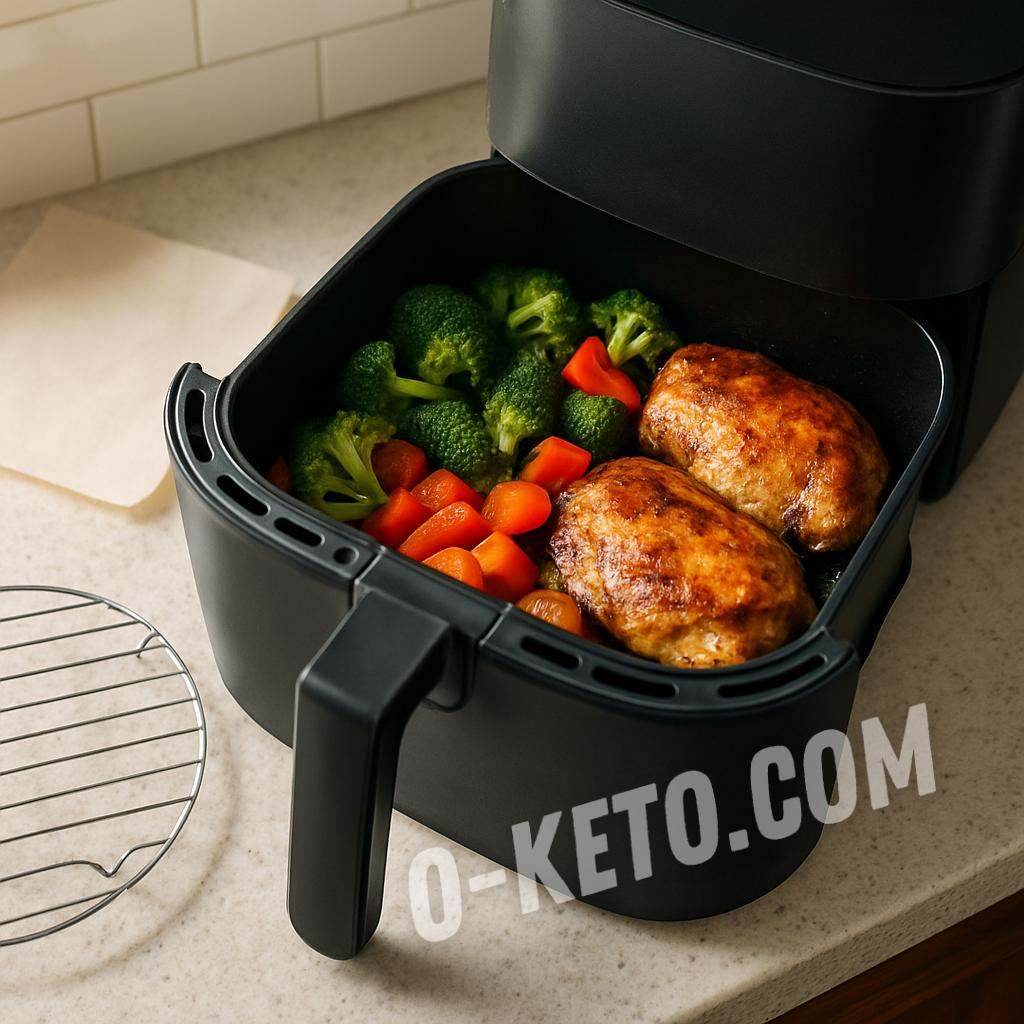

People like air fryers because they cook quickly and create a drier baked surface without much oil, but they work well only when hot air can move freely around the food. If the basket is overcrowded, fully covered with solid parchment, or filled with a thick compact layer, the surface browns fast while the inside cooks less evenly.
Why airflow matters so much
An air fryer depends on strong moving hot air, so food should be arranged in one layer with small gaps instead of being piled together. Better airflow usually means more even browning and less risk of having dry edges and an undercooked center.
Small items such as diced vegetables, shrimp, mushrooms, or chicken pieces benefit from shaking or stirring every 5 to 10 minutes, especially when you want a more even surface color.
When the rack helps most
A rack is useful for skewers, fish pieces, chicken strips, rolled meat, bacon, and other foods that should cook from below as well as from above. On a solid surface, the bottom tends to steam more and brown less.
Pans are better for gratins, juliennes, baked fillings, stuffed vegetables, and small casseroles that need to hold cream, cheese, or a loose mixture. In an air fryer, shallow pans usually work better than deep ones.
How to use parchment correctly
Parchment can prevent sticking and catch juices, but it should not block the airflow. Perforated parchment or a small sheet under the food works better than covering the whole basket. A fully solid sheet often traps more moisture under the food and reduces browning.
It is also safer to place food on the parchment before starting the fryer. A loose empty sheet can lift in the airflow and move toward the heating element.
Which pans work best
Silicone is convenient for soft portioned dishes and easy release, but it usually gives a softer crust. Metal heats faster and helps browning. Ceramic is useful for juliennes and casseroles that need steadier heat and neat serving straight from the dish.
How to choose time and temperature
When adapting an oven recipe, the air fryer often needs a slightly lower temperature rather than a higher one. Thin cuts of chicken, fish, squid, and vegetables can dry out quickly, so it is usually better to cook a little more gently and add a few minutes only if needed.
Check doneness earlier than you might in an oven. An air fryer can make the outside look ready before the center is fully cooked.
Why overloading the basket is a mistake
Trying to cook too much at once is one of the most common problems. An overloaded basket produces more steam and less dry circulation, which weakens browning and makes the result less predictable. Two smaller batches are often better than one crowded batch.
Do you need oil
An air fryer does not need much oil, but a very thin layer on the food or the rack can help prevent sticking, improve spice adhesion, and give more even color. This matters most for lean meat, fish, and vegetables.
One heating element versus two
Models with only top heat are more sensitive to thick layers and overcrowding. They often need more turning and a bit more attention. Models with top and bottom heating are more forgiving, especially for casseroles and stuffed dishes, but they still cook best when the basket is not overloaded.
How to choose a good air fryer for home use
For one or two people, the actual floor area of the basket is often more important than the total liters. A wider basket is usually more useful than a narrow tall one when you want to cook in a single layer. Removable parts, cleaning comfort, and enough power also matter because the best air fryer is one that stays practical to use regularly.
Conclusion
An air fryer works best when food is not packed too tightly, air can move above and below it, and the rack, parchment, or pan does not block circulation. Good spacing, moderate heat, and timely checking make it much easier to get browned surfaces and a juicy center without drying the dish out.