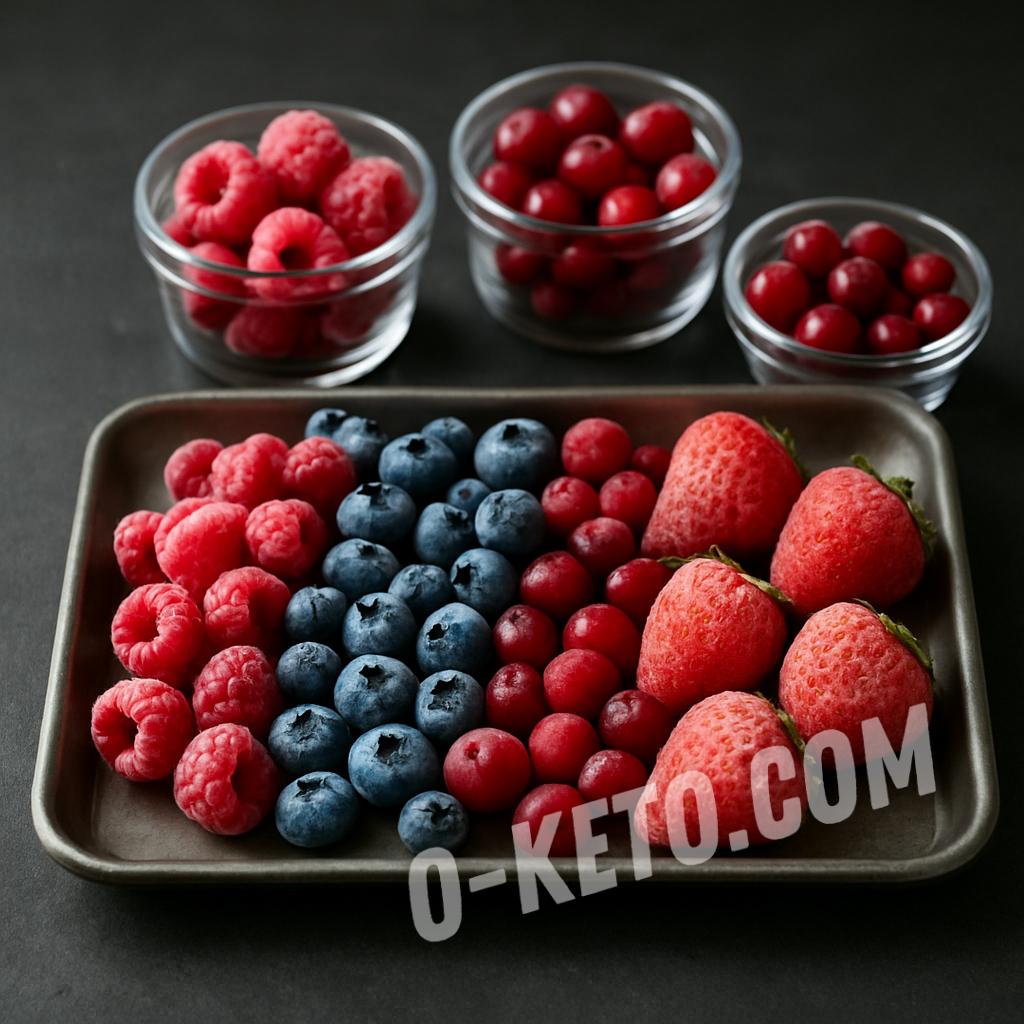

Freezing berries is convenient because it allows you to preserve seasonal flavor without excess sugar, syrups, and prolonged heat treatment. For keto and LCHF, this is especially beneficial: small portions of raspberries, strawberries, blueberries, or currants can be used in winter for sauces, yogurt, cottage cheese, ice cream, and desserts without turning the preparation into sweet jam. At the same time, freezing does not make the berries “more keto” by itself: it simply preserves the product almost in the same state as it was in summer, so the quality of preparation and storage directly affects the taste, texture, and food safety.
The main mistake when working with berries before freezing is to rush. If you poorly sort the raw materials, leave moisture on the surface, or immediately dump everything into one large bag, in winter, instead of a loose preparation, you get an icy lump, and some berries lose their aroma and spoil quickly after thawing. It is much better to spend a little time sorting, washing by type of berry, completely drying, and properly packaging. Then the berries last longer, are easier to portion, and behave better in recipes.
Which berries are best for freezing
Berries with a dense skin and relatively stable structure are especially convenient for freezing: blueberries, bilberries, currants, lingonberries, cranberries, cherries, sweet cherries, and honeysuckle. They tolerate washing, drying, and storage better, and after thawing, they do not quickly turn into puree. More delicate berries can also be frozen, but they require more care. Raspberries and blackberries crush easily, strawberries often lose their shape and release a lot of juice, so gentle handling and pre-freezing in a single layer are particularly important for them.
For keto, this is also a practical issue of portioning. Berries with a strong flavor, such as cranberries, lingonberries, raspberries, or black currants, are often used in small quantities, so it is beneficial to freeze them in portions of 50-150 g. This makes it easier to add them to meat sauces, cold desserts, yogurt, or baked goods without thawing excess.
How to prepare berries before freezing
Preparation begins with sorting. All bruised, rotten, moldy, or clearly overripe berries should be removed immediately. One spoiled berry does not “spoil the whole bag instantly,” but it increases moisture, releases excess juice, and worsens the overall result. Additionally, berries with a lot of leaves, stems, twigs, and other debris should not be sent for freezing: it will be inconvenient to sort them out when they are already frozen.
Strawberries and wild strawberries are convenient to wash in two stages. First, the berries are submerged in a basin of water, sorted one by one, the green parts are removed, and good fruits are transferred to a second container with clean water. After that, the berries are scooped out in portions and quickly rinsed under running water. This approach reduces the amount of dirt and sand and does not require holding the delicate berry under a strong stream for long.
Raspberries and blackberries should not be washed unnecessarily if the berries were picked in a clean place and have not been lying on the ground. It is sufficient to carefully sort them and remove the stems, damaged, and wormy fruits. If washing is still necessary, it should be as quick and gentle as possible. These berries do not tolerate prolonged contact with water and lose their shape more quickly afterward.
Blueberries, bilberries, currants, honeysuckle, cherries, sweet cherries, cranberries, lingonberries, and other dense berries can be conveniently rinsed in a large deep container filled with water, then scooped out in portions with a sieve and additionally rinsed under running water. After that, they should be spread out on a tray or table lined with paper or cloth towels in a single layer and allowed to dry completely.
Complete drying is a critical stage. If you send wet berries to the freezer, excess ice will form on the surface, the berries will freeze together, and after thawing, they will leak more quickly. For storage and convenience, this is more important than the speed of freezing. The surface must be dry, even if the inside of the berry remains juicy.
How to properly freeze berries

The best basic method is to pre-freeze the berries in a single layer. For this, dry berries are spread out on a tray, board, or flat container in a single layer so that they are not piled tightly together. It is convenient to line the tray with parchment paper or a silicone mat. In this form, the berries are placed in the freezer for a few hours until they are individually frozen. After that, they can be transferred to bags or containers for long-term storage.
This stage may seem unnecessary, but it prevents the formation of an icy monolith. When the berries freeze individually first, they are easier to scoop with a spoon, quickly weigh, and use in portions. This is convenient for desserts, sauces, and regular portion control. If you immediately place soft or wet berries in a deep bag, they will almost certainly freeze together.
Strawberries are often more convenient to cut in half or into large pieces before freezing if they will later be used in smoothies, ice cream, sauces, or baked goods. Many prefer to freeze cherries and sweet cherries without pits, especially if the preparation is needed for sauces and desserts. Blueberries, bilberries, cranberries, and currants are usually frozen whole. Raspberries should be spread out particularly carefully, not piled in a thick layer.
If it is clear in advance that the berries will not be used whole but as a base for sauce, mousse, cold dessert, or filling, part of the harvest can be frozen as puree. For this, the berries are sorted, washed if necessary, dried, crushed, and placed in small containers or silicone molds. This is a good option for strawberries, raspberries, currants, and mixed berry sets.
How to package berries and how long to store them
For long-term storage, thick zippered bags, vacuum bags, or containers with tightly closing lids are suitable. It is important not only to protect the berries from air but also not to overload the packaging. It is better to make several small portions than one huge bag that will have to be constantly opened, broken apart, and put back in the freezer.
It is useful to indicate the date and type of berry on each package. Without this, even a neat freezer can turn into a collection of identical bags after a few months. Labels help use older preparations first and not keep them longer than reasonable.
It is optimal to store frozen berries at a stable temperature of around -18 °C. In a household freezer, most berries retain good taste and workable texture for about 8-12 months. Soft berries like raspberries and strawberries are better used earlier, within 6-8 months, if a fresher aroma is important. Cranberries, lingonberries, currants, blueberries, and bilberries usually withstand storage better. If the temperature in the freezer fluctuates frequently due to frequent door openings or overload, the quality will deteriorate faster even within the formal timeframe.
Signs of poor storage look like this:
- thick snow crust inside the bag;
- gray dry areas and pronounced freezer burn;
- foreign odors from neighboring products;
- re-freezing after partial thawing;
- watery taste and almost complete loss of aroma.
Such berries are not always dangerous, but the culinary result will be noticeably worse. They can still be used for sauce or compote, but for beautiful presentation, desserts, and neat portions, it is unlikely.
How to thaw and use berries in winter
The method of thawing depends on the task. If the berries are going into smoothies, ice cream, mousse, hot sauce, or baked goods, they can often be used straight from the freezer. This is convenient and allows for better control of texture. For berry sauce with meat and poultry, keto ice cream, or dessert topping, frozen berries can be sent directly to a saucepan or blender bowl.
If a more delicate texture is needed, for example, for yogurt, cottage cheese, cold dessert, or decoration, it is better to thaw the berries slowly in the refrigerator. This usually results in less juice loss. Quick thawing at room temperature produces more liquid, and re-freezing fully thawed berries is undesirable: safety, structure, and taste all suffer.
Frozen berries are convenient to use in small portions. For keto and LCHF, this helps keep carbohydrate intake under control. Even relatively “friendly” berries should not be perceived as an unlimited product. A small addition to thick yogurt, cottage cheese mousse, chia dessert, or sauce usually works better than a large sweet bowl of berries at once.
Common mistakes when freezing berries
Almost all failures can be attributed to a few recurring mistakes:
- berries are not sorted and are sent for freezing along with soft or rotten fruits;
- berries are poorly dried after washing;
- berries are immediately dumped into a deep bag without pre-freezing in a single layer;
- too large packages are made, which are inconvenient to use in parts;
- preparations are not labeled, and it is forgotten what and when was frozen;
- thawed berries are re-frozen.
If you eliminate just these mistakes, home freezing will already become noticeably better. Berries remain convenient for recipes, retain their flavor longer, and do not turn into a chaotic icy stock in winter that is a shame to throw away and inconvenient to use.
How to freeze blueberries, cherries, and raspberries
Sort blueberries, rinse them quickly, and dry them completely: excess water forms an icy coating and makes the berries stick together. First freeze them in a single layer, then transfer them to a bag or container.
Remove stems and pits from cherries before freezing so you do not have to thaw a large package later. Freeze them in portions that can go straight into a sauce, porridge, or baked dish. Handle raspberries gently. If they are clean, they do not always need washing; if washing is necessary, dry them thoroughly and freeze them in a thin layer. Very soft or damaged raspberries are easier to freeze as puree in small portions.
Freeze peaches and apricots in slices only while they are firm; softer fruit is better frozen as puree. Their texture will soften after thawing, so these portions are especially useful in dishes where the fruit is mixed with other ingredients. Label each package with the food and date, do not add sugar, and avoid overloading the freezer with fresh packages at once.
Conclusion
Proper freezing of berries is based on four things: sorting, gently washing by type of berry, completely drying, and freezing in convenient portions. The most universal approach is first freezing in a single layer, then transferring to containers or bags with a date. At a temperature of around -18 °C, most berries can be stored for several months, and the densest can last up to a year. For keto, this is one of the most convenient ways to preserve seasonal berries without sugar and use them in small controlled portions in winter.