
Fish remains a valuable food: it provides complete protein, and many species supply EPA and DHA, vitamin B12, iodine, selenium, and vitamin D. At the same time, fish can contain methylmercury, a form of mercury that builds up in aquatic food chains. The practical question is therefore not whether to give up fish altogether, but which species can be rotated more often and which require more caution.
The simplest guide is this: smaller fish lower in the food chain usually contain less mercury, while large, long-lived predators tend to contain more. There is no universal list that applies to every country and every batch. Levels vary with species, size, age, fishing area, and local advisories.
What mercury in fish means
In the environment, microorganisms can transform mercury into methylmercury. Aquatic organisms absorb it, small fish are eaten by larger fish, and the concentration can rise as the substance moves up the food chain. As a result, large predatory fish are more likely to accumulate more methylmercury than small species.
Methylmercury matters most when assessing the diets of pregnant or breastfeeding women and children, because the developing nervous system is more sensitive to its effects. The World Health Organization identifies fish and shellfish containing methylmercury as the main dietary source of human exposure.
For most adults, an ordinary serving of fish does not automatically mean dangerous poisoning. Risk depends on the combination of species, portion size, frequency, and duration of exposure. A sensible strategy is to rotate species that accumulate less mercury rather than search for a supposedly “perfectly clean” fish or make one large predator the foundation of the menu.
Why larger fish often contain more mercury
Fish size matters mainly because it reflects age and position in the food chain. A large predator usually lives longer, eats more prey, and has more time to accumulate methylmercury in its muscle tissue. This is why the broad label “sea fish” is not enough: salmon, herring, and shark belong to the same broad food category but differ greatly in ecology and contaminant accumulation.

Levels can also vary within one species. A fish from a contaminated waterbody, a large older specimen, or fish covered by a local advisory requires more caution than a smaller fish with the same common name from another source. For store-bought fish, check the species, country or fishing area, and package information; for self-caught fish, check official advice for the specific waterbody.
This is why one table should not be applied to every country without qualification. FDA and EPA recommendations are a useful evidence-based reference for species, but local authorities may use their own data on waterbodies, fisheries, and commercial names.
Which fish to choose more often
The table below is a practical guide based on the FDA/EPA classification. It is not a laboratory test of every package and does not guarantee the same level for every region. Local advisories take priority:
| Group | Examples | How to use the guide |
|---|---|---|
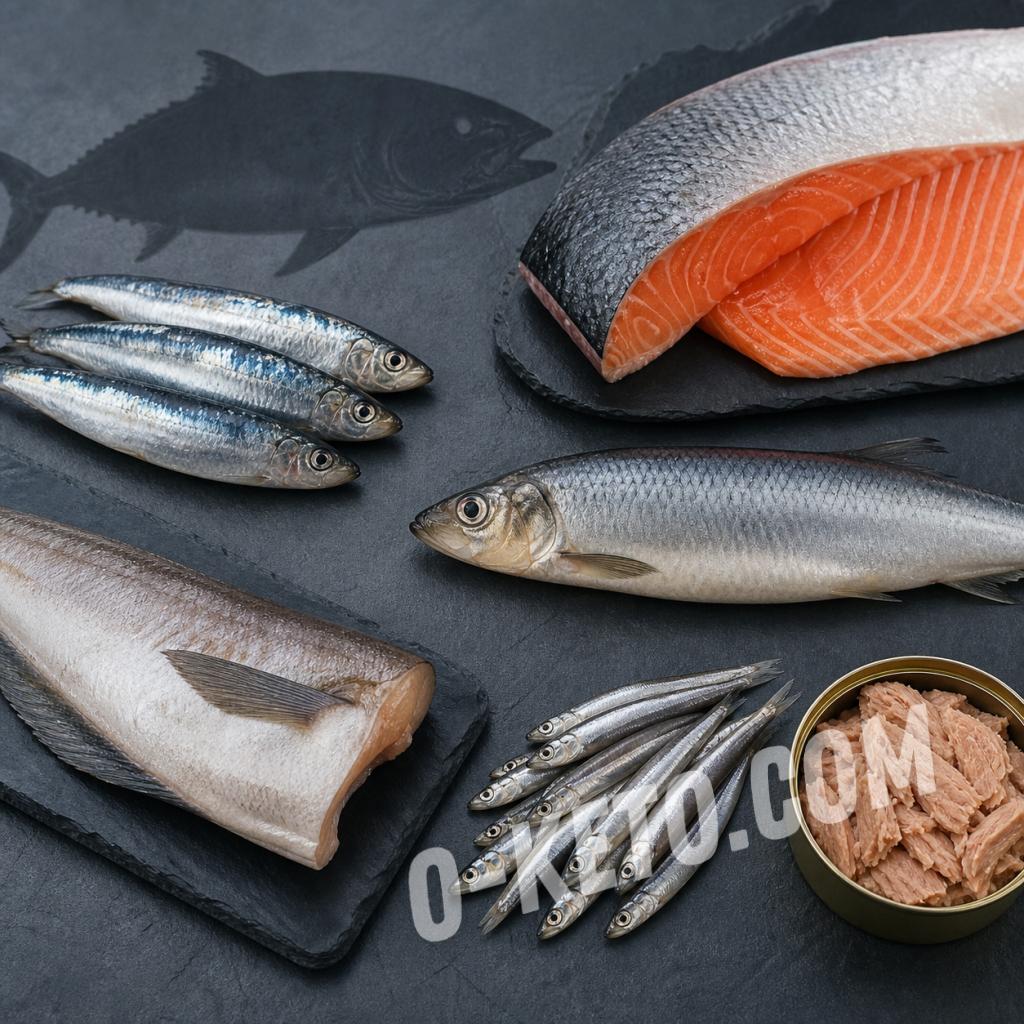
| Usually lower mercury | anchovies, herring, sardines, salmon, pollock, hake, cod, flounder, Atlantic and Pacific chub mackerel, canned light tuna or skipjack | good options to rotate regularly; still check the species and origin on the package |
| Intermediate guide category | albacore or white tuna, yellowfin tuna, Spanish mackerel, halibut, grouper, carp, Chilean sea bass | not automatically forbidden, but do not make these the only fish in the diet and consider portion size |
| Highest category in FDA/EPA advice | king mackerel, shark, swordfish, marlin, bigeye tuna, orange roughy, tilefish from the Gulf of Mexico | eat rarely or avoid, especially during pregnancy, breastfeeding, and childhood; check local advice |
The names need to be specific. “Mackerel” without a species can refer to fish with different mercury levels: Atlantic mackerel is a preferred option, Spanish mackerel is intermediate, and king mackerel is among the highest-risk choices. “Perch” also cannot automatically be treated as a high-mercury fish: levels depend on the particular species and waterbody.
Tuna: check the species, not only the word on the can
Tuna raises questions because several species and sizes are sold under one everyday name. In FDA advice, canned light tuna, including skipjack, is in the lower-mercury category. Albacore, or white tuna, and yellowfin tuna are in the intermediate category. Bigeye tuna is in the highest category.
The practical conclusion is not to ban all tuna, but to read the species on the label and rotate it with sardines, herring, salmon, or mackerel when available. Large tuna should not be the only fish eaten several times a week. During pregnancy, for children, and with frequent fish consumption, use official advice for the country where you live rather than relying only on a marketing statement such as “rich in omega-3.”
Pregnancy, children, and self-caught fish
Fish during pregnancy and childhood can provide protein, DHA, iodine, choline, iron, and other nutrients. The goal is therefore not complete avoidance, but choosing the species and amount carefully. FDA guidance gives pregnant and breastfeeding people a guide of 2–3 servings per week from the “Best Choices” category or one serving from the “Good Choices” category; one adult serving in that system is about 4 ounces, or approximately 113 g.
Children need age-appropriate portions. The same guidance gives examples ranging from 1 ounce for children aged 1–3 to 4 ounces at age 11, with two servings per week from the lower-mercury category. These numbers belong to the U.S. guidance system and do not replace national rules or advice from a clinician.
If you catch fish yourself, first look for an advisory for the specific waterbody. If no advisory is available, FDA/EPA recommend limiting the catch to one serving and eating no other fish that week. This matters especially for large freshwater fish, which may accumulate contaminants regardless of the everyday name used for the species.
Does cooking remove mercury?
No. Methylmercury is distributed through the fish’s muscle tissue, so rinsing, removing the skin, frying, boiling, or baking does not remove it from the edible portion. Cooking is important for killing parasites and reducing foodborne illness, but it does not replace choosing a species with lower mercury.
For some other contaminants, removing skin and fat can matter, especially with self-caught fish. That advice should not be transferred to mercury. When methylmercury is the concern, the effective measure is eating less of the contaminated fish and choosing species that accumulate less.
A simple rule for choosing fish
Start with rotation rather than blanket bans. Build regular meals around herring, sardines, anchovies, salmon, pollock, hake, cod, and other smaller or faster-growing species that are lower in mercury according to available advice. Keep larger species for occasional meals, and check official regional limits for pregnancy, children, and self-caught fish.
If a package says only “tuna,” look for the species, product type, and origin. If the fish is a large predator, do not try to make it safer through longer cooking; choose another species. This approach preserves the nutritional value of fish while reducing unnecessary methylmercury exposure.
Conclusion
Fish should not be divided into absolutely safe and absolutely dangerous categories. A better guide is the food chain: small species usually accumulate less methylmercury, while large, long-lived predators accumulate more. Rotate herring, sardines, anchovies, salmon, pollock, hake, and cod; choose tuna by species; and eat shark, swordfish, marlin, king mackerel, and bigeye tuna rarely or avoid them according to local advice. Cooking reduces infection risk but does not remove mercury from muscle tissue.
Sources
- Advice about Eating Fish — U.S. Food and Drug Administration and U.S. Environmental Protection Agency;
- Mercury and health — World Health Organization;
- Questions & Answers from the FDA/EPA Advice about Eating Fish — U.S. Food and Drug Administration;
- Mercury in Food — U.S. Food and Drug Administration.