

The word “geroprotectors” is usually used for compounds studied for their possible influence on the biology of aging and on the years of life in which a person remains healthy and independent. Food lists built around this idea often include olive oil, green tea, berries, nuts, fish, mushrooms, and spices.
Yet a food that contains an interesting compound is not automatically a proven anti-aging treatment. In cells and animals, a molecule may affect inflammation, oxidative stress, mitochondria, or metabolism. In humans, the result depends on dose, absorption, starting health, and follow-up time. The useful question is therefore not “which food makes me younger?” but “which food properties may support healthy aging, and how strong is the evidence?”
What geroprotectors are
A geroprotector is a compound or intervention that may influence mechanisms of aging and related functional decline. It is a research term, not an official food category and not a diagnosis. Geroscience studies cellular senescence, inflammation, stress resistance, mitochondrial function, autophagy, metabolism, and other processes.
Different findings provide different levels of confidence. A laboratory experiment shows that a molecule can interact with a mechanism. An animal study asks whether that mechanism changes in a living organism and whether function or lifespan changes. An observational human study can show an association but cannot prove that a food caused the outcome. A randomized trial of a food or supplement provides a stronger test, but it still usually answers a narrow question, such as whether muscle endurance changes over several months.
This leads to an important practical limit: “geroprotector” does not mean “proven to extend life.” It describes a research direction. Ordinary food can be part of a diet that supports health, but it does not replace sleep, physical activity, treatment of disease, or preventive care.
Compounds studied in food
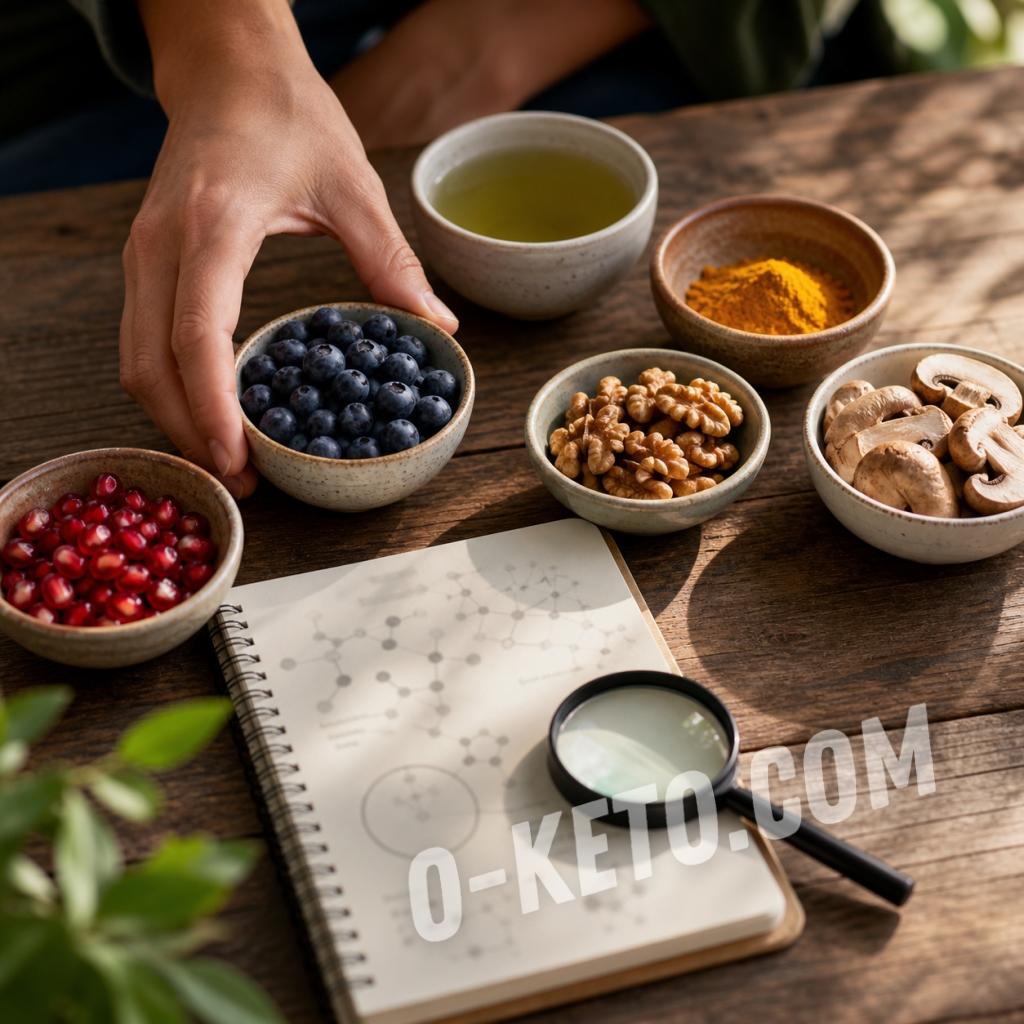
The table below is not a ranking of longevity foods. It gives examples of compounds found in foods or formed from them. The final column shows what can reasonably be concluded without turning a mechanistic or preclinical result into a proven human benefit.
| Compound or group | Food sources | What is studied | How to interpret it |
| Hydroxytyrosol | Olive oil, especially extra virgin olive oil | Antioxidant and inflammatory pathways, cellular protection from oxidative stress | The molecule’s properties do not prove that olive oil itself extends life; the whole diet and portion matter |
| Catechins | Green tea, cocoa, some fruits | Signaling pathways and vascular or metabolic markers | Tea and cocoa are not the same as a concentrated extract; doses and tolerance differ |
| Quercetin | Onions, apples, berries, buckwheat, broccoli | Inflammation, cellular stress, and senescent cells in experimental models | Studies of supplement-based senolytic effects cannot be transferred to an ordinary onion or apple |
| Curcuminoids | Turmeric and curry dishes | Inflammatory signaling, oxidative stress, and metabolism | The amount and absorption in a spice are limited; an enhanced-bioavailability extract is a different product |
| Anthocyanins and proanthocyanidins | Berries, grapes, fruit skins, cocoa, cinnamon | Vascular responses, cellular protection, and microbial polyphenol metabolism | This supports plant-food variety, not a promise to prevent a particular disease |
| Naringenin | Citrus, especially grapefruit, and tomatoes | Lipid and glucose metabolism and cellular signaling | Grapefruit can interact with medicines; check compatibility with a clinician or pharmacist |
| Caffeic and rosmarinic acids | Herbs, coffee, olive oil, and fruit | Antioxidant and inflammatory mechanisms | The amount in a normal serving and a clinical outcome cannot be inferred from a laboratory assay |
| Creatine | Meat, poultry, and fish | Muscle energy metabolism and performance during exercise | Maintaining strength and function matters for healthy aging, but creatine is not a universal anti-aging treatment |
| Nicotinamide | Meat, fish, poultry, legumes, and other sources of vitamin B3 | Production of NAD and NADP coenzymes needed for cellular metabolism | Adequate vitamin intake supports normal physiology; more is not automatically rejuvenation |
| L-theanine | Green tea | Relaxation, attention, and nervous-system signaling | A possible effect on how someone feels is not proof of longer life |
| Urolithin A | Made by gut microbes from ellagitannins in pomegranate, berries, and nuts | Mitophagy and muscle endurance | Clinical work studied a standardized supplement, not “rejuvenation” from an ordinary serving of pomegranate |
| Fucoxanthin | Some seaweeds | Pigment and metabolic mechanisms in experimental models | Seaweed composition varies, while excess iodine and contaminants create separate concerns |
| Glucosamine | Chitin from seafood shells; food provides limited amounts | Joint symptoms and cellular inflammatory pathways | A food source is not the same as a supplement dose; people with seafood allergy need caution |
| Silymarin | Milk thistle seeds | Liver and inflammatory mechanisms | Active fractions differ between tea, powder, and standardized extract |
| Pinitol and other compounds in legumes | Legumes and soy | Glucose and lipid metabolism in cellular and animal models | Legumes are best understood as foods with protein and fiber, not as a medicine for metabolic aging |
The table illustrates a general rule: food has a composition, while evidence has a specific object, dose, and outcome. An effect from a purified molecule in an experiment cannot simply be renamed a property of the whole food and turned into a promise of protection from aging.
Why food is not the same as an extract
In whole food, a compound arrives with water, protein, fat, fiber, and other components. They affect digestion and absorption. The gut microbiota also transforms many polyphenols differently from person to person, so the same serving of berries does not necessarily produce the same metabolites in everyone.
A supplement is different: a capsule or powder can deliver a dose that would be difficult to obtain from food. That can be useful for a study, but it also makes contraindications, interactions, and product quality more important. Urolithin A is a useful example: a randomized trial in older adults studied 1000 mg of a standardized compound daily for four months. Some measures of muscle endurance improved, but not all main outcomes differed from placebo. That result cannot be translated into a promise that pomegranate or berries themselves rejuvenate muscle.
The same caution applies to quercetin, curcumin, silymarin, green-tea extracts, and other concentrates. Seeing a compound named on a label does not tell you its bioavailability, and an attractive cellular mechanism is not a clinical outcome.
Which foods make sense in a regular diet
If the goal is to support health with age, it is more useful to build meals around foods that provide protein, fiber, essential fatty acids, and micronutrients together. This is more reliable than chasing one “longevity molecule.”
- Use olive oil as one source of fat without treating it as a medicinal dose.
- Include fish, seafood, eggs, and other protein foods regularly according to tolerance and the overall diet.
- Use berries, vegetables, leafy greens, onions, cabbage, and spices to increase plant variety and fiber.
- Choose nuts and seeds in moderate portions, accounting for energy density and allergy.
- Treat green tea and unsweetened cocoa as foods and drinks rather than concentrated polyphenol products.
- Select legumes and other fiber sources according to tolerance and the purpose of the diet.
This is not an anti-aging protocol. Its purpose is simpler: varied food helps meet ordinary nutritional needs and reduces dependence on advertising. Muscle function is especially tied to adequate protein and resistance exercise; no polyphenol replaces those basics.
How to assess longevity claims
Be careful with phrases such as “activates longevity genes,” “clears old cells,” “reverses biological age,” and “prevents cancer.” They may summarize a laboratory mechanism, an animal result, or a change in a marker, but they do not by themselves prove a clinical benefit.
Check four things: was the whole food or an extract studied, what dose was used, what exactly was measured, and how long did follow-up last? A change in a biochemical marker is not the same as fewer fractures, greater strength, better memory, or longer life. An observational study can show an association between diet and an outcome, but it cannot establish causation on its own.
With chronic disease, pregnancy, allergies, or regular medication use, discuss concentrated botanicals and polyphenol products with a clinician. This matters especially for grapefruit, concentrated green tea, curcumin, and multi-ingredient products whose total dose may be unclear.
Conclusion
Some foods contain compounds studied in geroscience: polyphenols, pigments, amino acids, creatine, and metabolites made by the gut microbiota. But olive oil, berries, green tea, and turmeric have not been proven to provide standalone protection from aging. A realistic approach is a varied diet, enough protein, fiber, physical activity, and careful evaluation of every concentrate by dose, quality, and evidence.
Sources
- Trans-NIH Geroscience Interest Group — National Institute on Aging
- New phytochemicals as potential human anti-aging compounds: Reality, promise, and challenges — Critical Reviews in Food Science and Nutrition
- Unveiling the Longevity Potential of Natural Phytochemicals: A Comprehensive Review of Active Ingredients in Dietary Plants and Herbs — Nutrients
- Effect of Urolithin A Supplementation on Muscle Endurance and Mitochondrial Health in Older Adults: A Randomized Clinical Trial — JAMA Network Open
- Senolytics: targeting senescent cells for age-associated diseases — Nature Medicine