


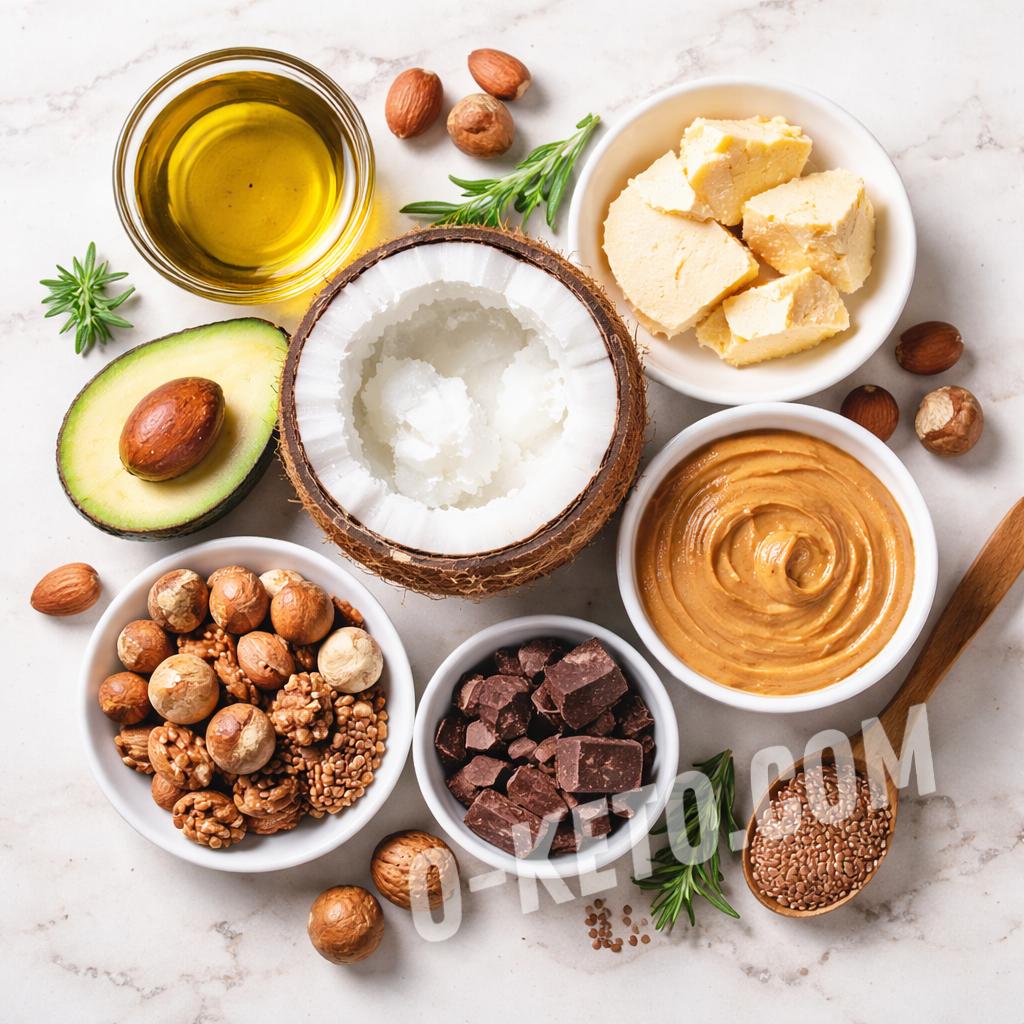

Plant fats in cooking are often perceived merely as a source of energy; however, their role is much broader. They shape texture, influence dish stability, provide plasticity, and directly determine organoleptic properties—from creaminess to crunchiness. This is especially important in recipes with reduced carbohydrate content or without sugar, where fats partially compensate for the lost functions of other components.
Functions of Plant Fats in Cooking
Fats perform a number of key technological tasks without which it is impossible to achieve the desired structure of a dish:
- they create softness and plasticity of texture;
- they reduce dryness and brittleness of products;
- they participate in moisture retention;
- they ensure structural stability;
- they influence mouthfeel and flavor richness.
In desserts and baked goods, fats are particularly important. For example:
- adding vegetable oil to sponge cake makes it more elastic and prevents cracking when rolling;
- in muffins, replacing butter with vegetable oil increases moisture without a watery effect.
Key Properties of Plant Fats
For proper use, it is important to understand the basic characteristics of fats:
- melting point—determines whether the product will be solid or soft;
- degree of saturation—influences density and stability;
- crystallization behavior—responsible for texture, especially in glazes and chocolate;
- viscosity—influences fat distribution in the mass;
- oxidation stability—determines shelf life and stability.
These parameters allow predicting the behavior of fat in a recipe: whether the cream will hold its shape, how dense the structure will be, or how the product will feel when bitten into.
Main Types of Plant Fats and Their Applications
Coconut Oil. Has high saturation and relatively low melting point. It hardens quickly when cooled and melts easily in the mouth. Used in:
- candies and bars for stabilization;
- creams to improve texture;
- ice cream to reduce crystallization;
- glazes to form structure.
Cocoa Butter. A key component of chocolate. Forms a dense, stable structure and provides characteristic crunch:
- used in chocolate and glazes;
- ensures stability at room temperature;
- creates “snap” and a clean cut.
Nut Oils. Primarily responsible for flavor and aroma, rather than structure:
- soften the texture of fillings;
- enhance flavor profile;
- do not provide pronounced stability due to low melting point.
Liquid Plant Oils. Include olive oil and grape seed oil. They are used where softness is required:
- in glazes to reduce hardness;
- in baking to increase moisture;
- in creams to improve plasticity.
| Oil | Melting Point | Freezing Point (start of crystallization) | Degree of Saturation | Crystallization Behavior |
| Coconut Oil | ~24–26 °C | ~20–24 °C | High (~80–90% saturated fatty acids) | Crystallizes quickly, forms relatively large crystals, gives a dense but brittle structure |
| Cocoa Butter | ~32–35 °C | ~30–32 °C | High (~60% saturated fatty acids) | Polymorphic crystallization (multiple forms), requires tempering, forms a stable solid structure with a “snap” |
| Grape Seed Oil | Below 0 °C (remains liquid at room temperature) | ~ -10 to -15 °C | Low (~10% saturated fatty acids) | Practically does not form structural crystals at 20 °C, remains liquid, does not create a solid matrix |
| Olive Oil | ~ -6 to -2 °C (may cloud) | ~ -6 °C | Low-medium (~14% saturated fatty acids) | Weakly expressed crystallization, forms soft crystals when cooled, does not form a dense structure |
| Nut Oils (almond, hazelnut) | Below 0 °C | ~ -5 to -10 °C | Low (~8–12% saturated fatty acids) | Do not structure the mass, remain liquid at room temperature, act as a softening fat phase |
Technological Techniques for Use
- adding 5–10% liquid oil to chocolate makes the glaze softer;
- using solid fats increases the stability of products;
- combining different fats allows precise control over texture;
- high-protein products require additional fat to eliminate dryness;
- in creams, fat reduces the crystallization of sweeteners and improves consistency.
Common Mistakes When Using Plant Fats:
- reducing the amount of fat without compensating with other components;
- ignoring the melting point;
- using only one type of fat without considering the recipe’s tasks;
- misunderstanding the role of fat in the product’s structure;
- focusing only on calorie content instead of functionality.
When there is insufficient fat, products become dry, brittle, or, conversely, overly dense and “rubbery”.
Practical Approach to Choosing Fat. The choice of plant fat should be based on the desired outcome:
- for a crispy structure—solid fats with a high melting point;
- for softness—liquid oils;
- for stability—a combination of solid and liquid fats;
- for flavor—adding nut oils;
- for plasticity—using coconut oil.
Plant fats are not just an ingredient but a tool for managing texture. Understanding their properties allows for the creation of stable, predictable, and technologically sound dishes, especially in low-carbohydrate and functional cooking.
Scenarios for Using Plant Fats
To achieve a solid, crispy stable glaze. To form a dense, thermally stable glaze, cocoa butter is used. It has pronounced crystallization behavior, which results in a dense structure with characteristic crunch and stability at room temperature.
To make a soft “biteable” glaze. For a more plastic glaze texture, a small amount of liquid plant oils, such as grape seed oil, is used in combination with chocolate. This reduces the brittleness of the coating and makes it softer when bitten into.
To structure the filling. If it is necessary for the filling to stabilize and hold its shape after cooling, coconut oil is used. It hardens quickly in the refrigerator, increases the density of the mass, and ensures the stability of the product.
To make the cream smoother. When preparing creams, adding coconut oil or increasing the proportion of cocoa butter forms a more homogeneous fat matrix. This improves texture and reduces the likelihood of sweetener crystallization.
To soften high-protein or dry mass. In recipes with high protein or dietary fiber content, adding coconut oil makes the texture less dry, reduces crumbliness, and improves the overall mouthfeel of the product.
To increase the plasticity of sponge cake. Liquid plant oils, especially those neutral in flavor, make sponge cake more flexible and moist. This prevents cracking when rolling and improves the crumb structure.
To add aroma and depth of flavor. Nut oils are used to enhance the flavor profile. They add richness, make the texture more paste-like, and improve the organoleptic perception of fillings and creams.
To reduce the density of chocolate mass. Adding a small amount of fractionated coconut oil increases the flowability of the chocolate mass. This makes the texture softer and easier to work with.
To achieve a “melting” texture in the mouth. Coconut oil, due to its low melting point, ensures the product melts quickly. This creates a pronounced sensation of creaminess and lightness when consumed.


