


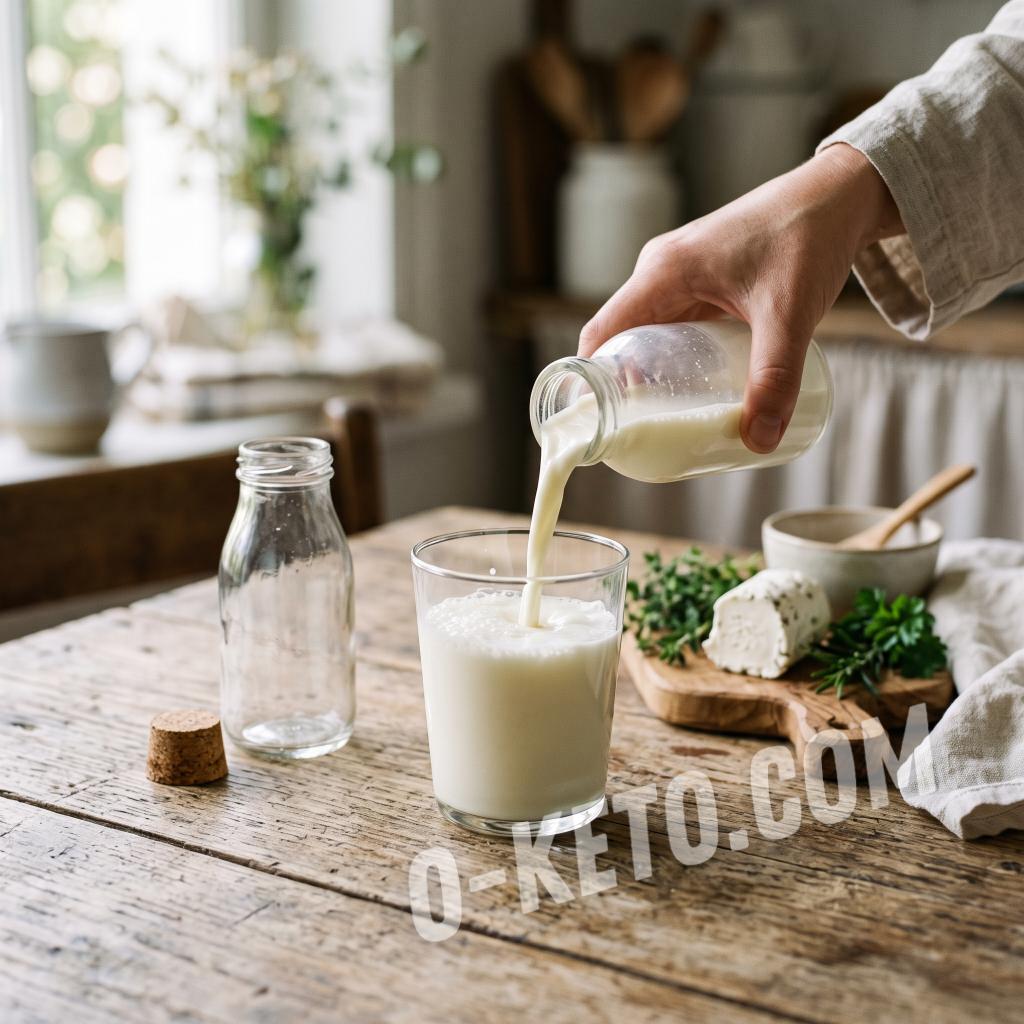

Goat milk is a real dairy food with a stronger flavor, a slightly different texture, and a somewhat different fat profile compared with standard cow milk. People often choose it for taste, family cooking traditions, or because it feels subjectively easier to tolerate. In a keto context, however, the key issue is not which animal produced the milk, but how much lactose remains in the serving and how easily that serving pushes total daily carbohydrates upward.
Why goat milk is not automatically keto-friendly
Goat milk is sometimes treated as if it were a special lighter option that barely needs to be counted. For strict low-carb eating, that is the wrong starting point. It still contains milk sugar, which means real carbohydrates. Because of that, a glass of goat milk is not nutritionally equivalent to heavy cream, butter, or full-fat sour cream, where the carb load per practical serving is often lower. If the goal is tight ketosis control, goat milk remains a product that needs deliberate portion awareness.
The main issue is usually volume. A small amount in coffee, eggs, a sauce, or a recipe is one thing. A full glass as a beverage is another. In day-to-day eating, that difference between “used a little” and “drank a serving” is what determines whether goat milk functions as a workable compromise or as a quiet source of extra carbs.
What it offers besides carbohydrates
At the same time, goat milk should not be reduced to lactose alone. It is still a complete dairy product with protein, fat, calcium, phosphorus, potassium, and B vitamins. It has both nutritional value and a real culinary role. For people who do include dairy, it can be a reasonable ingredient in measured amounts, especially when the rest of the diet is already structured carefully.
That means the useful question is not whether goat milk is universally allowed, but what role it plays in the overall meal pattern. If someone is already using yogurt, berries, nuts, vegetables, and other carb-containing whole foods, a large volume of milk may be harder to justify. If the portion is truly modest and intentionally counted, it can still fit.
How it is used in practice
Most of the time, goat milk is chosen not because someone wants to drink large glasses of milk, but because it works in cooking. It is used in homemade cheeses, coffee, tea, creamy soups, sauces, desserts, and baking. In those settings, the quantity is often easier to manage. For low-carb cooking, that is usually a more practical role than treating it as a free-standing drink.
If a milk-like experience is desired in stricter keto eating, alternatives such as heavy cream, mascarpone, butter, sour cream, or unsweetened lower-carb plant milks are often easier to work with. That does not mean goat milk must be excluded, only that it deserves honest accounting rather than automatic trust.
What to check when buying it
If the product comes from a store, it is useful to look beyond fat percentage and check the full ingredient list. Plain whole goat milk is usually straightforward, but flavored versions, milk-based beverages, powders, and mixes may include added sugars or other ingredients that change the carb picture quickly. For keto, the simpler the composition, the easier it is to predict.
Tolerance matters too. Some people enjoy the stronger taste, while others find it more intense than expected. When digestion is sensitive, larger servings are rarely the best first step. In a low-carb context, that caution makes sense anyway, since the goal is usually controlled use, not unlimited drinking.
Limitations
Goat milk is a weaker fit for people aiming for very low daily carbs, struggling with lactose tolerance, or noticing that liquid dairy tends to increase hunger or make portions harder to regulate. It is also not the strongest foundation for keto menus built around fattier, lower-carb dairy options. In those cases, goat milk works better as an occasional ingredient than as a routine staple.
The practical conclusion is simple: goat milk can be used in keto eating, but only as a food with real carbohydrates, not as some special dairy that somehow escapes attention. In a small measured amount it may fit well. In larger volumes it can complicate strict low-carb control more than people expect.


