


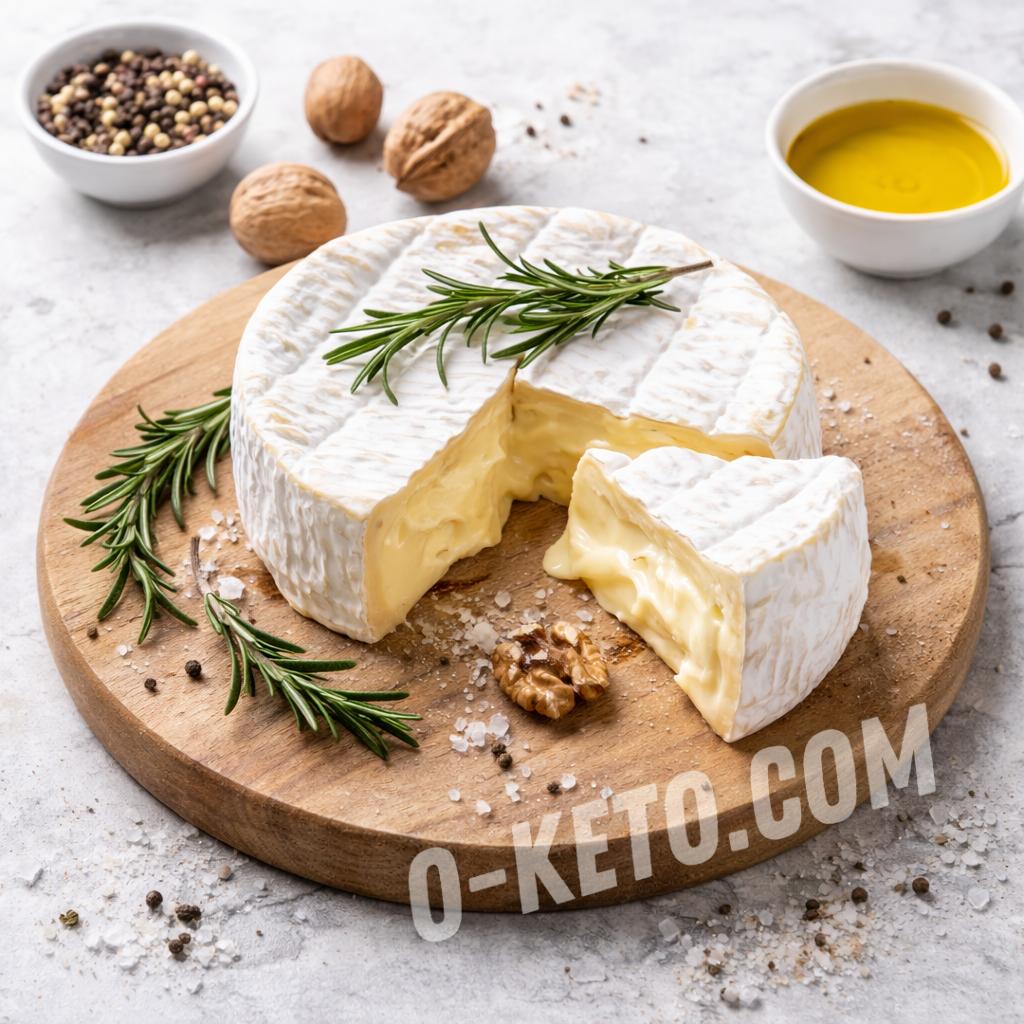

Camembert is a soft cow’s milk cheese with a white mold rind and creamy center. It comes from Normandy and is named after the village of Camembert. As it ripens, the cheese becomes more flowing, the aroma brighter, and the taste deeper: from milky and creamy in young cheese to mushroom-like and sharper in mature cheese.
For keto and LCHF, Camembert is convenient because it contains plenty of fat and protein while carbohydrates are usually very low. But it is not an unlimited food: the cheese is calorie-dense, salty, rich in taste, and easy to eat in larger amounts than planned, especially with nuts, berries, or wine.
Nutritional value
In 100 g of Camembert there are usually about 280–320 kcal, 18–21 g protein, 22–26 g fat, and roughly 0.5–1 g carbohydrates. Exact numbers depend on milk fat, producer, and ripeness. A 30–60 g portion is often more practical than a large cheese plate without tracking.
It contains calcium, phosphorus, vitamin B12, vitamin A, and other dairy micronutrients. The fats include saturated and monounsaturated fatty acids. Mold cultures participate in ripening and create the characteristic rind, aroma, and soft texture.
Is it suitable for keto?
Camembert fits keto well by macronutrients if eaten without bread, sweet jams, honey, and crackers. It can be part of a cheese plate, salad, hot appetizer, or sauce. For a more controlled portion, the cheese is better paired with greens, cucumber, celery, olives, or sugar-free sliced meat.
Cheese plates often become a source of excess energy not because of carbohydrates but because of total fat content. If the goal is weight reduction, Camembert is better sliced in advance and the rest of the wheel put away instead of left open on the table.
If Camembert is served with berries, the berry portion should be small and without sweet sauce. Tart accents work well: a few cranberries, blackcurrants, or raspberries, a drop of lemon juice, herbs, and pepper. They freshen the fatty cheese without turning the dish into dessert.
How to use it
Camembert is eaten at room temperature, when the center becomes softer and the taste opens better. It can be served in slices, added to salad, melted in a hot appetizer, used in a sauce for chicken, mushrooms, or cauliflower, or baked as a whole wheel without sweet filling.
When heated, the cheese melts quickly, so it does not need long cooking. For a keto version, use vegetable sticks, fried mushrooms, lettuce leaves, cucumber slices, roasted cauliflower, or pieces of meat instead of baguette. Sweet cranberry or fig sauce is better replaced with a few berries or a tart berry salsa without sugar.
How to choose
Good Camembert has an even white rind without wet slime, dark spots, or a sharp ammonia smell. A light mushroom aroma is normal, but the smell of ammonia, bitterness, and rot indicates over-ripeness or poor storage. The center may be firm in young cheese and flowing in mature cheese.
The ingredient list should be short: milk, starter, salt, rennet, and mold cultures. Stabilizers are sometimes found, but sugar and starch are not needed for ordinary Camembert. Pasteurized cheese is more predictable for most buyers; raw milk cheese requires more caution.
Ripeness matters too. Young Camembert is firmer, cuts more neatly, and smells milder. More mature cheese flows more and has a brighter aroma. For hot appetizers, a riper wheel can work well; for salad, cheese that still holds shape is more convenient.
Limitations
Camembert is unsuitable for people with milk protein allergy. With lactose intolerance, the reaction is individual: mature cheeses usually contain little lactose, but that does not guarantee good tolerance. Pregnant people, older adults, and people with weakened body defenses are better choosing pasteurized soft cheeses and respecting storage dates.
How to store it
Camembert is stored in the refrigerator, in its factory packaging or parchment inside a container. Tight plastic wrap can trap excess moisture, while an open shelf dries the rind quickly. The cheese can be taken out 20–40 minutes in advance, but it should not be left at room temperature for long.
After cutting, the cheese is better eaten within the next few days. The knife should be clean, and storage next to fish, onion, and strongly aromatic foods is undesirable: soft cheeses absorb odors easily and quickly lose their neat aroma.
What can replace it?
The closest replacements are Brie, Coulommiers, and other soft cheeses with white mold; for a milder taste, cream cheese or young goat cheese can work. In hot dishes, Camembert can be replaced with Brie, Reblochon, Taleggio, or another well-melting cheese, but saltiness and aroma will differ.


