




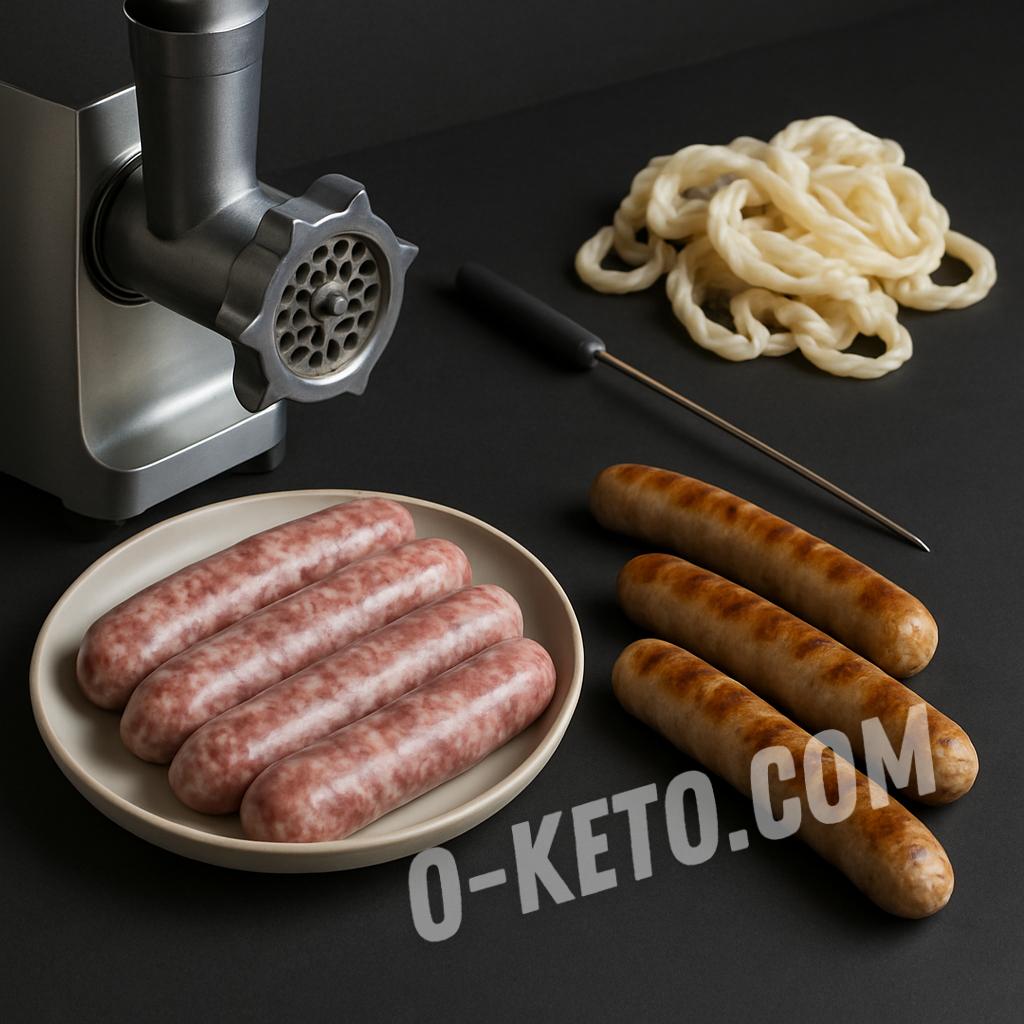

Homemade kupaty are often seen as simple grill sausages, but the result depends on more than the seasoning. Temperature, salt, grind size, stuffing density, resting, and safe heat treatment determine whether the sausages stay juicy and stable.

Why the mince must stay cold
The main goal during mixing is to keep meat juices bound in the mince. Meat is cut, partially frozen, and ground cold; water is added ice-cold. A practical target is to keep the mince below 8-10 °C during mixing.
Warm mince loses structure as fat softens. Spread meat in a thin layer, chill it for about an hour, and mix without leaving it on the counter. Pork kupaty benefit from a leaner cut plus fatty belly; chicken kupaty work better with thigh fillet than dry breast.
What matters in the mince
Salt, water, and spices should be weighed, not guessed. Around 16 g of salt per 1 kg of meat is a common starting point, and ice water helps the mince bind and stay juicy. Spices shape the flavor but do not replace technique.
The practical points are:
- cut and chill the meat before grinding;
- use a 4-5 mm grinder plate for a clear kupaty texture;
- add ice water, but do not exceed the recipe;
- mix until sticky and homogeneous, not just until spices are distributed;
- rest the mince in the refrigerator after mixing.
The grinder and sausage-stuffing equipment
Before grinding, check that the knife and plate are sharp, the knife faces the plate with its cutting edge, and the retaining ring is firmly secured. If the grinder parts have warmed up, chill them before use and keep the meat cold.
You can stuff casings with the grinder’s stuffing attachment or a separate sausage stuffer. Choose a tube that fits the casing; a tube around 10 cm long or more makes it easier to slide the casing fully onto the nozzle. When choosing a grinder, a wider feed opening can also make it easier to work with prepared pieces of meat.
How to prepare casings
Natural or collagen casings need preparation. Salted casings are soaked and rinsed; if the casing is not salted or the source is uncertain, a warm brine is more reliable. Use a 20% brine for 30-40 minutes, then rinse the casing in clean water.
Before stuffing, check for tears and do not overfill. Sausages should hold shape, but the mince needs a little room to expand during heating. Air pockets can be pricked with a thin needle.
Resting and maturing
Stuffed sausages should not go straight to strong heat. Refrigerator resting helps the mince settle inside the casing and stabilizes texture. Simple chicken or Georgian-style kupaty may rest for about 2 hours; chorizo-style sausages need 10-12 hours after the salted-meat stage.
Heat treatment before grilling
Kupaty can be grilled directly, but controlled preheating makes them safer and more predictable. Two methods can be used:
- pour boiling water over the sausages for 15 minutes, drain, and repeat;
- cook at 80 °C with steam or boiling water until the center reaches 70 °C.
The second method is more precise because it follows internal temperature rather than time. Use a probe thermometer inserted into the center of one sausage. After heating, cool the sausages fully on a rack and stabilize in the refrigerator; chorizo-style sausages benefit from about 12 hours.
Final grilling and storage
After heat treatment, the sausages have already reached a safe internal temperature, so final grilling is mainly for browning and aroma. Brown them quickly on a grill, skillet, or rack without overheating until juices run out.
Cooked and cooled kupaty can be frozen. Thaw through the refrigerator rather than at room temperature to protect texture and reduce risk.
Common mistakes
Most problems come from temperature, stuffing, and heat treatment rather than spice choice. Check these risks before cooking:
- the mince warmed above 8-10 °C and became loose;
- water was warm or excessive;
- the casing was poorly rinsed or overfilled;
- sausages were grilled immediately after stuffing;
- doneness was judged only by outside color;
- sausages were not cooled and stabilized after heat treatment.
Good kupaty are not complicated industrial work. They are an accurate home process: keep meat cold, weigh salt, allow resting time, and check internal temperature.


