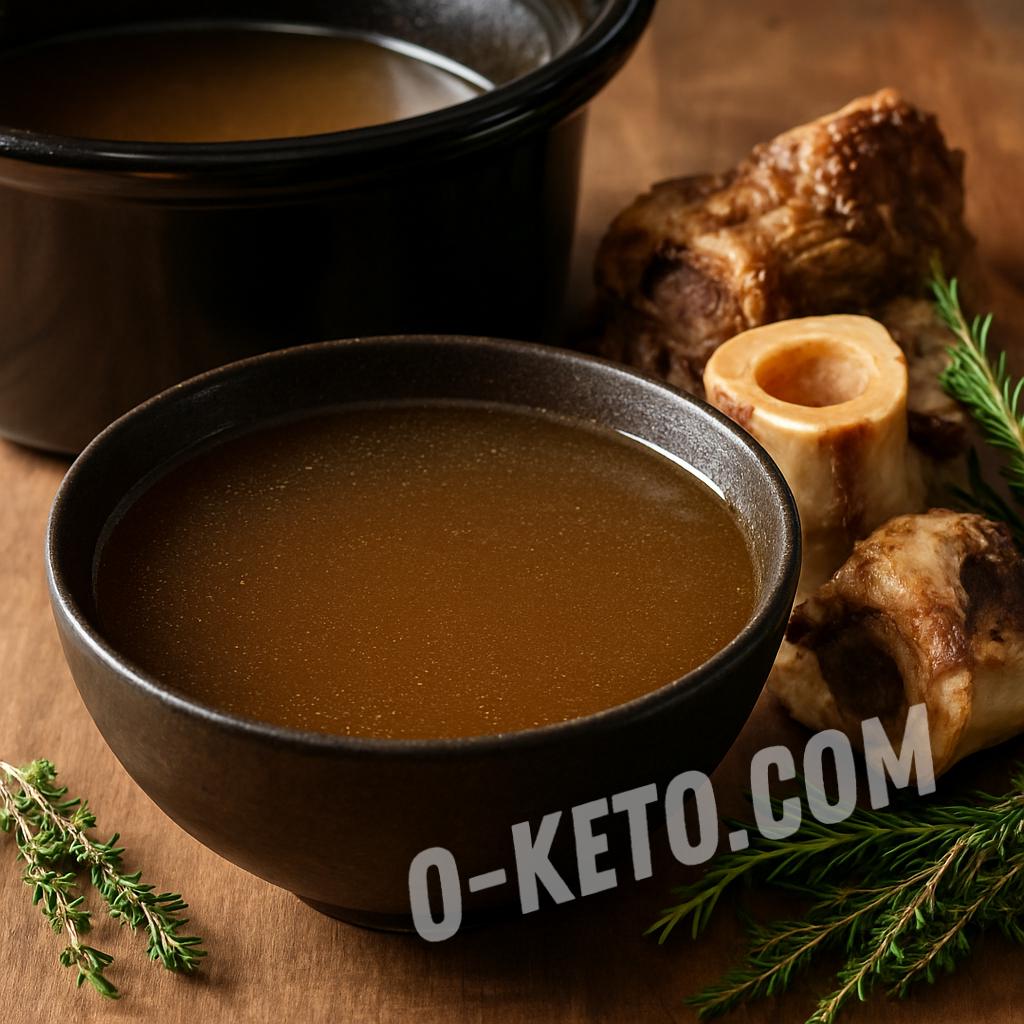

Bone broth is not a trendy cure-all. It is a slow-cooked broth made from bones, joint parts, skin, tails, feet, trotters, and other collagen-rich tissues. During long heating, some collagen turns into gelatin, so a good broth may become thick and jelly-like after cooling.
In low-carb nutrition, bone broth is useful as warm, gentle, nourishing food. It can replace a morning coffee, become a soup base, help with fluid and salt, and provide glycine, proline, glutamic acid, and other collagen-profile amino acids. But it should not be treated as complete protein, a mineral pill, or a mandatory food for everyone.
Why Bone Broth Is Useful
The main value of bone broth is not magic from bones, but gelatin, flavor, gentle tolerance, and connective-tissue amino acids. It can be especially helpful when large portions of meat are hard to eat but a warm protein-fat support feels good.
Bone broth may be useful in these situations:
- the diet needs more glycine, proline, and other collagen-profile amino acids;
- soft food is needed during digestive recovery;
- warm salty fluid is helpful on a low-carb diet;
- a base is needed for soups, sauces, and stewing meat or vegetables;
- collagen powders are not appealing, but broth, aspic, or gelatin foods are well tolerated.
Bone broth does not replace meat, fish, eggs, and other complete protein sources. It contains many collagen-related amino acids, but it does not provide a complete essential amino acid profile. It is best viewed as an addition to a protein-rich diet, not as the main protein target.
What to Use for Bone Broth
Despite the name, bones are not the only useful ingredient. Parts with joints, cartilage, skin, tendons, and connective tissue work best. These are the parts that give gelatinous texture and deep flavor.
Good raw materials include these options:
- beef tails, joint bones, shanks, and bones with cartilage;
- chicken feet, wings, necks, carcasses, and skin;
- pork trotters, hocks, tails, and skin;
- bones left after roasting meat, if they are not burnt or covered in sweet sauces;
- bone marrow separately, when the goal is rich nutrient-dense food rather than broth.
Raw material quality matters. Ideally, bones and joint parts come from animals with reasonably good feeding and traceable origin, as far as that can be checked. Bones can accumulate not only minerals but also unwanted substances, so bone broth should not become the only daily drink in liter quantities, especially from random raw materials.
How to Cook It: Simmer, Do Not Boil Hard
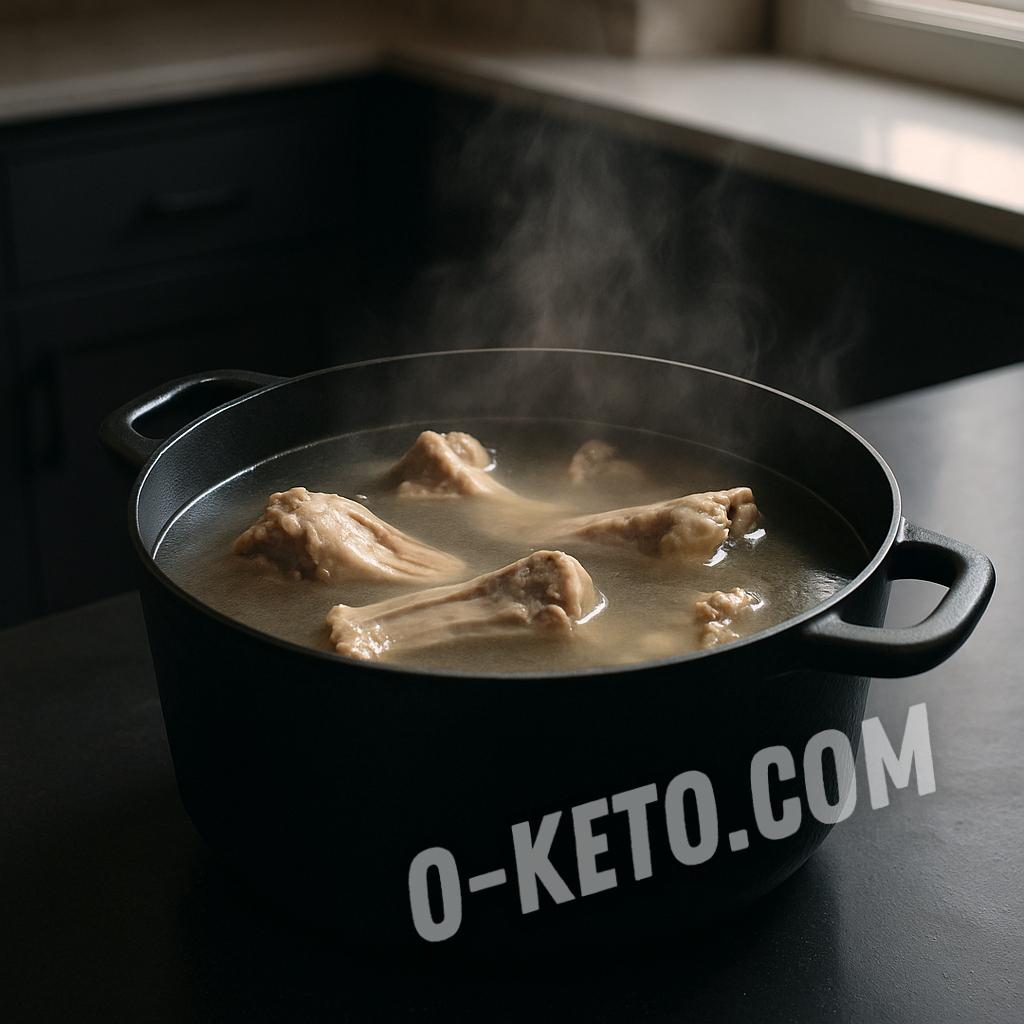
Bone broth is best simmered gently rather than boiled hard. The temperature should stay below active boiling: the water may move slightly, but it should not bubble aggressively. This keeps the flavor cleaner, reduces fat oxidation, and makes the broth easier to clarify.
The basic cooking logic is as follows:
- wash bones, joint parts, feet, or tails well;
- place the raw materials in a pot, Dutch oven, slow cooker, or multicooker;
- cover with cold filtered water so that the bones are fully submerged;
- add a little apple cider vinegar if you want to help extract some minerals from the bones;
- heat gradually and skim foam at the beginning;
- simmer without rolling boil for 6 to 12 hours depending on the raw material;
- strain, cool, and store in the refrigerator or freeze in portions.
Exact timing depends on pot size and ingredients. Chicken feet, skin, and carcasses often give a good result in 6-8 hours. Beef tails, joint bones, and larger parts can be simmered for 8-10 hours or longer. The main rule is simple: the bones should stay covered with water and the broth should not boil hard.
Why Broth Becomes Cloudy
Cloudiness usually comes from technique rather than spoilage. Active boiling, unwashed ingredients, sudden heating, and foam left in the pot make the liquid more cloudy.
For clearer broth, these steps help:
- wash the raw materials well before cooking;
- start with cold water and heat gradually;
- skim foam at the beginning of simmering;
- avoid a rolling boil;
- strain the finished broth through a sieve or cheesecloth;
- to clarify already finished broth, use beaten egg white and strain again.
Cloudy broth can still be eaten when the raw materials were good, the smell is normal, and storage was safe. Clarity affects appearance and flavor more than basic suitability.
What to Do With the Fat
After cooling, a firm fat cap often forms on the surface. If fat is well tolerated and the taste is pleasant, it can be left in. On a low-carb diet, it may be a normal part of the dish.
If the broth feels too heavy, the fat cap is easy to remove with a spoon after full cooling. This is useful for people who get nausea, heaviness, reflux, or bile-related discomfort from fatty broth.
The removed fat does not always need to be discarded. If it smells clean and is not bitter, it can be used in small amounts for stewing, but only when tolerated well.
Minerals, Vinegar, and Realistic Expectations
Bone broth is often described as a rich mineral source. In practice, mineral content depends strongly on raw material, time, acidity, water volume, and cooking method. Vinegar may help extract some minerals, but broth still should not be treated as a complete mineral supplement.
Bones are roughly half mineral matter, but that does not mean all of it moves into a cup of broth. Studies show that minerals in finished broth can be modest and highly variable. The main value of broth is flavor, gelatin, collagen-profile amino acids, and culinary convenience, not a guaranteed dose of calcium or magnesium.
Gelatin, Collagen, and Bone Broth
During long heating, collagen from connective tissue partially turns into gelatin. This is why cooled broth may set. The more joints, cartilage, skin, and feet in the raw material, the higher the chance of a firm gel.
Gelatin and collagen peptides are related, but they behave differently. Gelatin forms a gel and gives broth or aspic a firm texture. Collagen peptides usually dissolve more easily and do not set in the same way. Both provide collagen-profile amino acids, but neither replaces complete meat protein.
How to Use Bone Broth in the Diet
Bone broth does not have to be a separate ritual. It is often more useful as a normal culinary tool, because then it fits the diet naturally and does not become boring.
Practical uses include these options:
- drink a cup of warm broth in the morning or between meals if it is satisfying;
- use it as a soup base with meat, egg, fish, or vegetables;
- add it to stews with meat, poultry, cabbage, zucchini, or mushrooms;
- make flour-free and starch-free sauces and gravies;
- freeze portions so it does not need to be cooked from scratch every time.
There is usually no need to measure broth to the milliliter. The practical rule is that it should taste good, be well tolerated, and not replace complete meals with meat, fish, eggs, and other protein sources.
When Bone Broth May Not Fit
Even useful food does not suit everyone. Some people get heaviness, reactions to fat, bile-related discomfort, reflux, nausea, or sensitivity to specific amino acids and compounds that pass into the liquid during long simmering.
Pay special attention to your reaction in these situations:
- fatty foods are poorly tolerated or gallbladder problems are significant;
- broth causes reflux, nausea, heaviness, or bloating;
- there is histamine sensitivity or a reaction to long-stored meat products;
- the raw material is questionable and the broth is planned as a frequent drink;
- broth is being used to replace normal food and complete protein.
If bone broth is unpleasant, there is no need to force it for health. Collagen-profile amino acids can also come from aspic, gelatin foods, slow-cooked joint parts, skin, tails, feet, or quality collagen powder.
Lead and bone broth
A small controlled study found that lead concentrations in some chicken bone broths were higher than in the water used for cooking: 7.01 µg/L in broth made from bones and 9.5 µg/L in broth made from skin and cartilage. This does not mean that every homemade broth is dangerous: the study was small, used a limited number of samples, and does not establish a typical lead level for all ingredients or cooking methods. The finding is nevertheless a reason not to drink litres of bone broth every day, especially when the origin of the bones is unknown. A more sensible approach is to choose ingredients with a traceable origin, vary broth with other foods, and not treat it as a medicine or a guaranteed mineral supplement.
Conclusion
Bone broth is useful as slow-cooked, warm, practical food. It provides gelatin, flavor, salty fluid, and collagen-profile amino acids. It is best made by gentle simmering below active boiling, while keeping the bones covered with water.
The key is not to overpromise it. Bone broth is not complete protein, does not replace meat and eggs, does not guarantee a large mineral dose, and does not have to suit everyone. If it tastes good and is well tolerated, it is an excellent kitchen tool and a gentle dietary support. If not, it can be replaced with other sources of protein, gelatin, and collagen amino acids.
Sources
- The Risk of Lead Contamination in Bone Broth Diets — Medical Hypotheses
- Essential and Toxic Metals in Animal Bone Broths — Food & Nutrition Research