


Gelatin in keto desserts solves several tasks at once. It helps maintain the structure of mousses, creams, no-bake cheesecakes, berry inserts, soft layers for cakes, and homemade candy masses. However, mistakes with gelatin occur constantly: some people use too little, some do not take into account the Bloom strength, some pour boiling water over it, and some try to substitute gelatin with agar as if they are the same. As a result, the dessert either does not stabilize, becomes rubbery, or starts to have a strange taste and loses its clean texture.
In low-carb desserts, this is especially noticeable because there is no usual sugar system that helps the body of the dessert to be denser and more cohesive. When sugar is replaced with erythritol, allulose, or other sweeteners, and there is minimal flour and starch, gelatin becomes a more noticeable technological tool. Therefore, it is important to understand not only the grams but also how exactly it works: how much water it needs, when to heat it, what acidity does, and why different brands behave differently.
What is Bloom strength and why does it change the outcome
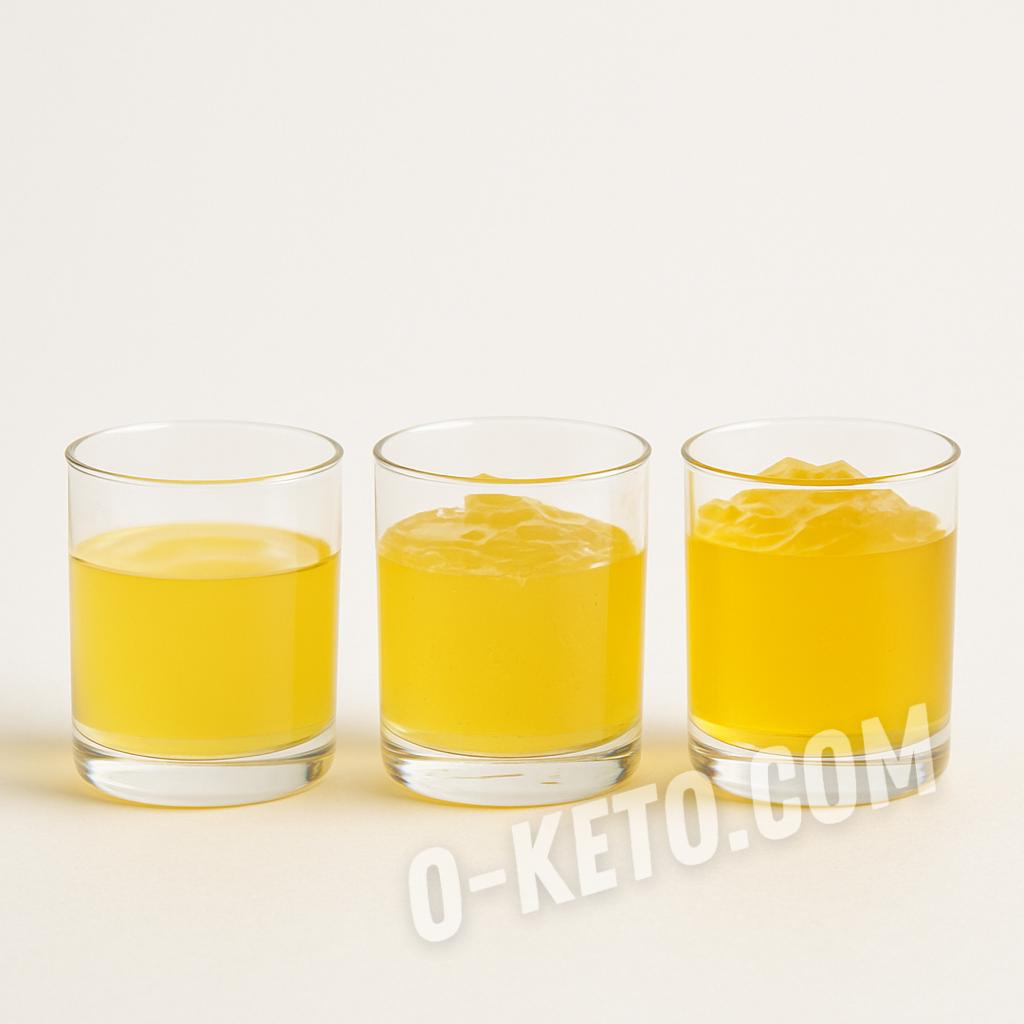
Bloom strength indicates how strong a gel can be formed by a specific gelatin. The higher the number, the stronger the gelling ability. In practice, this means that 10 g of gelatin with Bloom 240 and 10 g of gelatin with Bloom 160 will yield different results even in the same recipe. The stronger gelatin will set the mass more densely, quickly, and stably, while the weaker one may leave it softer or even unstabilized.
For homemade desserts, this is important for a very simple reason: recipes are often written for a specific range, for example, for 180–200 Bloom or for 220–240 Bloom. If a person takes a package without the specified strength and mechanically repeats the measurements, they are essentially altering the recipe’s structure. With the same mass, one can end up with either an overly delicate mixture that does not hold its shape on the table or an excessively elastic layer that does not melt smoothly but rather springs back on the spoon.
The simplest principle to keep in mind is: the higher the Bloom, the less gelatin is usually needed for the same density. Conversely, the weaker the gelatin, the more often one has to slightly increase the measurements. But this does not mean that recalculating can be done solely by intuition. One also needs to consider the dessert itself: mousse, berry filling, piping cream, no-bake cheesecake, and dense candy mass require different textures even with the same volume of liquid.
How to Properly Soak Gelatin
Regular powdered or granulated gelatin is most often soaked in cold water first. This is necessary for even swelling. If it is simply added to a hot mixture without preparation, it can clump together, partially dissolve, and partially remain as small undissolved particles. In the finished dessert, this is later felt as grittiness, unevenness, or weak stabilization.
A practical lower guideline for soaking is no less than 1:6 in relation to gelatin to water. For example, for 10 g of gelatin, at least about 60 g of water is used. In many home recipes, more water is used if it does not break the overall formulation. The main thing is to give the gelatin time to fully swell. In most cases, this takes about 20–40 minutes, although the exact time is best checked with the specific packaging.
Swollen gelatin should not float as separate solid granules. A good indicator is a homogeneous soft mass without dry grains. If the center is still dry while the edges have become jelly-like, it simply needs more time. In keto desserts, rushing at this stage is especially harmful because later the entire defect goes into the texture of the finished layer and there is nothing to mask it.
How to Heat Gelatin and Why It Should Not Be Boiled
After swelling, gelatin is usually dissolved in a warm or hot mixture, but it should not be brought to a vigorous boil unnecessarily. For most common food gelatins, the working melting range is around 60–70 °C. This is sufficient for it to completely dissolve in cream, berry mixtures, or custard bases. Boiling usually does not provide any benefits here and can sometimes even spoil the flavor and reduce the sensation of a clean texture.
When gelatin is overheated, especially in a small pot and over high heat, the mixture can easily start to smell stronger and may yield a less neat, coarser finish in taste. In some cases, overheating does not completely ruin the dessert but makes it less delicate. Therefore, at home, it is safer not to “boil gelatin” but rather to dissolve it to a clear, homogeneous state and immediately remove it from the heat.
This is especially important for delicate desserts where there are no strong spices, alcohol, or intense chocolate flavors. In vanilla cream, light mousse, milk layer, or berry cheesecake, any extra taste is more noticeable. The cleaner the flavor of the base, the more carefully gelatin needs to be handled.
When the mass stabilizes and why cold is not just a formality here
Gelatin begins to gather structure not at the moment of mixing, but during subsequent cooling. A practical guideline is the zone around 15 °C and below, where noticeable stabilization begins. This is why the dessert may seem still liquid right after mixing, but can set properly after a few hours in the refrigerator.
This is important for planning assembly. When it comes to cakes, mousses, fillings, or creams for decorative piping, one must consider not only the preparation time but also the time for complete stabilization. Sometimes the mass needs more than just cooling to room temperature. It needs to sit in the refrigerator for several hours for the gel to firm up and stop being fragile and mobile. Trying to rush this stage usually results in the layer melting, the sides behaving unstably, and the surface not being able to hold the decoration.
On the other hand, too rigid cooling is not always beneficial if the mass needs to be made workable again later. Some creams, after complete stabilization, need to be slightly whipped or briefly softened to regain their plasticity. This is normal technological logic and not a sign that the gelatin “did not work correctly.”
How Acidity Affects Gelling
Acidic environments can weaken the gelling properties of gelatin. In practice, this is most often observed in berry fillings, lemon layers, citrus creams, and desserts with a large amount of sour puree. If the recipe is based on a very acidic foundation, simply transferring the “normal” gelatin measurement from a creamy mousse to an acidic layer may not work.
This does not mean that acidic desserts with gelatin cannot be made. It means that in these cases, the Bloom strength, adequate measurement, and correct order of operations are especially important. Often, gelatin is added only after the base has been prepared and removed from active heat, and then careful attention is paid to cooling and stabilization time. The more acidic the mixture, the less sense there is to rely on chance, and the more important it is to test the texture in advance on a small volume.
Why Gelatin and Agar Are Not Equal to Each Other
One of the most common household mistakes is to think that gelatin and agar-agar differ only in origin and proportion. In reality, they are different systems in terms of behavior. Gelatin provides a more elastic, springy, slightly stretchy texture. Agar forms a more brittle, sharper, and often more fragile gel. Therefore, a dessert made with gelatin and one made with agar feel different not only in the mouth but also during cutting, storage, and serving.
If a recipe is designed for a soft creamy cut, a delicate berry insert, or a pliable layer, substituting gelatin with agar without completely reworking the recipe often destroys the intended result. The mass may become tougher, more brittle, or separate from adjacent layers in unexpected ways. The reverse substitution is also not always safe: an agar recipe converted to gelatin may become too soft and “jiggly,” especially when served warm.
What to do if the packaging does not indicate Bloom
This is a common situation for mass-market products. Many packages do not specify the Bloom strength at all, leaving the person only with the name “food gelatin” or “instant gelatin.” In such cases, it is safest to treat the product as average gelatin and allow time for testing. If the recipe is very important for texture, it is better to first check the behavior of the batch on a small test volume: for example, on part of the cream or on a small portion of berry mixture.
If the gelatin performed weaker than expected, it is better to carefully recalculate the grams in the next attempt rather than trying to save the already assembled dessert with a chaotic addition of another portion at the last moment. In products with multiple layers, such haste almost always results in unevenness.
Common Mistakes
Gelatin is most often misused for the following recurring reasons:
- not considering the difference in Bloom strength;
- soaking for too little time or in insufficient water;
- adding gelatin to boiling mass and overheating it;
- trying to use the same measurement for the creamy and acidic layers;
- replacing gelatin with agar without fully changing the recipe logic;
- rushing the stabilization and starting assembly before the mass has truly set.
If these specific mistakes are avoided, gelatin becomes a very predictable ingredient. It stops being a “fussy additive” and becomes a normal tool for achieving precise texture.
Conclusion
Gelatin in keto desserts requires not magic, but technological precision. It is important to consider the strength of Bloom, soak it in cold water at a ratio of at least 1:6, allow it to swell for 20–40 minutes, dissolve it without excessive boiling, and remember that final stabilization occurs only after proper cooling. Acidic mixtures require more caution, and agar and gelatin cannot be considered interchangeable. When these principles are followed, mousses, creams, fillings, and cake layers turn out to be much more stable and delicious.


