
Sugar-free marshmallow looks simple, but its stability does not come from one “correct” ingredient. In a conventional sugar recipe, the syrup provides sweetness, mass, viscosity, and part of the water control at the same time. In a lower-carbohydrate version, those jobs are divided between the sweetener, liquid, protein foam, and gelling agent, so the workflow becomes part of the formula.
What makes sugar-free marshmallow stable
The finished foam must be light enough to remain airy and structured enough to keep the shape made by the piping tip. Protein creates the foam, hydrated albumin can make it more predictable, and agar forms a framework during heating and cooling. The syrup connects these elements and gives the mixture its working flow.
Judge the system by more than taste. A thin base spreads, an overly firm one is difficult to pipe, and an uneven syrup produces lumps or zones of different density. A reliable result is coordinated texture at every stage, not an attempt to hide a process error under a thick coating.
The role of the main ingredients
Allulose and syrups based on chicory or Jerusalem artichoke differ in sweetness, viscosity, color, and moisture retention. Allulose has a mild sweetness and is useful in a syrup base, but it does not behave like sucrose in every heating regime. Water or very fluid berry juice controls concentration; a thick purée cannot be treated as an interchangeable liquid.
Choose agar by gel strength, not by its name alone. Products can differ substantially, so a quantity from one formula may not transfer directly to another. Citric or another food acid affects flavor and can influence the protein system, but it should be used as part of the intended process rather than as a way to rescue an overcooked syrup.
How the syrup works
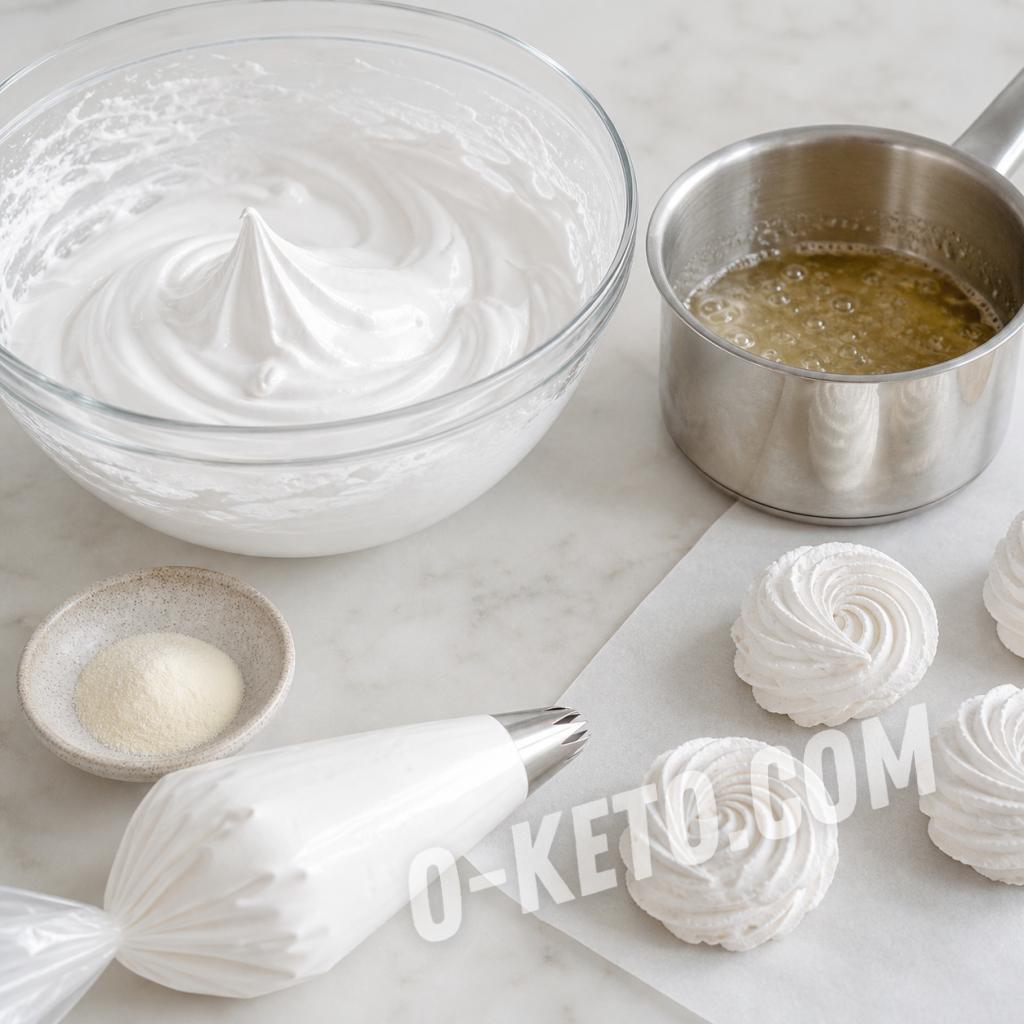
For the syrup, disperse the agar evenly with the allulose first, then add water or a fluid juice. Heat until the whole surface is actively boiling, rather than waiting for a few bubbles at the edge. After a short hold, use the syrup immediately: as it cools, it loses flow quickly and becomes harder to combine with the foam.
Temperature should not be the only guide. Sweeteners with different composition and moisture can behave differently, so watch the evenness of the boil, viscosity, and flow. Overheating increases the risk of a dense or uneven framework; insufficient boiling can leave the structure weak.
The protein base: what matters for the foam
The protein must be free of fat and yolk. If albumin is used, allow it to hydrate in the liquid, usually for about 20–30 minutes unless the product instructions specify another method. After hydration, the base whips more evenly and tolerates the later addition of hot syrup better.
The goal is a dense, smooth, stable foam, not the largest possible volume. Under-whipped foam will not hold its shape, while dry, coarse foam accepts syrup less evenly. Xanthan is not a substitute for agar and is not a universal way to reinforce egg white: in some protein systems it changes viscosity and can reduce stability after syrup is added.
Equipment and workstation setup
For a first attempt, a hand mixer with narrow, rigid beaters, a stable glass or metal bowl, and a small rigid saucepan are enough. A silicone spatula helps clear the bowl, while accurate scales matter for agar, acid, and small additions. Volume-based kitchen measures often round precisely the quantities that control the structure.
Have the piping bag and tip ready before combining syrup and foam. Cover the work surface with parchment or a silicone mat, prepare a board for moving the pieces, and clear unnecessary tools away. The foam sets quickly, so searching for equipment after the syrup is cooked almost always makes piping worse.
Combining syrup with the protein foam
Add the hot syrup in a thin stream while the mixer is running, directing it between the beater and the side of the bowl. Pouring it all at once can locally scald the protein and create dense lumps. Pouring directly onto the beater sends syrup onto the sides and leaves part of the agar outside the mixture.
Do not keep whipping for a long time “just in case.” Look for a smooth, glossy, sufficiently firm mass that can pass through the tip. Once that texture is reached, pipe it: every extra pause shortens the working window.
Piping, setting, and coating
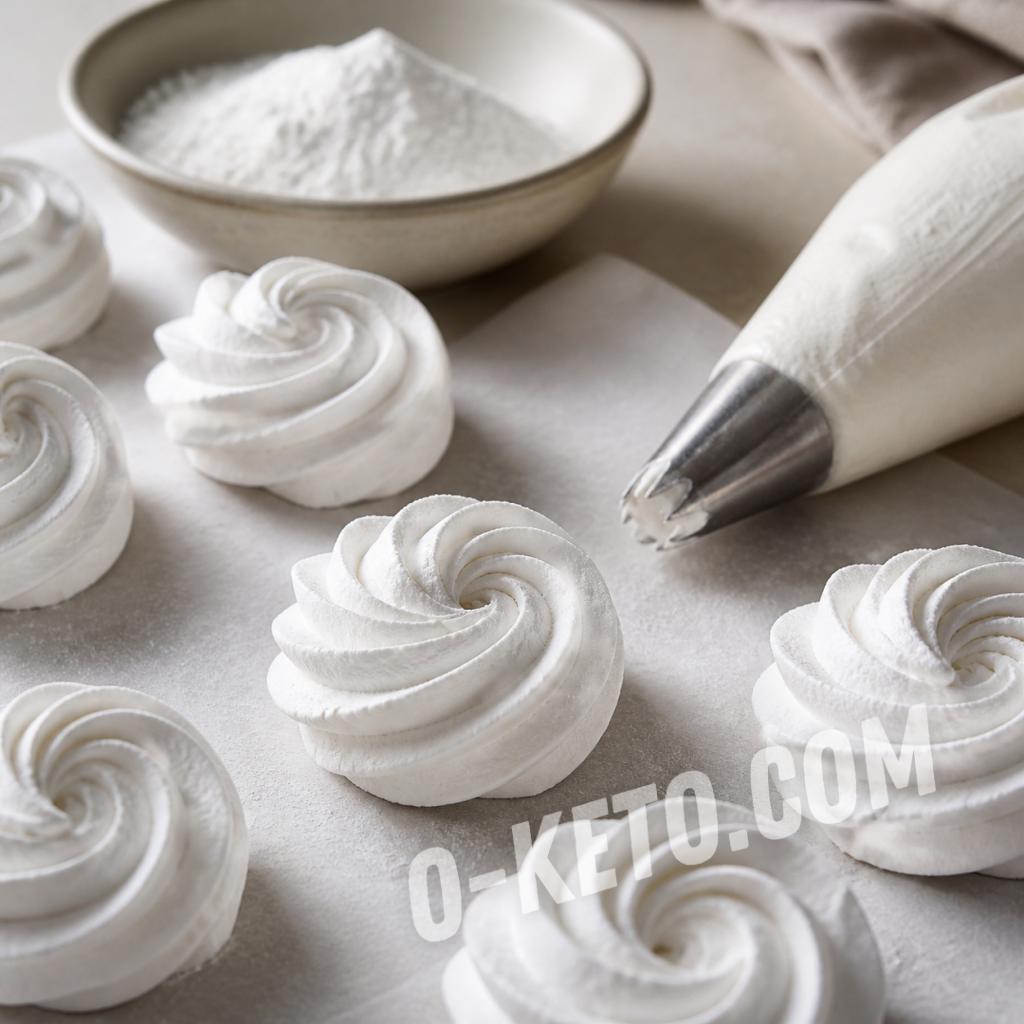
Pipe each piece onto the prepared surface with an even motion, keeping the bag vertical. Uneven ridges are often caused not by the tip technique but by a mixture that has already started setting in the bowl. Leave the halves to stabilize at room temperature in a dry place; the exact time depends on composition, size, and humidity.
A dry coating improves handling and protects the surface, but it cannot repair a wet or weak foam. If a powder is used, consider both the dessert composition and its carbohydrate contribution. A sugar crust cannot appear literally without sugar, so replacing it with starch alone produces a different taste and texture.
Common mistakes and how to recognize them
Spreading ridges usually point to weak foam, insufficiently active boiling, excess liquid, or piping too late. A hard, brittle structure is more often linked to too much agar, excessive reduction, or a mismatch between gel strength and the original dosage. Lumps appear when dry agar is not dispersed evenly or the syrup is added too quickly.
If the mixture sets in the bag, check syrup temperature, working speed, and whether the equipment was ready. If wet patches remain inside, check the liquid balance and foam quality before simply extending the drying time. Change one variable at a time so the cause of an improvement remains visible.
A practical checklist
Before starting, check agar strength, weigh the small ingredients, hydrate the albumin, and prepare the bag and tip. During cooking, achieve active boiling across the whole surface and do not leave the syrup standing. During combining, pour in a thin stream, assess smoothness, and pipe as soon as the mass reaches working firmness.
This checklist is more useful than memorizing one universal temperature or time. Sweetener composition, purée acidity, protein hydration, and agar strength all change the process, while visual signs—uniformity, flow, firmness, and shape retention—help you adapt it safely.
What “sugar-free” means
Here, “sugar-free” means that sucrose is absent from the formula, not that the dessert contains no sweetness, calories, or carbohydrate at all. Syrups, fruit ingredients, dairy components, and coatings can contribute their own carbohydrates, so the complete label matters. A lower-carbohydrate dessert is not automatically healthy simply because sugar was replaced.
The practical conclusion is to identify the function of each component before choosing a substitute. Protein provides foam, agar provides the framework, syrup provides moisture and a working window, and the coating affects the surface only. When these roles remain distinct, sugar-free marshmallow becomes a controllable technique rather than a random experiment.
Sources
- Effect of polysaccharides on the functional properties of egg white protein: A review
- Citric Acid Improves Egg White Protein Foaming Characteristics and Meringue 3D Printing Performance
- Agar as a gelling agent: chemical and physical analysis
- Hydrocolloids as thickening and gelling agents in food: a critical review
- Pectin Hydrogels: Gel-Forming Behaviors, Mechanisms, and Food Applications