


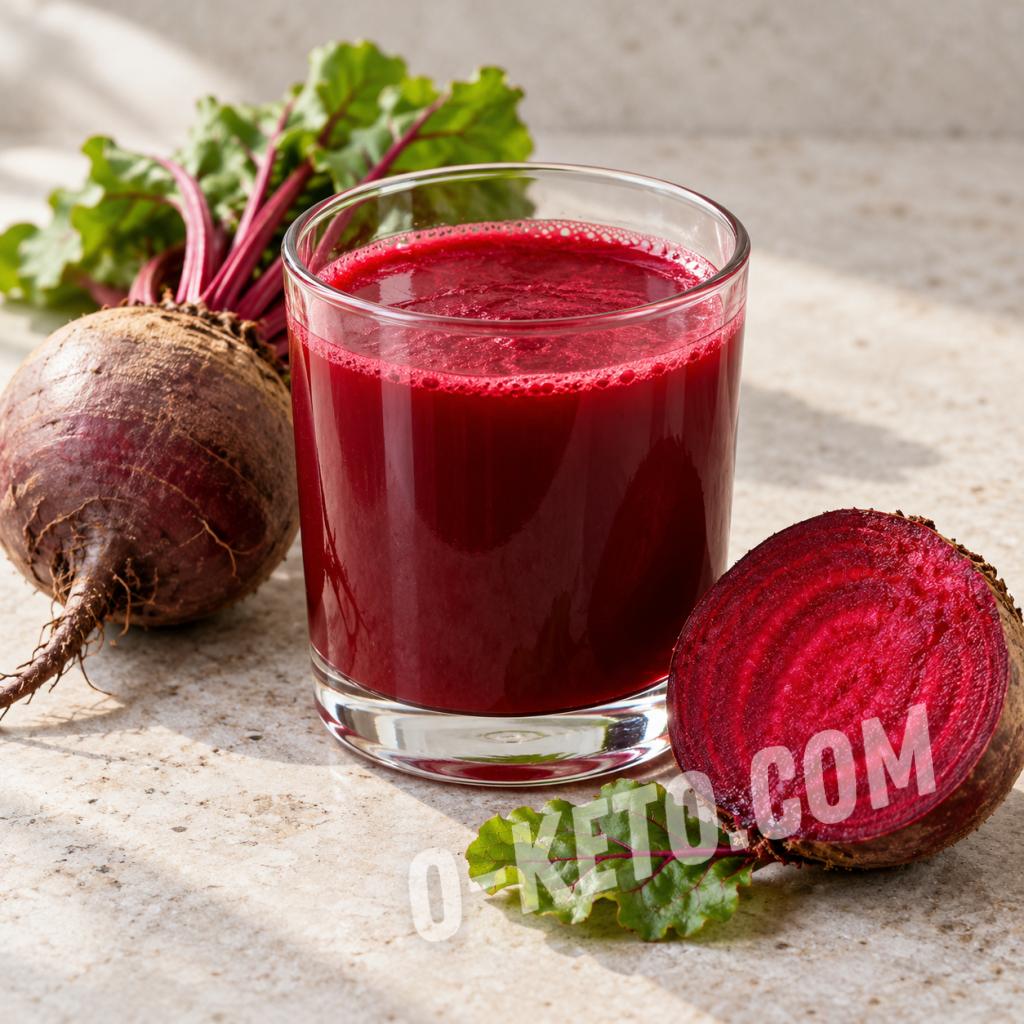

Beetroot juice is pressed from table beet roots and is served on its own, blended with other vegetable juices, or used as a vivid flavouring ingredient. It may be freshly pressed, pasteurized, clarified, or sold with pulp. These forms differ in texture and taste, and also in sugars, fibre, nitrate and other compounds. Variety, maturity, processing and the ingredients in a particular package all affect the final composition.
How beetroot juice is made
For fresh juice, the roots are washed, optionally peeled, crushed and pressed. Some producers filter the liquid; others leave fine pulp in it. A packaged product may be pasteurized to extend shelf life, and its ingredient list may include water, salt, lemon juice, acid or juices from other vegetables. The words “beetroot juice” alone do not tell you how concentrated the drink is or whether it contains added sugar.
Beetroot has an earthy sweetness, and freshly pressed juice usually tastes dense and vegetal. Heating or prolonged storage can soften its aroma and change its colour. A clarified version blends more easily into drinks and sauces; a pulpy juice is thicker and retains more particles from the root. Check the ingredient list, processing method and nutrition panel rather than judging a product by colour, thickness or the word “natural”.
Nutrition
The USDA FoodData Central record “Beet juice” for raw juice lists about 25 kcal, 0.72 g protein, 0.06 g fat and 5.91 g carbohydrate per 100 g, including 1.1 g dietary fibre. That is roughly 4.8 g of available carbohydrate per 100 g. The same record includes potassium, magnesium, calcium, iron, vitamin C, vitamin B6 and folate, but in amounts that are modest compared with foods that serve as concentrated sources of those nutrients.
These figures describe one reference entry, not every bottle. Clarification can reduce fibre, dilution changes concentration, and adding apple or another sweet juice increases sugars. When the package provides a nutrition panel, use the producer’s values to work out your serving. For an unlabelled drink, exact composition cannot be inferred from its colour, thickness or the word “natural”.
Beet pigments and nitrate
The red-purple colour comes from betalains, water-soluble pigments in beetroot. Their concentration can change during processing and storage; a vivid colour does not indicate a particular nutrient dose or a therapeutic effect. Another group studied in beetroot juice is dietary nitrate. In the body, some nitrate can enter the pathway that produces nitric oxide, a molecule involved in regulating vascular tone. Nitrate levels vary considerably among beet varieties and commercial juices, and the label often does not state the amount.
A 2024 systematic review of randomized trials in adults with hypertension reported an average reduction of about 5.3 mmHg in clinic systolic blood pressure with daily juice providing 200–800 mg nitrate. The authors rated the certainty of evidence as low and found no significant effect on diastolic pressure or 24-hour monitoring outcomes. The trials do not establish the same effect for an arbitrary serving of shop-bought juice: dose, duration, participants and nitrate concentration all matter. Juice is not a replacement for prescribed treatment, and it is not a reason to change medication without a clinician.
Carbohydrates and diet fit
Juice contains less fibre than a whole beet, and liquid sugars are easy to drink faster than the equivalent amount of root can be eaten. For a ketogenic diet, both the portion and the carbohydrate value on the label matter: even a small bottle can contribute several grams, while a sweetened blend can contain more. If you track net carbohydrate, subtract fibre only when it is listed separately and your tracking method allows it.
A small amount can be added to a sauce, vegetable blend or dressing without turning it into a large glass of sweet drink. In a strict ketogenic plan, juice is often difficult to fit without using a sizeable part of the daily allowance; a measured portion of whole beet makes volume easier to control and keeps more of the original structure. The issue is not that the drink is “bad”; its liquid form can simply make the carbohydrate load easy to underestimate.
Oxalate and individual restrictions
Reviews on nutrition for kidney-stone prevention list beetroot juice among drinks with appreciable oxalate; one review reports roughly 60–70 mg per 100 mL in the samples it cites. This is not a universal value for every batch because cultivar, pressing and filtration can change the result. Oxalate content alone does not make beetroot unsuitable for most people, but anyone following a prescribed low-oxalate diet, with recurrent calcium-oxalate stones, or with another specific medical restriction should check the portion with a qualified clinician. A general food table cannot replace individual guidance.
Choosing, using and storing it
First check whether the label describes 100% beetroot juice, a juice blend, a nectar or a flavoured drink. Compare carbohydrate and sugars for the same amount, and look for syrup, sugar, salt and flavourings. “No added sugar” does not mean that the drink contains no naturally occurring sugar. If nitrate content is declared, that figure is more useful for comparison with research than colour or a general promise to “support circulation”.
Beetroot juice can be mixed with carrot, cucumber or lemon juice, added in small amounts to cold sauces and marinades, or stirred into puréed soup. A little adds colour and an earthy-sweet note; too much can overpower other ingredients. In baking and thick mixtures, account for the added liquid: juice changes batter moisture more than grated beet does. Start with a small amount and adjust acidity, salt and liquid to taste.
Store unopened juice as directed on the label: pasteurized juice may be shelf-stable until opened, while fresh or chilled juice needs refrigeration. After opening, keep the bottle closed and cold, follow the producer’s use-by guidance, and avoid drinking directly from the bottle if it will be stored again. Discard it if the package is swollen, the drink fizzes unexpectedly, or mould, unusual slime or a fermenting smell appears. Some sediment can occur in natural juice; shake it before serving unless the producer advises otherwise.
Sources
USDA FoodData Central. “Beet juice,” NBD record 2709682; nutrition per 100 g.
“Effects of beetroot juice on blood pressure in hypertension according to European Society of Hypertension Guidelines: A systematic review and meta-analysis,” Nutrition, Metabolism and Cardiovascular Diseases, 2024.
“Compositional characteristics of commercial beetroot products and beetroot juice prepared from seven beetroot varieties grown in Upper Austria,” Journal of Food Composition and Analysis.
“Nutrition and Kidney Stone Disease,” Nutrients, 2021; review of oxalate in foods and drinks.


