


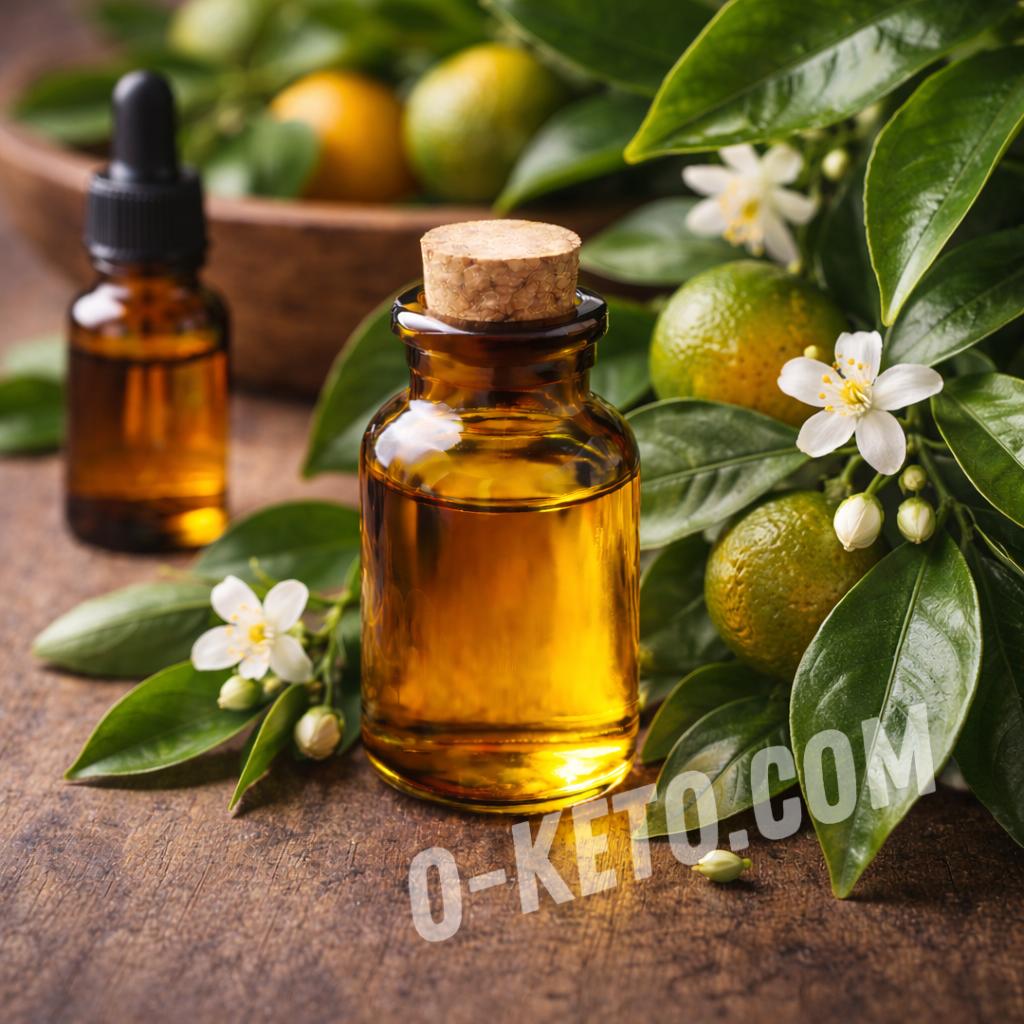

Mandarin petitgrain essential oil is obtained not from fruit peel, but from the leaves and young twigs of Citrus reticulata by steam distillation. Its aroma therefore differs from mandarin peel oil: it is less sweet, greener, woody-herbal, with a soft citrus top note and slight bitterness.
Mandarin petitgrain is used in perfumery, diffuser blends, cosmetic formulas, and diluted massage blends. It is a concentrated aromatic product, not juice and not zest. For keto and LCHF it has almost no food role: it is usually not added to food, and without food-use labeling it should not be taken internally.
Composition and aroma
The oil profile may include linalyl acetate, linalool, terpineol, limonene, sabinene, and other volatile compounds. Exact proportions depend on raw material, region, season, and distillation. Compared with neroli, petitgrain is usually greener and drier; compared with mandarin peel oil, it is less sweet and less juicy.
Good oil smells clean, fresh, green-citrus, and slightly woody, without rancidity, mustiness, or harsh solvent notes. If the smell becomes flat, sour, or heavy, do not use the product on skin. In perfume blends, petitgrain often acts as a bridge between citrus, floral, and woody notes.
Is it suitable for keto?
From a carbohydrate perspective, mandarin petitgrain does not affect keto because it is used by the drop and usually outside food. But it should not be treated as a culinary substitute for mandarin. If mandarin flavor is needed in a low-carb dessert or drink, use food extract, zest, a tea blend, or a flavoring with clear labeling.
At home, the oil can sit near keto recipes as a room aroma or cosmetic component, but not as a plate ingredient. Confusion between citrus oils matters: peel oil, neroli from flowers, and petitgrain from leaves have different smells and different limits.
How to use it
In a diffuser, mandarin petitgrain pairs with lavender, bergamot, sweet orange, neroli, cedarwood, sandalwood, marjoram, clary sage, and rosewood. It can make a citrus blend less sweet and more grown-up in tone. Keep the dose moderate because the green bitterness can easily move forward.
For skin, dilute the oil in a carrier oil and patch test first. In cosmetics, it works as an aromatic component in creams, body oils, shower products, and massage blends. Essential oil should not be dropped straight into bath water: mix it first with a suitable base or emulsifier.
Mandarin petitgrain can be used in perfume accords where green citrus without bright sweetness is needed. It connects floral notes with woody notes and softens the sharpness of herbal oils. For small rooms, a minimal amount is enough.
How to choose
The label should show Citrus reticulata, plant part such as leaves or twigs, extraction method, country of raw material, shelf life, and intended use. If it says only “mandarin oil,” it may be peel oil rather than petitgrain. If it says “fragrance,” it may be a perfume composition.
A dark glass bottle with a dropper and tight cap is preferable. A good producer states batch and limits clearly. Cloudiness, sticky cap, harsh chemical smell, and missing Latin name are reasons to choose another product.
Limits
Mandarin petitgrain is concentrated and may irritate skin, eyes, and mucous membranes. Do not use it undiluted, leave it within reach of children, or take it internally without food-use labeling. Citrus allergy, pregnancy, childhood, sensitive skin, and regular medication use are reasons to discuss use with a qualified professional.
Unlike some citrus peel oils, petitgrain is usually not treated as a major photosensitizing oil, but producer warnings should still be read. Old or poorly stored oil is more likely to irritate skin, so freshness matters.
Storage
Keep the bottle tightly closed in a cool dark place, away from the stove, window, and damp bathroom. After opening, write the date on it. Citrus-green oils change aroma over time, so an old bottle is better not used in facial cosmetics. Make dilutions in small portions.
What can replace it?
In aromatic blends, substitutes can include petitgrain bigarade, FCF bergamot, neroli, sweet orange with cedarwood, mandarin peel oil, or soft rosemary, but the profile will change. For food mandarin flavor, use zest, food extract, or flavoring, not essential oil without food-use approval.


