


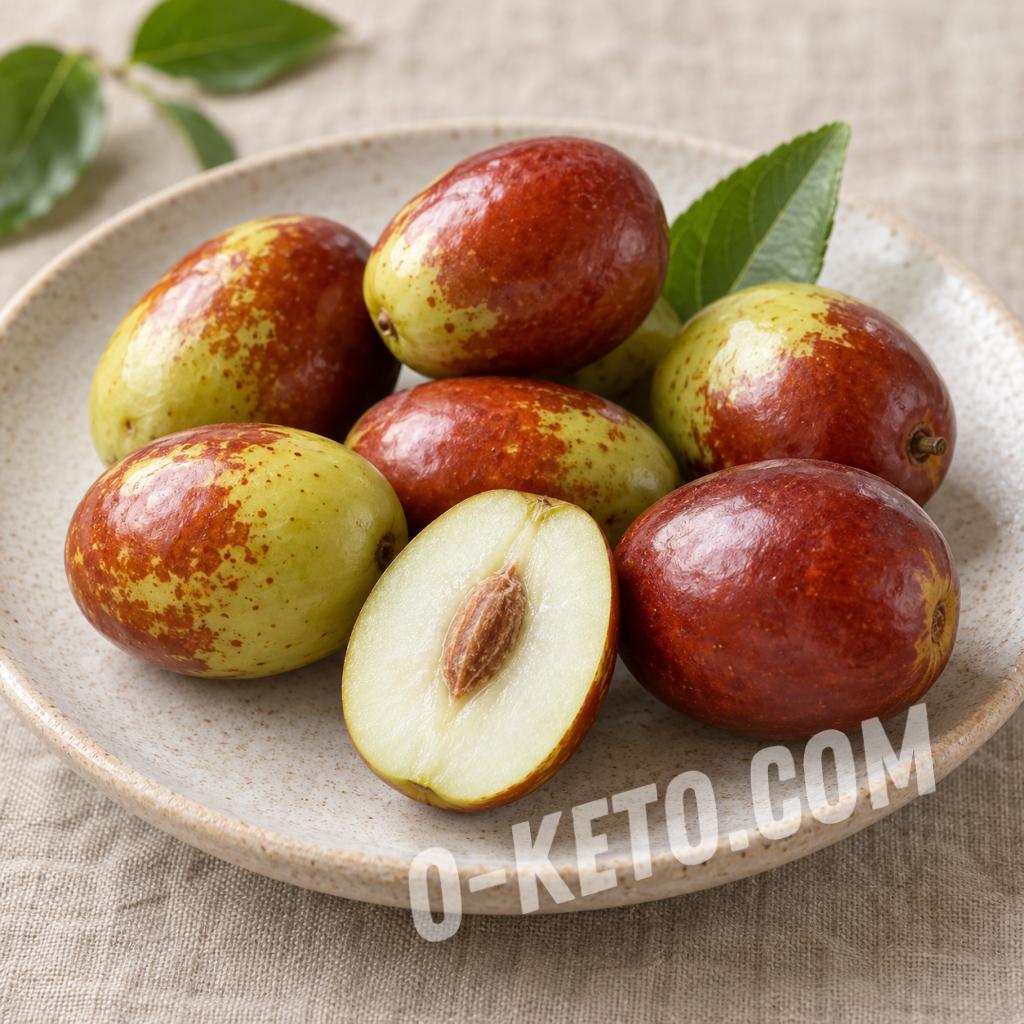

Jujube, also called Chinese date or unabi, is the fruit of Chinese jujube (Ziziphus jujuba Mill.), a member of the buckthorn family. Fresh fruit is eaten after removing its hard central pit. Depending on cultivar and ripeness, the flesh can be crisp with a slight tang or softer and sweeter. Products sold as jujube may be fresh or dried, and those forms have very different nutrition, texture, and uses.
Origin and forms
Chinese jujube has been cultivated in East Asia for centuries. The common name “Chinese date” describes its sweet, date-like flavour when ripe or dried; it is not a date from a palm tree. In shops, “unabi” often refers to fresh fruit, while “dried jujube” and “red dates” usually refer to the preserved form. Indian jujube (Ziziphus mauritiana) is a related species, but it is not the same fruit and its composition can differ.
Fresh jujubes are harvested at different stages. As they mature, the skin may shift from green toward yellow and develop reddish-brown patches; the flesh also becomes less firm. Some cultivars are enjoyed while crisp, while others soften more noticeably when fully ripe. Colour alone is not a reliable ripeness test across all varieties. Check the fruit’s firmness, aroma, and the seller’s description, and expect natural variation in size and taste.
Nutrition
A reference entry in USDA FoodData Central for “Jujube, raw” lists 79 kcal, 1.2 g protein, 0.2 g fat, and 20.23 g carbohydrate per 100 g of edible portion. USDA does not report dietary fibre for this raw entry. A literature review gives approximately 1.6 g fibre per 100 g of fresh jujube, although values vary across cultivars and studies. As a result, net-carbohydrate calculations can differ depending on the data source; a tested product label or cultivar-specific analysis takes precedence.
The USDA raw-fruit record also lists 69 mg vitamin C, 250 mg potassium, 21 mg calcium, 23 mg phosphorus, and 10 mg magnesium per 100 g. These are reference values for a database entry, not a guaranteed analysis of every fruit. Published measurements vary with cultivar, maturity, growing region, season, and storage. Fresh and dried jujubes should never be treated as interchangeable in a nutrition calculation: removing water concentrates nutrients and sugars. USDA’s separate entry for Chinese jujube, fresh, dried, lists 281 kcal and 72.52 g carbohydrate per 100 g.
Flavour and ways to eat it
To eat a fresh jujube, rinse it, cut around the pit, and discard the pit. Firm fruit has a crisp texture often compared with an apple, with mild sweetness and a refreshing tart note. The flavour becomes sweeter as the flesh softens. Because fruits vary in ripeness, taste one before deciding how to use the rest. Thin slices are convenient when the fruit is especially crisp; a soft ripe fruit is easier to cut over a plate so its juice is retained.
Fresh slices work in savoury salads, with soft cheese and nuts, or on a fruit plate. They can be added to porridge or yoghurt, but their carbohydrates add to those of the other ingredients. In cooked dishes, jujube is used with poultry, meat, and soups for a gentle sweet-tart note. Add fresh pieces toward the end of cooking if you want them to keep their shape; a longer simmer makes the flesh softer. Dried jujubes are more often used in infusions, compotes, and desserts, where their concentrated sweetness changes the result.
Jujube on a low-carbohydrate diet
Fresh jujube contains about 20 g carbohydrate per 100 g, so it is not a food to eat freely on a strict ketogenic diet. Even a modest portion can use a noticeable share of a daily carbohydrate allowance, and dried fruit contains much more carbohydrate by weight. If you include fresh jujube in a low-carbohydrate plan, weigh the edible flesh without the pit and use data for the fresh form. The USDA reference record does not provide a universal glycaemic index for every cultivar and ripeness stage, so a single precise GI value should not be assumed from it.
On Mediterranean or Paleo-style eating patterns, fresh jujube can be treated as a whole fruit, while portion size still matters for someone monitoring carbohydrate or glucose intake. Dried jujube may contain no added sugar, but drying concentrates the fruit’s naturally occurring sugars; read the ingredient list and do not compare equal-weight servings of fresh and dried fruit. Candied jujube pieces and jujube syrup are different products with a different nutrition profile.
Choosing and storing
Choose fresh fruit with intact skin and no wet patches, mould, deep cracks, or fermented smell. Natural colour changes may be normal for the cultivar; pronounced shrivelling or excessive softness can signal moisture loss or overripeness. If you have not tried jujube before, start with one fruit because sweetness and firmness vary considerably. For dried jujubes, check whether sugar, syrup, oil, or preservatives have been added. Moist clumps or damaged packaging deserve extra caution.
Keep fresh jujubes refrigerated in a clean, dry container or a bag that allows a little air circulation, and use bruised or very soft fruit first. Rinse the fruit under running water before eating, including when you plan to peel it. Once cut and pitted, the flesh dries and deteriorates faster, so do not leave it at room temperature for long. Store dried jujube tightly closed in a cool, dry place and follow the date and storage directions on the package. Anyone who develops an unusual reaction should stop eating the fruit and seek appropriate advice.
Sources
USDA FoodData Central, SR Legacy: “Jujube, raw,” FDC ID 168151; “Jujube, Chinese, fresh, dried,” FDC ID 168152.
Li J.-W., Fan L.-P., Ding S.-D., Ding X.-L. Nutritional composition of five cultivars of Chinese jujube. Food Chemistry. 2007;103(2):454–460. DOI: 10.1016/j.foodchem.2006.08.016.
Functional Nutrients and Jujube-Based Processed Products in Ziziphus jujuba. Molecules. 2024;29:3437.


