


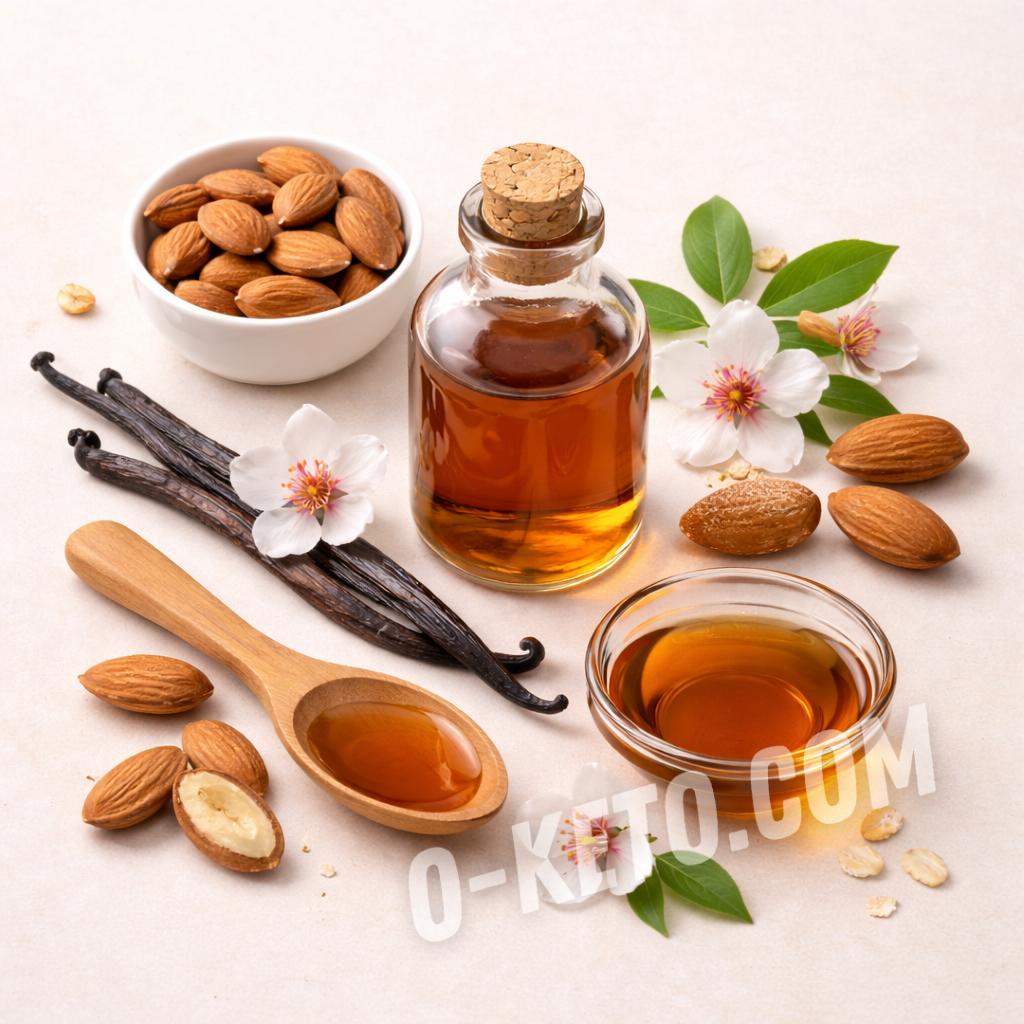

Almond flavoring — a concentrated flavor and aroma additive widely used in cooking, confectionery production, and the food industry. Its characteristic sweet-nutty profile enhances the taste of dishes without adding the nuts themselves, making the flavoring a technologically convenient and economical ingredient. Historically, almond aroma has been associated with desserts, baked goods, and liqueurs, but today its application is significantly broader.
There are two main types of almond flavoring — natural and synthetic. They differ in origin, depth of aroma, and potential limitations in use. Understanding these differences allows for a more informed choice of product and correct application in recipes, maintaining flavor balance and safety requirements.
Composition and Properties
Almond flavoring is a mixture of aromatic compounds that create the characteristic scent of bitter and sweet almonds. The key substance defining the aromatic profile is benzaldehyde. It is this compound that creates the recognizable “almond” note familiar from marzipan and amaretto.
Depending on the production technology, the composition may include:
- benzaldehyde as the main aromatic base;
- terpenes and auxiliary aromatic compounds;
- an alcoholic or aqueous-glycerin base;
- stabilizers and aroma carriers.
Natural almond flavoring is obtained from almond raw materials or apricot kernels, while synthetic flavoring is produced through chemical synthesis of structurally identical molecules.
Natural variants usually have a more complex and softer aroma, while synthetic ones are characterized by stability and pronounced scent.
Application in Cooking
Almond flavoring is used in minimal dosages due to its high concentration. It allows for flavor formation without altering the texture or nutritional value of the dish.
The most common areas of application include:
- baking, including cookies, cakes, and pies;
- creams, glazes, and fillings;
- mousses and cold desserts;
- beverages, including coffee, cocktails, and liqueurs.
In savory dishes, almond flavoring is used less frequently but can be added to sauces or marinades to create complex flavor accents. It is important to adhere to dosage, as excess flavoring can impart a sharp or bitter taste to the dish.
Benefits and Technological Advantages
The main advantage of almond flavoring lies in its ability to enhance flavor perception without adding sugar, nuts, or extra calories. This makes it a convenient tool in dietary and low-carb cooking.
From a technological standpoint, the flavoring:
- provides a consistent taste from batch to batch;
- helps reduce the cost of recipes;
- does not affect the macronutrient composition of the dish;
- is suitable for use in thermally processed products.
For people limiting sugar intake or following keto-oriented diets, almond flavoring can be used as a way to enhance the sweet perception of dishes without actually increasing carbohydrates.
Possible Risks and Limitations
Despite its wide application, almond flavoring requires careful handling. Some products may contain synthetic additives, sweeteners, or preservatives that are not always suitable for sensitive individuals.
The main potential risks include:
- allergic reactions in people with nut sensitivity;
- irritation of mucous membranes when exceeding dosage;
- undesirable additives in budget flavorings.
Although benzaldehyde in its purified form does not contain nut protein, production impurities or cross-contamination may pose a risk for individuals with severe allergies.
Usage Recommendations
Almond flavoring should be used in a strictly measured manner. Usually, a few drops are sufficient for the entire volume of the dish. It is recommended to first add a minimal amount and then adjust the flavor as needed.
When choosing a flavoring, pay attention to the composition, type of base, and absence of added sugars. A quality product allows for a clean almond profile without foreign chemical notes.


