


Mastopathy
Mastopathy usually refers to benign changes in the breast tissue, which often result in swelling, cyclical tenderness, and a feeling of graininess or lumps. The term itself does not negate the need for examination: similar complaints must be distinguished from cysts, mastitis, and more serious causes of changes in the breast.


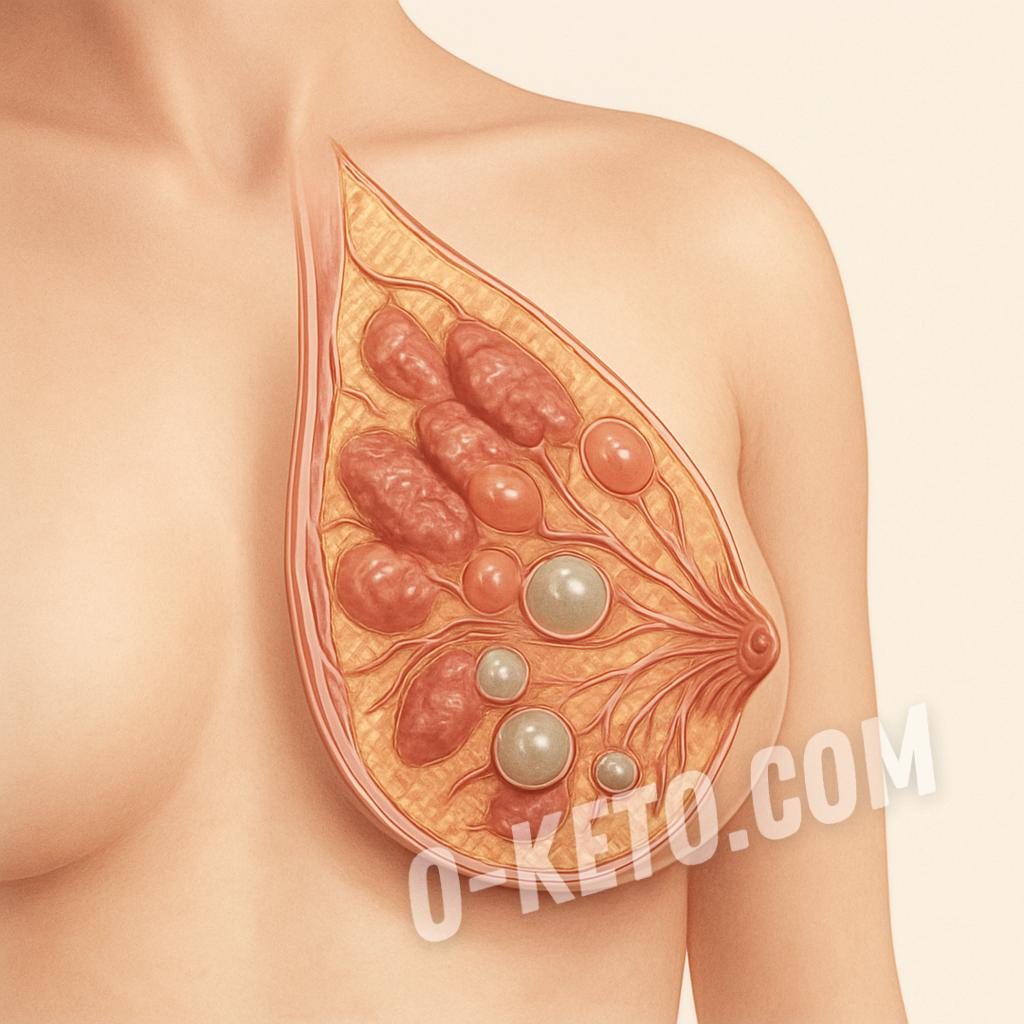
Mastopathy in Russian-speaking practice often refers to a group of benign changes in breast tissue, characterized by swelling, cyclical tenderness, a feeling of unevenness, graininess, or individual lumps. In modern clinical language, this term is not always used with the same strictness: it often implies fibrocystic changes associated with the structural features of glandular and connective tissue, sensitivity to hormonal fluctuations, and local edema at different phases of the cycle.
For a woman, the most important thing here is not only to hear a familiar word but also to understand its limits. Mastopathy does not mean cancer, but it should not be used as a universal soothing label for any complaint regarding the breast. Similar sensations may hide ordinary cyclical mastalgia, cysts, trauma consequences, inflammation, lactational changes, and situations that require more careful examination. Therefore, the main goal of this article is to explain what is usually meant by mastopathy, why symptoms often intensify before menstruation, and in which cases the concept itself is no longer sufficient without in-person diagnosis.
What usually lies behind this diagnosis
Most often, it refers to benign restructuring of breast tissue, where the ratio of glandular component, stroma, and fluid in small cavities changes. In practice, this may be accompanied by a feeling that the breast has become denser, lumpier, tenser, or more painful to the touch. For some women, symptoms are minimally expressed and are only detected during examination or ultrasound, while for others, pain, swelling, and sensitivity become the main reasons for seeking help.
The breast tissue itself is very sensitive to hormonal background, especially to cyclical fluctuations of estrogens, progesterone, prolactin, and local tissue factors. Therefore, many complaints become more noticeable in the second phase of the cycle when the breast seems to swell and reacts more strongly even to ordinary touch. After menstruation, symptoms may decrease. This cyclicity often suggests to the doctor that it is more likely benign hormone-dependent changes rather than an incidental inflammatory or tumor process.
What complaints are most common
The most typical complaints are a feeling of fullness, heaviness, tenderness, a sensation of swelling, increased sensitivity of the nipples or specific areas of the breast, and a feeling of “lumps” and unevenness of the tissue. Pain can be dull, aching, diffuse, sometimes radiating to the armpit area. Some women experience symptoms only before their period, while others have discomfort that lasts longer and interferes with sleep, workouts, intimate life, or the usual wearing of underwear.
It is important to understand that a subjective feeling of thickening does not always mean the presence of a single clear nodule. Often, a woman palpates not a single ball but a general graininess or denser areas against the background of tissue edema. However, the opposite mistake is also dangerous: not every true nodular formation can be attributed to “ordinary mastopathy.” Therefore, any new, persistent, or asymmetrical finding requires examination, even if the pain appears cyclical.
What influences the severity of symptoms
The intensity of complaints is usually influenced by the phase of the cycle, overall hormonal background, severity of premenstrual syndrome, stress, sleep quality, and individual pain sensitivity. For some women, the breast reacts more strongly during periods of hormonal restructuring: after childbirth, when restoring the cycle, in perimenopause, with weight changes, or against the background of endocrine disorders. Sometimes symptoms become more pronounced when combined with hyperprolactinemia, significant fluid retention, or painful PMS.
A separate topic is the perception of pain. The higher the anxiety and the more often a woman checks the painful area, the stronger the feeling of constant threat can become. This does not mean that the pain is “in the head”; it only means that the neuroendocrine background indeed affects how sensitively the body experiences even benign changes. Therefore, a competent assessment includes not only ultrasound or mammography as indicated but also an analysis of the cycle, accompanying symptoms, and the overall hormonal-metabolic context.
What mastopathy is not
Mastopathy does not automatically equal a cancerous disease, but it also does not exempt one from diagnosis if the picture is atypical. The term should not replace a complete description: diffuse changes, cysts, local nodules, ductal features, inflammation, and other findings have different clinical meanings. The words “you have mastopathy” are only useful when they are backed by a clear interpretation and a monitoring plan, not an attempt to end the conversation without explanations.
Additionally, mastopathy does not mean that breast pain is necessarily caused by the structure of the gland. Sometimes, pronounced discomfort originates from the chest muscles, costal cartilages, cervical-thoracic spine, or even from overly tight underwear. Therefore, it is important for the doctor to distinguish true mastalgia of the breast from pain that is only felt “in the breast” but anatomically related to another area.
When to seek examination sooner
It is advisable to consult a doctor sooner in cases where a new dense formation appears that does not disappear after menstruation, especially if it is unilateral and clearly localized. Reasons for a quicker examination also include skin or nipple retraction, bloody discharge from the nipple, persistent localized redness, rapidly increasing asymmetry, pronounced swelling unrelated to lactation, and any change that noticeably progresses.
If the pain is not cyclical, does not depend on the phase of the cycle, and persists in one spot for a long time, this also requires separate evaluation. In perimenopause and after menopause, new symptoms regarding the breast are assessed especially carefully. During lactation, similar complaints often need to be distinguished from lactostasis and mastitis, as the tactics in these situations will be different.
How mastopathy is usually interpreted in practice
In practice, the doctor correlates complaints, age, phase of the cycle, examination results, and imaging data. In younger women, ultrasound is often prioritized, while in older women or based on specific indications, mammography and other methods are added. The purpose of the diagnosis is not just to “confirm mastopathy” but to understand whether there are ordinary benign changes or something that requires a different routing.
If the picture truly corresponds to benign diffuse changes, further tactics are usually built around observation, symptom control, and working with factors that exacerbate discomfort. However, even in this case, a woman should understand which signs are habitual cyclical for her and which are new and require a follow-up visit. Such understanding reduces both anxiety and the risk of missing a truly important change.
What is important to remember without self-treatment
Mastopathy is not a situation where one should independently draw conclusions based solely on finger sensations or one old ultrasound. Even if benign changes were previously mentioned, new symptoms should be reassessed. Both excessive panic and the other extreme—years of ignoring thickening under the formula “this is my ordinary mastopathy”—are dangerous.
The most reasonable approach is to observe the pattern of symptoms, note their connection with the cycle, avoid traumatizing the breast with constant rough palpation, and timely undergo examination if complaints change. This approach helps distinguish benign hormone-dependent changes from conditions that can no longer be left without more precise diagnosis.
If you have any questions about the term "Mastopathy", you can ask them to AI. Please note, a low-cost OpenAI model is used. It may answer questions about disease treatment with errors!


