When someone may have a broken bone, people often react in the same unhelpful ways: they try to lift the person quickly, test whether the arm or leg still works, straighten the limb, or rush them somewhere by force. In real first aid, that kind of urgency can easily worsen the injury. With a suspected fracture, the safest early approach is built on a simpler idea: less movement, more support, and no heroic attempts to fix the bone on the spot.
Even when the fracture is closed and no bone is visible, there may already be displacement, swelling, bleeding into the tissues, and damage to nerves, muscles, or blood vessels. Rough handling in the name of “checking how bad it is” can make pain worse and turn a manageable injury into a much more complicated one. That is why first aid for a suspected fracture is not field diagnosis or home reduction. It is protection of the injured area until proper assessment and safe transport are available.
When to suspect a fracture
A fracture is not the only possible injury after a fall or blow, but some clues make it much more likely. Strong pain after trauma, a visible deformity, an unnatural limb position, fast swelling, inability to use the arm normally, or inability to bear weight on the leg are all warning signs. A person may still be able to move fingers or toes a little, or even take a few careful steps, and still have a fracture.
Extra concern is needed when there is an open wound near the injury, visible bone, numbness, tingling, pale fingers or toes, bluish discoloration, or obvious loss of function below the injured area. These signs raise concern not only for a broken bone but also for disrupted circulation or nerve injury. In that situation, minimizing movement and getting medical care matter even more.
What to do in the first minutes
Start by checking safety. If the injury happened on a road, staircase, near machinery, broken glass, fire, or another hazard, address the immediate danger first. If the scene is safe, the person should be encouraged not to move. In a painful situation, it is usually more useful to reassure them, ask them to stay still, and support the injured area than to rush into transportation.
If the pain is severe, the limb looks abnormal, the person cannot get up safely, or there is concern about the spine, pelvis, neck, or head, emergency services should be called early. Clear early information for the dispatcher is usually more helpful than several confused attempts to manage everything without help. If others are nearby, one person can call while another stays with the injured person and stabilizes the area.
Immobilization means support, not forced straightening
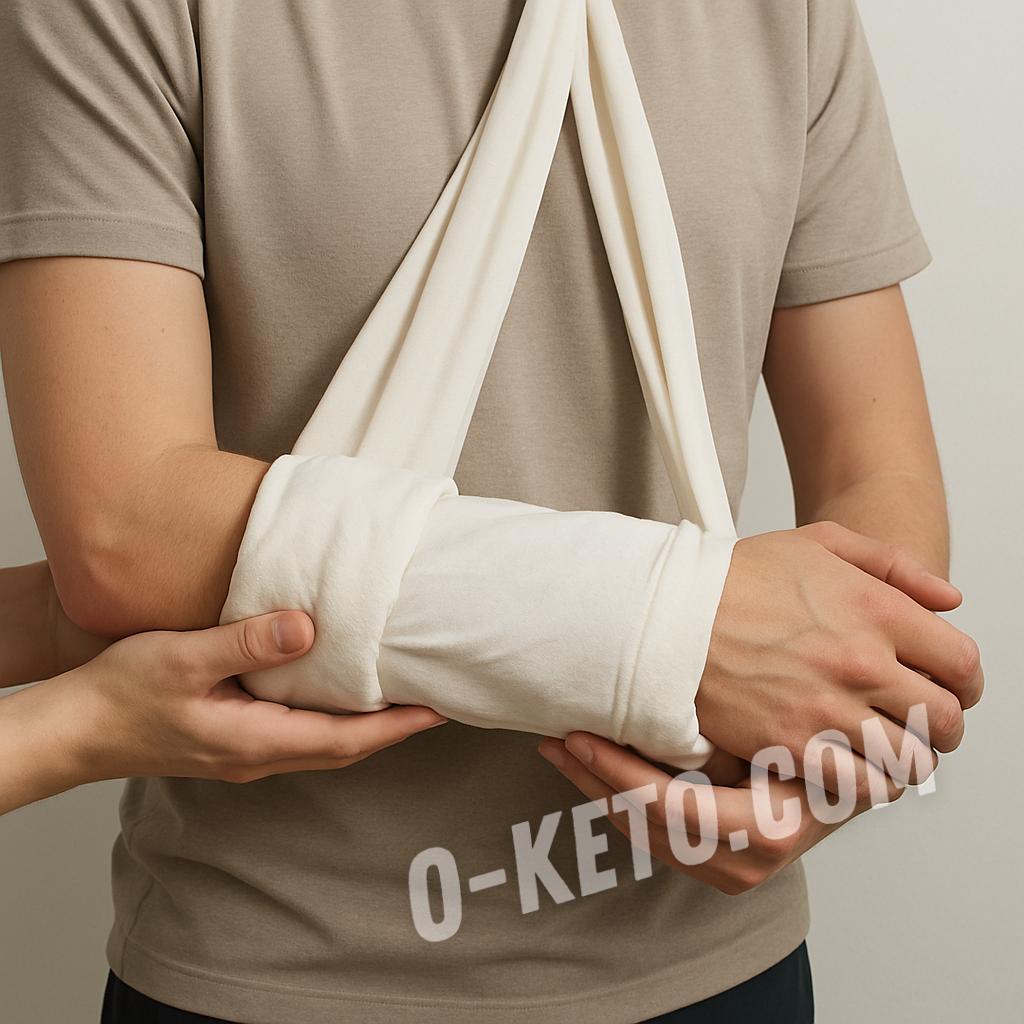
The purpose of immobilization is to reduce movement and limit pain and further damage. It is not to make the limb look perfect. If the arm or leg has settled into a position that the injured person is guarding because it hurts less, that position is usually respected. Pulling, twisting, or forcefully straightening the limb is not first aid.
The simplest support may be the person’s own hand, a folded sweater, a towel, a pillow, a scarf, or an improvised sling. If help will be delayed and the rescuer actually knows how to do it, a simple padded splint can be used to support the joints above and below the likely fracture. But even then, gentle stability matters more than a neat-looking device.
For an injured arm, a sling for the forearm and sometimes an extra soft wrap securing the arm to the torso may be enough. For a leg injury, soft padding can help keep the limb still, and in some cases the injured leg can be supported next to the uninjured leg if this does not require painful force. Any immobilization should reduce suffering, not become a wrestling match with the body.
What not to do
The most dangerous mistake is trying to “set” the bone. That is not a home procedure. It can increase bleeding, worsen displacement, injure nerves, and turn a closed injury into something much more severe. It is also a mistake to ask the person to move the limb through strong pain just to see what still works. If testing movement hurts badly, that test is no longer useful first aid.
Another mistake is wrapping splints or supports so tightly that circulation is compromised. After immobilization, it is sensible to look at the fingers or toes below the injury and notice whether they become colder, paler, bluer, more numb, or more painful. It is also a mistake to let a person walk simply because they are technically able to do so. A few painful steps can sometimes worsen a serious injury significantly.
What to do with an open fracture
If there is a wound and bone is visible or deep tissues are exposed, the situation is more urgent. Do not try to push the bone back in. If there is bleeding, control it as carefully as possible with a clean dressing placed around the wound rather than pressing directly on the protruding bone. Cover the area with a clean material and arrange urgent medical care.
Open fractures are risky not only because of pain and displacement but also because of infection. This is exactly the kind of injury where improvised “correction” at home can do serious harm. The useful priorities are to minimize movement, protect the wound, watch the person’s general condition, and avoid wasting time before professional treatment.
When the person should not simply be moved
If there is concern about injury to the neck, back, pelvis, or a major trauma after a fall from height, road crash, blow to the head, or loss of consciousness, the person should not be moved unless it is truly necessary. Warning signs include strong neck or back pain, unusual weakness, loss of feeling, inability to move normally, confusion, or not remembering what happened. In such cases, a rushed lift and carry can be more dangerous than waiting.
The clear exception is immediate danger, such as fire, traffic, collapse, or another life-threatening hazard at the scene. Then movement may be necessary to save the person, but even then the goal is to move only as much as needed and to avoid twisting the body if possible. If the scene is safe, waiting for trained help is usually better than dragging the person to a “more comfortable” place.
How to move and transport someone if it is truly needed
If transport cannot be avoided, the same principle still applies: minimize unnecessary motion. If the injury is mainly to the arm and the person is otherwise stable, they may sometimes walk with the arm well supported and pain tolerable. But if there is a suspected leg fracture, pelvic injury, or major trauma, asking the person to walk is often a poor choice. Several helpers, a stretcher, or a rigid surface are safer when available.
Before moving, it helps to assign roles. If several people are helping, one person should coordinate the lift so that everyone moves together rather than pulling in different directions. The injured area should be supported above and below the suspected break so it does not swing freely. Fast turns, jerks, and attempts to sit the person up suddenly are usually worse than a slow coordinated move.
What to keep watching before medical help arrives
After immobilization and the emergency call, much of the job is quiet observation. Watch the pain level, the color and warmth of fingers or toes below the injury, and the person’s general condition. Look for worsening weakness, pallor, sweating, confusion, or increasing pain. If the person is cold, cover them. If a support seems too tight and the fingers or toes change color or sensation, the support may need to be loosened carefully while preserving overall stability.
Calm reassurance also matters. People with fractures often try to move because they are embarrassed, frightened, or trying not to inconvenience others. A simple explanation that staying still now may prevent a worse injury later can be surprisingly protective.
Takeaway
First aid for a suspected fracture is mainly about gentle stability, not testing or fixing the injury on the spot. Support the injured area in the position that causes the least pain, use soft padding, a sling, or a simple splint, and do not try to realign the bone. In an open fracture, cover the wound and do not push exposed bone back inside.
Transport also needs caution. If neck, back, head, or pelvic injury is possible, avoid moving the person unless there is immediate danger. If movement is necessary, do it slowly, with coordination, and with steady support of the injured area. The most harmful mistakes are forced straightening, painful movement testing, overly tight fixation, and hurried rough transport.
Sources
- 2024 American Heart Association and American Red Cross Guidelines for First Aid
- First Aid Guidelines — Resuscitation Council UK 2025
- First Aid for Fractures — 2024 American Heart Association and American Red Cross Guidelines
- First Aid for Severe External Bleeding — 2024 American Heart Association and American Red Cross Guidelines
- Advanced Trauma Life Support (ATLS): Student Course Manual — American College of Surgeons