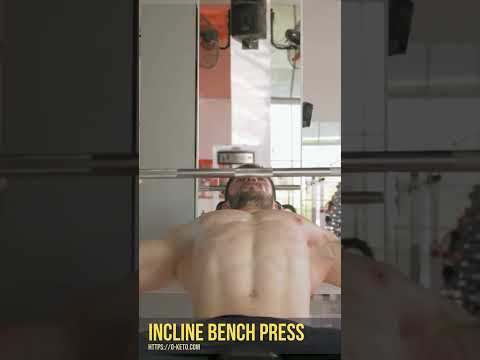
The barbell bench press on an incline bench is a variation of the classic press that targets the upper part of the chest muscles. This exercise helps to develop a fuller and more defined chest, while also actively engaging the shoulders and triceps.
This press is performed at an angle of 30 to 45 degrees, which allows for a redistribution of load to the upper part of the chest muscles, leaving the central part under less stress.
At 30°:
- the main load is placed on the upper part of the chest muscles;
- minimal involvement of the anterior deltoid muscles.
At 45°:
- increased load on the anterior deltoid muscles (shoulders);
- the upper part of the chest is still actively working, but to a lesser extent than at 30°;
- may place more strain on the shoulder joints, which is not always comfortable.
This exercise is considered one of the most effective for developing a strong and voluminous upper body.
Muscles Engaged in the Incline Bench Press
- Upper pectoral muscle (clavicular part): the main focus of the exercise.
- Anterior deltoid muscles: assist in the lifting of the barbell.
- Triceps: involved in elbow extension.
- Core (abs and lower back): maintain body stability during execution.
Execution Technique

Preparation:
- Set the angle of the bench (ideally 30 degrees, maximum — 45 degrees).
- Lie on the bench so that the barbell is directly above your eyes.
- Place your feet on the ground for stability.
- Grip the barbell with your hands slightly wider than shoulder-width (if there are markings on the barbell, your pinky fingers should be at the markings).
Removing the Barbell:
- Lift the barbell off the racks, keeping it on straight arms above your chest.
Lowering:
- Slowly lower the barbell to the upper part of your chest (5–8 cm below the collarbone).
- Your elbows should be at an angle of about 75–85° to your body.
Pressing Up:
- With effort, press the barbell upwards without fully extending your elbows.
- Control the movement, avoiding abrupt jerks.
Completion:
- After completing all repetitions, carefully return the barbell to the racks.
Advantages
- Focus on the upper chest: helps create balanced and defined chest muscles.
- Development of the shoulder girdle: active engagement of the anterior delts improves shoulder strength and volume.
- Versatility: suitable for strength training, bodybuilding, and fitness.
- Improvement of functional strength: beneficial for many sports that require upper body strength.
Common Mistakes and How to Avoid Them
Too high an angle of incline: an angle greater than 45° shifts the load to the shoulders, reducing effectiveness.
Set the angle to 30–45°.
Lowering the barbell to the neck: this increases the risk of injury.
Lower the barbell to the upper part of the chest, but not too high.
Weak leg fixation: an unstable position reduces strength.
Place your feet firmly on the ground for maximum support.
Excessive weight: heavy weights often lead to poor technique.
Work with a comfortable weight and gradually increase it.
Jerking and loss of control: this can lead to injuries.
Control each phase of the movement.
Tips for Beginners
Start with a light weight: master the technique before increasing the load.
Work with a partner or spotter: this is important for safe training.
Don’t forget to warm up: prepare your shoulder and elbow joints for the load.
Variations of the Incline Bench Press
Dumbbell bench press on an incline: provides a more natural range of motion, allowing each arm to be worked separately.
Smith machine incline press: suitable for beginners and those who want to focus on isolated muscle work.
Barbell press with different grips: a narrow grip increases the load on the triceps. A wide grip emphasizes the chest.
Sources
- Influence of bench angle on upper extremity muscular activation during bench press exercise
- Effect of Five Bench Inclinations on the Electromyographic Activity of the Pectoralis Major, Anterior Deltoid, and Triceps Brachii during the Bench Press Exercise
- An electromyography analysis of 3 muscles surrounding the shoulder joint during the performance of a chest press exercise at several angles
- Resistance training and health in adults: an overview of systematic reviews