


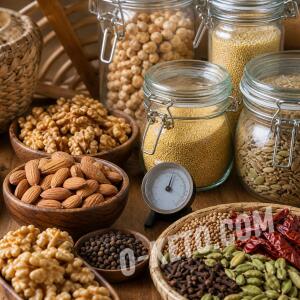
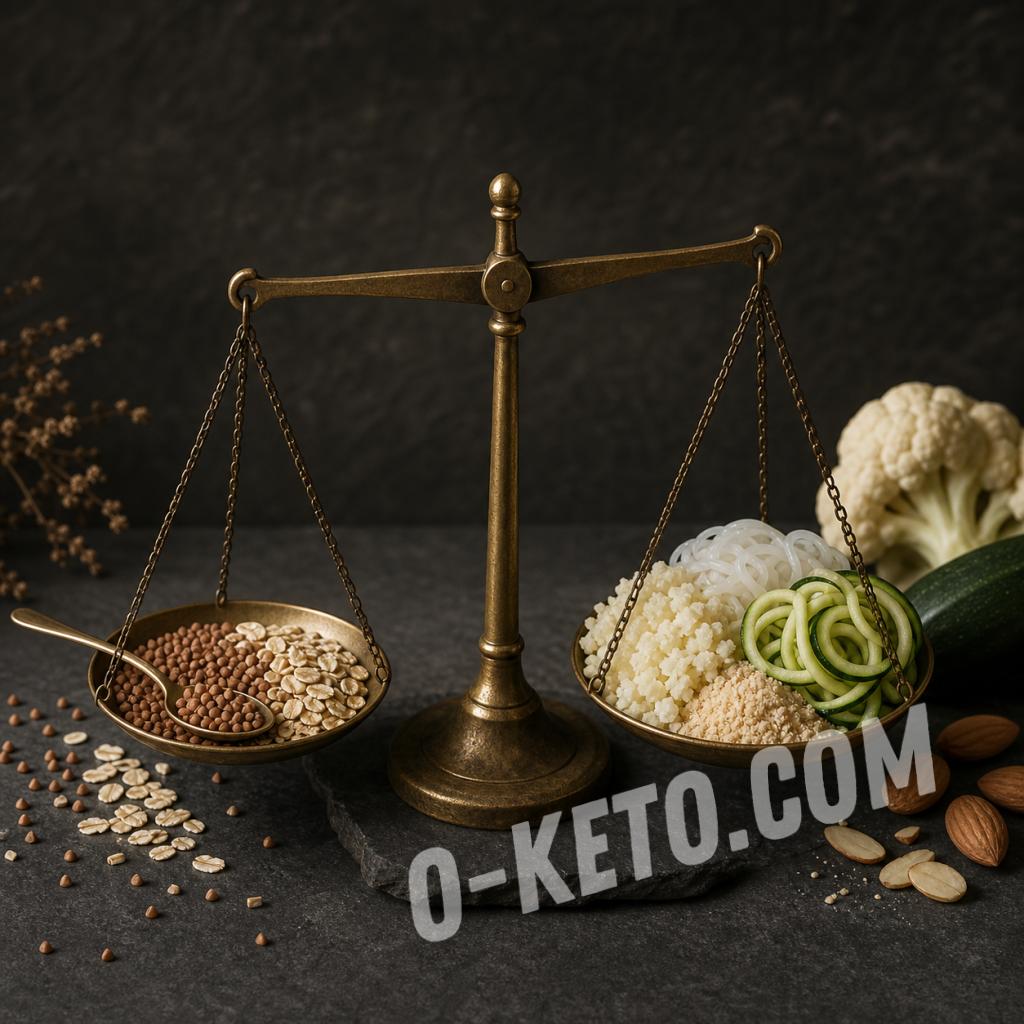

Cereals are often treated as a neutral foundation of healthy eating: they are served with meat, fish and vegetables or used instead of bread. On a ketogenic diet, however, the important question is not whether a food has a healthy reputation, but how many digestible carbohydrates a real portion contains. Oats, buckwheat, millet, corn, rice and wheat can be nutritious foods, yet an ordinary serving of most of them can use a large part of a strict daily carbohydrate limit.
That is why the question “can you eat grains on keto?” cannot be answered with one universal list. A strict ketogenic diet, a more moderate LCHF plan and an individual lower-carbohydrate diet are not the same. A normal bowl of porridge usually does not fit strict keto, while a small weighed portion may occasionally fit a less restrictive plan. The decision depends on the form of the food, the amount, the rest of the meal and the purpose of the diet.
Why cereals rarely fit strict keto
Dry grains concentrate starch. Cooking adds water and increases their weight, but it does not remove the carbohydrate from the original portion. A bowl of porridge can therefore look light while still containing a substantial carbohydrate load. Portion control becomes even harder when the grain is turned into flour, instant flakes, crackers, granola or sweet porridge.
Processing also matters. The more a grain is milled and gelatinized, the less its physical structure slows access to starch. A systematic review of oats found lower glycaemic responses for steel-cut and large-flake oats than for quick-cooking and instant oats. This does not make oats keto-friendly, but it explains why different forms of the same grain should not be treated as identical.
The practical conclusion is that processing can change the speed of digestion, but it does not remove the grain’s starchy base. On strict keto, an ordinary bowl of porridge therefore does not fit even when the least processed form is chosen.
Which grains usually do not fit strict keto
Oats, millet, buckwheat, corn, barley, rice and wheat-based cereals contain too much starch for a typical strict-keto serving. Buckwheat and millet do not become low-carb foods merely because they are gluten-free, and brown or black rice remains a starchy grain even when its outer layers are preserved. Corn also comes in very different forms: fresh kernels, meal, starch, flakes and syrup. They differ in texture and use, but most remain carbohydrate-dense.
Arguments for grains often focus on fibre, minerals, polyphenols or oat beta-glucan. These properties may be useful in a suitable dietary pattern, but they do not cancel the carbohydrate content. Beta-glucan is a viscous soluble fibre whose effect depends on dose, food form and the complete meal. It should not be presented as a promise to normalize glucose or treat a metabolic disease.
In short, oats, millet, buckwheat, corn, barley, rice and wheat cereals usually do not fit strict keto. Fibre and useful compounds may support their place in another dietary pattern, but they do not make these foods a low-carb foundation.
When a small portion may be possible
On a moderate LCHF plan, a grain may be used occasionally if the person has defined a carbohydrate limit and weighs the dry portion. A small measured amount is very different from a deep bowl of porridge. It is usually more practical to combine it with meat, fish, eggs, cheese, butter and non-starchy vegetables so that the meal is not mostly carbohydrate.
This approach is not suitable for everyone. With diabetes, marked insulin resistance, poor appetite control or a therapeutic ketogenic protocol, carbohydrate portions should be discussed with a clinician or qualified diet professional. A personal experiment with a “healthy” cereal should not replace glucose monitoring or prescribed treatment.
The conclusion is that a small cereal portion belongs only in a calculated, less restrictive plan and is not a universal keto recommendation. If stable ketosis or therapeutic carbohydrate control is the goal, cereal sides should generally be avoided unless individually calculated.
Low-carb alternatives to a cereal side dish
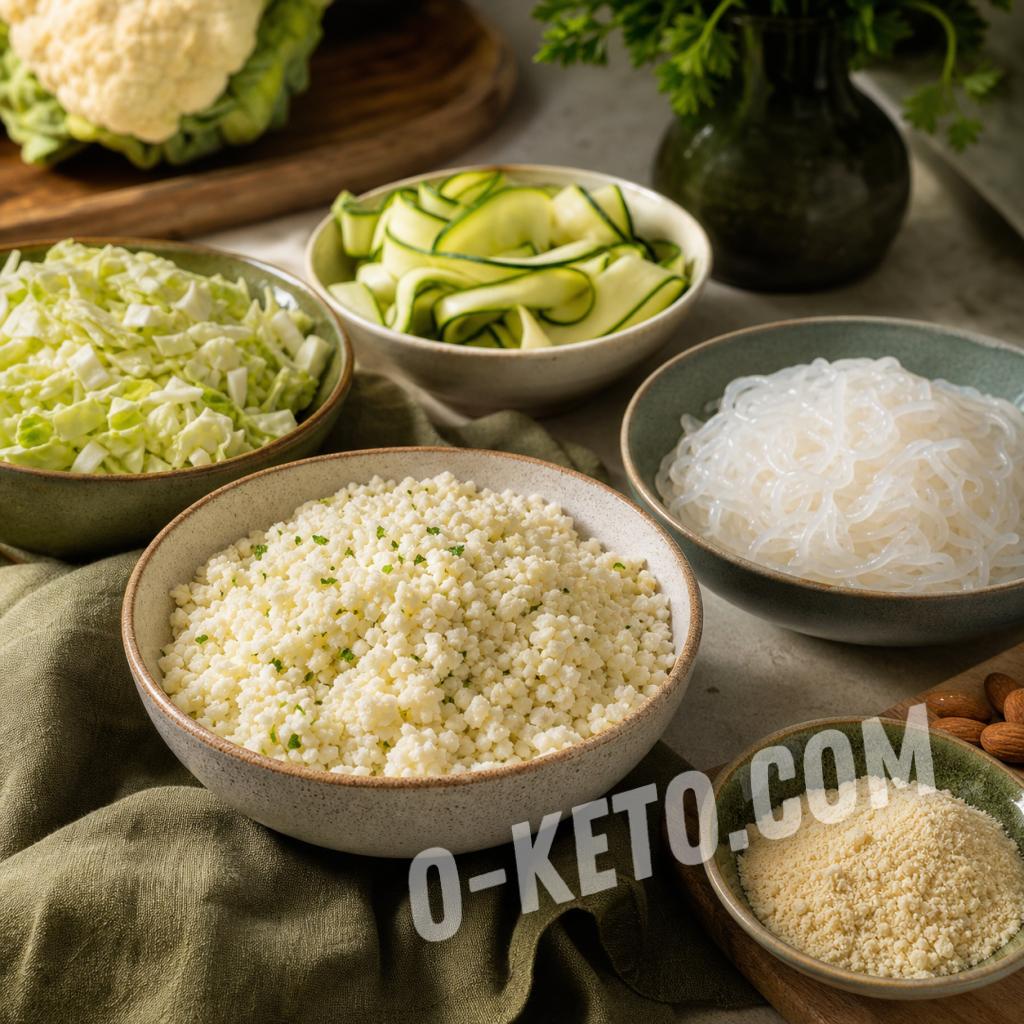
The best substitute depends on the role the grain played in the dish. For volume and a neutral side dish, use cauliflower rice, finely chopped cabbage, broccoli or zucchini. They can be sautéed in fat, steamed or combined with meat, eggs and cheese. The result still feels like a complete plate, but usually contains far fewer digestible carbohydrates than rice or porridge.
Shirataki or konjac rice can work in soups and saucy dishes when its texture is acceptable and the product is rinsed well. For baking, grains cannot simply be replaced with one flour: almond and coconut flours absorb liquid differently, while flax meal and psyllium change the structure of dough. The whole recipe usually needs adjustment.
For a slightly grain-like texture, small amounts of seeds, chopped nuts or hemp hearts may be useful. They are still energy-dense, so replacing a cereal does not create an unlimited portion. Both carbohydrate content and the overall energy density of the meal matter.
The best substitute therefore depends on the dish, but the principle is consistent: preserve volume and texture with non-starchy vegetables or shirataki rather than recreating cereal with flour and starch. This keeps the meal substantial without using most of the carbohydrate allowance.
How to choose a cereal outside strict keto
Start with the form: whole groats, flakes, flour, starch, a ready-made mix or a sweet product with syrup. Then check the dry weight and carbohydrate content rather than only the cooked volume. Instant porridge, granola, cereal bars and baked goods often contain added sugars, starches and dried fruit, so they should not automatically be treated like an intact grain.
Gluten-free eating also requires attention to labeling. Buckwheat, corn, rice and millet are not wheat, but cross-contact can occur during farming, transport, milling and packaging. Oats do not contain wheat gluten, yet people with celiac disease may need certified gluten-free oats and individual assessment of tolerance to avenin.
Conclusion
On strict keto, ordinary cereals are usually a poor foundation: oats, buckwheat, millet, corn, rice and wheat products can raise carbohydrate intake quickly. Gluten-free status, an intact outer layer or added fibre does not change that basic calculation. For a side dish, cauliflower, broccoli, zucchini, cabbage, shirataki and measured seeds are usually more practical, while cereals belong in rare, calculated portions of a less restrictive plan.
Sources
- Systematic review of the effect of processing of whole-grain oat cereals on glycaemic response;
- The molecular weight, solubility and viscosity of oat beta-glucan affect human glycemic response by modifying starch digestibility;
- Buckwheat phenolic metabolites in health and disease;
- A Systematic Review and Meta-Analysis of the Potential of Millets for Managing and Reducing the Risk of Developing Diabetes Mellitus;
- Beta-glucans from oats or barley and reduction of postprandial glycaemic responses: EFSA scientific opinion.


