How long food keeps depends on more than its name. Temperature, packaging, freshness at purchase, whether the package was opened or the food was cooked, and how long it stayed outside the refrigerator all matter. A storage table is therefore not a mechanical countdown. It is a quick way to decide what can be kept, what should be frozen, and what is safer to discard.
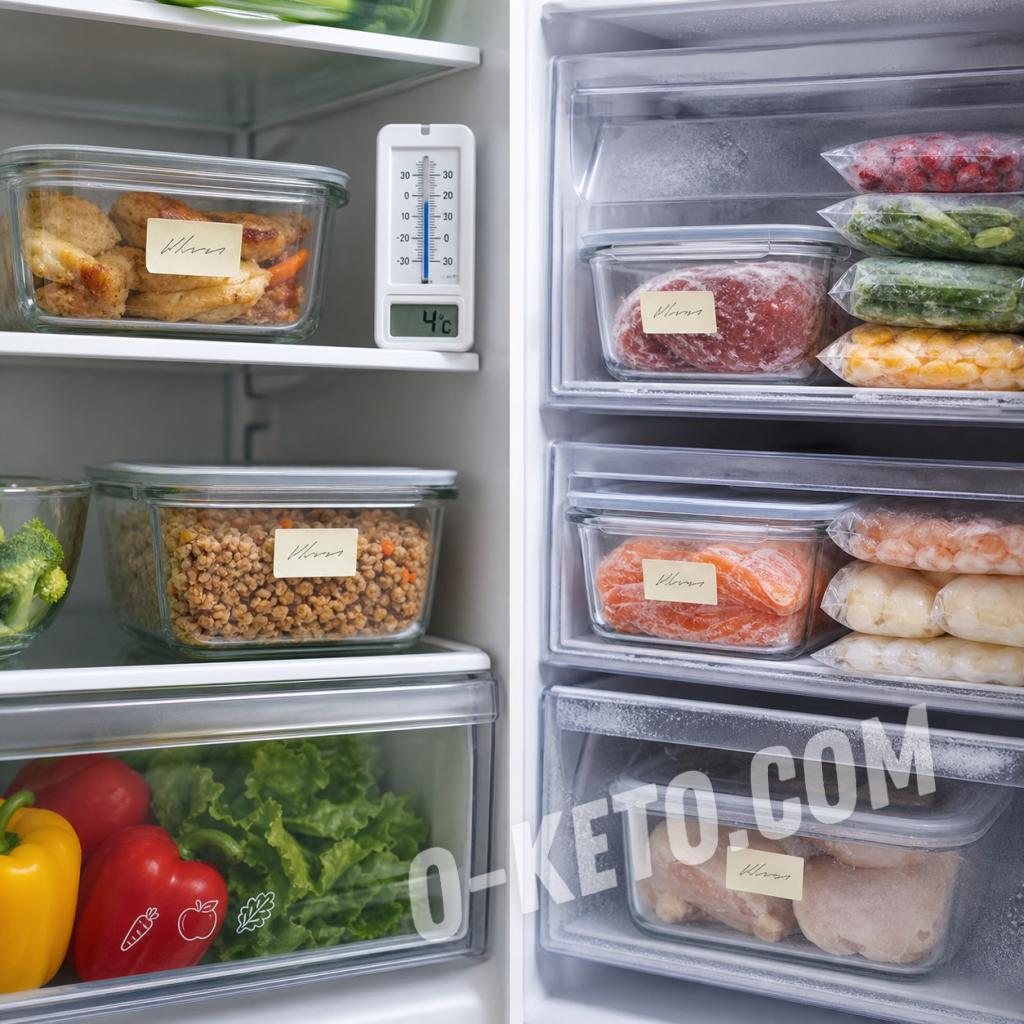
The home guidelines below assume a refrigerator at 4 °C (40 °F) or colder and a freezer at about −18 °C (0 °F). Freezer times mainly describe quality. Food kept continuously at −18 °C can remain safe longer, but taste, texture, and aroma gradually decline. If the package gives different storage instructions, follow the manufacturer’s directions.
How to read storage times
The same food can have different limits in different states. A whole raw chicken, cut pieces, cooked meat, and an opened can are not the same storage situation. Always read the row together with the condition of the food.
Refrigerator times assume that the food stayed cold throughout. If it sat on the counter, travelled without sufficient cooling, or was kept in a refrigerator that became too warm, the table cannot guarantee safety. Freezing does not reset the clock: putting food into the freezer cannot make food safe after it has already spent too long in warm conditions.
Meat, poultry, seafood, and eggs
Keep raw animal foods in sealed containers on the lowest shelf so their juices cannot reach ready-to-eat food. If meat, poultry, or seafood will not be cooked soon, freeze it soon after purchase instead of waiting until the refrigerator limit is nearly over.
| Food | Refrigerator at 4 °C or colder | Freezer at −18 °C: best quality |
|---|---|---|
| Fresh beef, veal, pork, or lamb: steaks, chops, and roasts | 3–5 days | 4–12 months |
| Ground meat | 1–2 days | 3–4 months |
| Whole raw chicken or turkey | 1–2 days | up to 12 months |
| Chicken or turkey pieces | 1–2 days | up to 9 months |
| Fresh fish and shellfish | 1–2 days | usually 3–6 months, depending on the species and packaging |
| Opened canned meat, poultry, or fish | 3–4 days | follow the product and packaging instructions |
| Raw shell eggs | 3–5 weeks | do not freeze in the shell |
| Raw egg whites and yolks out of the shell | 2–4 days | whites can be frozen for about a year; yolks need separate preparation |
| Hard-cooked eggs | up to 1 week | freezing is not recommended because texture suffers |
Ground meat and fresh fish have especially short refrigerator limits because moisture and a larger exposed surface can accelerate quality loss. If a package is swollen, leaking, or clearly abnormal, do not try to extend its life by freezing or prolonged cooking.
Dairy products and cheese
The date on the package belongs to that specific product and its production conditions, so a general table cannot replace the label. Once opened, milk, yogurt, sour cream, and fresh cheeses deteriorate faster, especially when they are repeatedly left on the counter or eaten directly from a shared container.
| Food | Refrigerator guideline | Freezing |
|---|---|---|
| Milk | usually up to 5–7 days after opening, unless the label says otherwise | about 3 months for quality |
| Yogurt | about 1–2 weeks, considering the date and package condition | 1–2 months; texture may change |
| Sour cream | about 1–2 weeks | often damages the texture |
| Cottage cheese and ricotta | about 1 week after opening; unopened product follows its label | usually avoid unless the texture change is acceptable |
| Hard cheese | 3–4 weeks after opening; unopened cheese follows its packaging | up to 6 months for quality |
| Butter | about 1–2 months | 6–9 months for quality |
Mold on soft cheese, cottage cheese, sour cream, or yogurt is not a situation where simply removing the top layer is enough. Moist soft foods can be contaminated below the visible surface, so discarding the whole package is safer. Hard cheeses may have different handling rules, but when in doubt, do not save a small remainder at the expense of safety.
Fruits, vegetables, and berries
For produce, storage times often describe quality rather than a sharp safety boundary. Ripeness, moisture, damage, and packaging can matter more than the category name. Berries, leafy greens, and cut vegetables require more attention and usually keep for much less time than whole firm produce.
| Food | Refrigerator | Freezer |
|---|---|---|
| Apples | about 4–6 weeks | up to 8 months for quality |
| Citrus fruit | about 10–21 days | 4–6 months, preferably as segments or juice |
| Grapes | about 1 week | about 1 month for quality |
| Berries, including strawberries and blueberries | usually 2–7 days; discard damaged berries promptly | 8–12 months after proper preparation |
| Peaches, nectarines, plums, and pears | 3–5 days after ripening | 8–12 months for quality |
| Broccoli, cauliflower, and Brussels sprouts | 3–5 days | 10–12 months after suitable preparation |
| Cabbage, carrots, and celery | about 1–3 weeks | 10–12 months for quality |
| Spinach and leaf lettuce | 3–7 days | usually lose texture; freeze mainly for cooking |
| Tomatoes, cucumbers, onions, and potatoes | depends on ripeness and conditions; some keep better outside the refrigerator | usually after preparation or in cooked form |
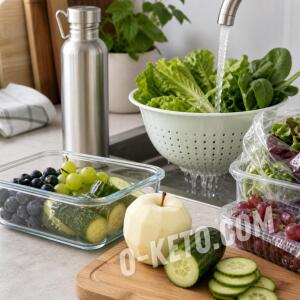
Do not wash berries, herbs, or vegetables long before storage unless you can dry them thoroughly. Extra moisture speeds mold growth. Keep damaged produce separate from intact items, and do not leave soft berries in the same package as firm ones.
Cooked food, soups, and homemade preparations
Cooked food should be moved into the refrigerator promptly, but it does not need to sit on the counter until completely cold. Divide a large pot into small, shallow containers so heat can escape faster instead of leaving the whole mass warm for hours.
| Prepared food | Refrigerator | Freezer: best quality |
|---|---|---|
| Cooked meat or poultry | 3–4 days | 2–6 months, depending on the dish |
| Egg casseroles | 3–4 days | 2–3 months |
| Vegetable or meat soup | 3–4 days | 2–3 months |
| Meat or bone broth | 3–4 days after rapid cooling | 2–3 months for quality |
| Egg, chicken, ham, tuna, or macaroni salad | 3–4 days | usually freezes poorly |
| Homemade sauce, pesto, or dip | about 2–5 days; depends on ingredients and heating | only when the specific recipe allows it |
| Homemade nut milk | about 2–3 days | usually avoid unless texture has been checked |
Sauerkraut and kimchi can keep for months, but there is no universal number. Acidity, salt, temperature, cleanliness, packaging, and pasteurization all matter. For home fermentation, follow the recipe and assess the product’s condition instead of using the maximum number from a generic chart.
What to do after shopping or cooking
The first hours after purchase or cooking can matter more than the final date in a table. Refrigerate or freeze perishable food as soon as possible. Do not leave meat, seafood, eggs, dairy, or cooked food at room temperature for more than two hours, or more than one hour in a hot room.
Write the opening or cooking date on containers. Keep raw food separate from ready-to-eat food, use sealed packaging, and do not store a large hot pot as one deep mass. If the power goes out, consider how long the refrigerator stayed warm instead of relying only on appearance.
Thaw food in the refrigerator, in cold water that is changed regularly, or in a microwave followed by immediate cooking. Countertop thawing warms the surface faster than the center. Refreezing is acceptable only when the food remained sufficiently cold or still contains ice crystals; quality may decline.
Why smell alone is not enough
Smell, color, and appearance can reveal obvious spoilage, but they cannot prove that food is safe. Pathogenic microorganisms may be present without noticeable changes in taste or smell. Storage time, temperature, and handling history are more reliable than tasting a suspicious product.
Discard food with mold, slime, swollen or leaking packaging, broken seals, an unknown storage history, or signs of repeated thawing. Never taste suspicious canned food. For pregnant people, young children, older adults, and people with weakened immunity, use a more cautious limit and follow cold-storage rules especially strictly.
Conclusion
A storage table is a guide, not permission to keep every food until the last listed day. Identify the food and its condition, then check temperature, time outside the refrigerator, packaging, and opening date. For leftovers, rapid cooling and the 3–4-day rule usually matter most; for raw meat and seafood, the refrigerator window is short; and in the freezer, protection from air matters because the listed months mainly describe quality.
Sources
- Cold Food Storage Chart — FoodSafety.gov
- Are You Storing Food Safely? — U.S. Food and Drug Administration
- Freezing and Food Safety — USDA Food Safety and Inspection Service
- Leftovers and Food Safety — USDA Food Safety and Inspection Service
- Refrigerator Thermometers — U.S. Food and Drug Administration