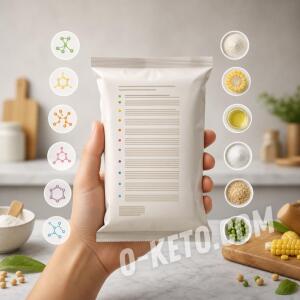


Sugar is not always written on a package as one short word. It can appear as a syrup, a juice concentrate, the name of a specific monosaccharide, or a traditional name such as muscovado or coconut sugar. That is why a front-of-pack phrase such as “no sugar” or “natural” does not replace reading the full ingredient list and the nutrition panel.
At the same time, not every word in a long list actually means added sugar. Maltodextrin, dextrin, maltol, and caramel can have different technological roles. Some provide sweetness or carbohydrates, while others affect texture, aroma, or color. The distinctions below help you notice less obvious sugar names without treating every familiar word as sugar.
Why sugar has different names
A manufacturer must identify the ingredient, but does not always have to use the single word “sugar.” Sweetening may come from sucrose, glucose, fructose, honey, syrups, concentrates, or starch-derived ingredients. Each one can appear under its own name in the ingredient list.
WHO defines free sugars as monosaccharides and disaccharides added by the manufacturer, cook, or consumer, as well as sugars naturally present in honey, syrups, fruit juice, and fruit-juice concentrates. This does not mean that lactose naturally present in ordinary milk or sugar inside a whole fruit is automatically the same as added sugar. The source and form of the food matter.
How to read the ingredient list
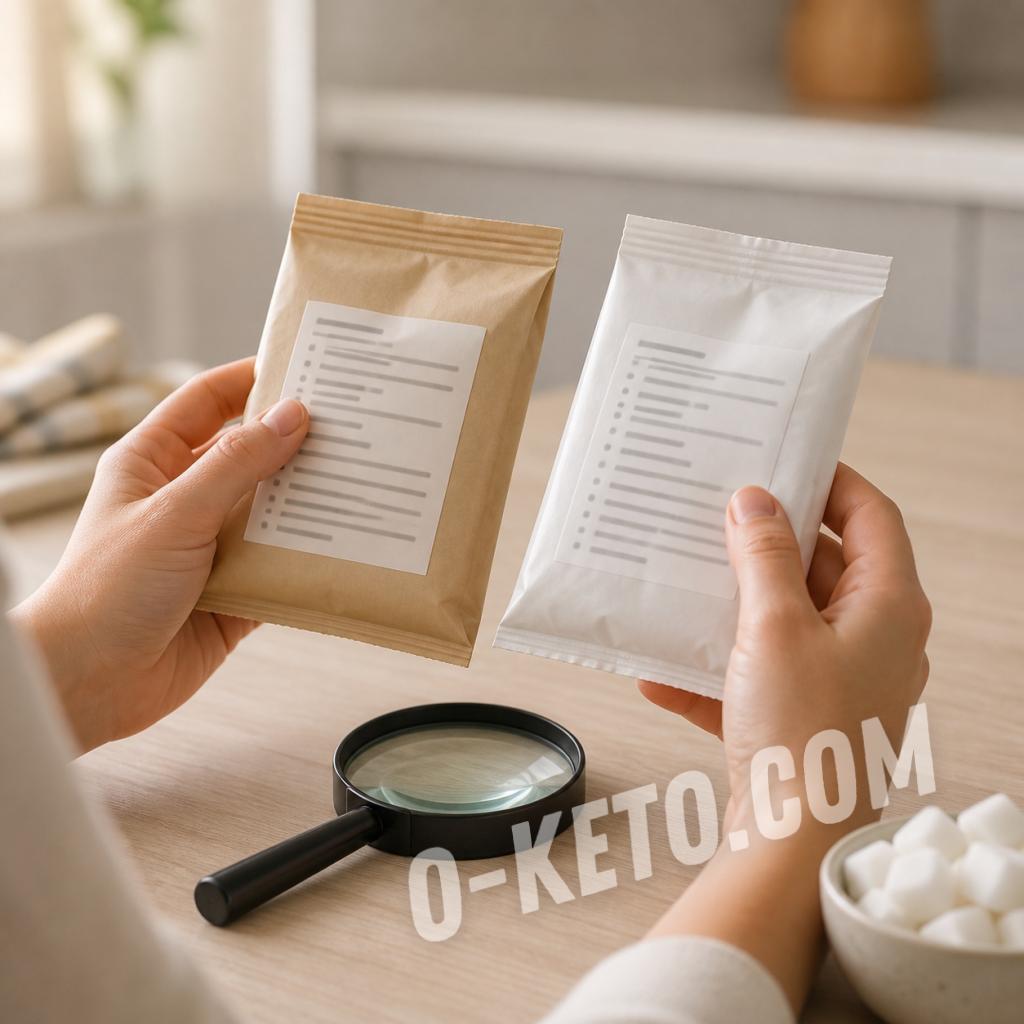
First decide what you are trying to assess: sweetness, total carbohydrate intake, added sugar, or a specific product in a medical context such as diabetes. The same ingredient list cannot be judged without knowing the question.
- Read the first ingredients. They are usually listed by weight, although exact rules depend on the country and food category.
- Look beyond the word “sugar” for syrups, honey, juice concentrates, glucose, fructose, dextrose, maltose, and other names in the table.
- Check the nutrition panel. The “sugars” line shows sugars per serving, but does not always separate naturally occurring and added sugars.
- Check serving size. A small number per serving can look very different when a package contains several servings and is eaten in one sitting.
- Separate sweeteners from flavorings, colors, and bulking agents. Maltol may provide aroma, while caramel color may provide color, so neither should automatically be counted as sugar without context.
The practical rule is to assess the whole list, the amount of sugars, and the real portion. Several smaller sweetening ingredients can add up, even when none of them appears first.
Names of sugars, syrups, and sweet ingredients
The table includes terms from a common English-language list. The translation helps identify the ingredient, but its position, the nutrition panel, serving size, and the labeling rules in the relevant country determine how to interpret it.
| Label name | What it means | How to interpret it |
|---|---|---|
| Agave nectar | Agave nectar or syrup | A sweet syrup and source of free sugars despite its natural-sounding name |
| Barley malt syrup | Syrup made from barley malt | A sweet syrup containing sugars and starch-breakdown products |
| Beet sugar | Sugar from sugar beet | Ordinary sucrose from a different plant source |
| Brown sugar | Brown sugar | Sugar with molasses or less refining; not a diet sugar |
| Cane sugar | Sugar from sugar cane | Sucrose from cane |
| Caramel | Caramel or a caramel product | May be a sweet ingredient or part of a color; context matters |
| Carob syrup | Carob syrup | A sweet syrup, not a zero-carbohydrate sugar substitute |
| Coconut sugar | Sugar from coconut-palm sap | Still a concentrated sugar product |
| Confectioner’s sugar / icing sugar | Powdered sugar | Two names for a finely ground sugar product |
| Corn syrup | Corn syrup | A sweet carbohydrate ingredient made from corn starch |
| Date sugar | Sugar made from dates | A dry sweet product; not nutritionally identical to a whole date |
| Dehydrated or evaporated cane juice | Dehydrated or evaporated cane juice | An alternative name for sugar or a concentrated sweet ingredient |
| Dextrin | Dextrin | A partial starch-breakdown product; a carbohydrate, but not necessarily a simple sugar |
| Dextrose | Dextrose | Glucose, a simple sugar |
| Disaccharide | Disaccharide | A chemical class, not one specific ingredient; look for the exact name |
| Fructose | Fructose | A simple sugar; “fruit” in the name does not settle its role in the product |
| Fruit juice concentrate | Concentrated fruit juice | A concentrated source of sugars, not the same as a whole fruit |
| Galactose | Galactose | A simple sugar often encountered as part of milk sugar |
| Glucose | Glucose | A simple sugar |
| Golden syrup / golden sugar | Golden syrup or golden sugar | A sweet syrup or sugar product |
| Grape sugar / grape juice | Grape sugar or grape juice | May refer to glucose or juice; inspect the specific formulation |
| High-fructose corn syrup | High-fructose corn syrup | An added syrup with a high proportion of fructose |
| High-maltose corn syrup | High-maltose corn syrup | Corn syrup containing a high proportion of maltose |
| Honey | Honey | A natural food, but still a source of free sugars |
| Invert sugar syrup | Invert sugar syrup | A mixture of glucose and fructose made from sucrose |
| Jaggery | Jaggery, less-refined palm or cane sugar | A sugar product; less refining does not make it metabolically neutral |
| Lactose | Lactose | Milk sugar; context matters because it may be naturally present or added separately |
| Maltose | Maltose, or malt sugar | A disaccharide and sweet carbohydrate ingredient |
| Maltodextrin | Maltodextrin | A short chain of glucose units from starch; do not confuse it with maltol |
| Maltol | Maltol | A flavoring substance; the name alone does not mean sugar |
| Maple syrup / maple sugar | Maple syrup or maple sugar | A sweet syrup or sugar product |
| Molasses / treacle | Molasses or treacle | A syrup-like by-product of sugar production containing sugars |
| Monosaccharide | Monosaccharide | A chemical class of simple sugars, not one specific ingredient |
| Muscovado | Muscovado | Dark, less-refined cane sugar |
| Raw sugar | Raw sugar | Less-refined sugar; still a concentrated source of sugars |
| Refiner’s sugar | Refiner’s sugar | A refined sugar product |
| Rice syrup | Rice syrup | A sweet syrup made from rice starch |
| Sucrose | Sucrose | Table sugar; some lists contain the misspelling Succharose |
| Syrup | Syrup | Too broad by itself; look for the source and full formulation |
| Trehalose | Trehalose | A disaccharide and added sweet ingredient when used in a product |
| Xylose | Xylose | A monosaccharide whose role depends on the product and amount |
The table shows why “natural-sounding” does not mean “ignore it.” Honey, agave syrup, date sugar, and coconut sugar differ in origin and flavor, but can all add free sugars. Maltol and caramel color need a different assessment because one is linked to aroma and the other to color rather than necessarily to a large sugar load.
Words that often mislead shoppers
“With fruit” does not mean that a product contains no added sweetener. The ingredient list may still include sugar, syrup, juice concentrate, or a high-sugar fruit preparation. “No refined sugar” also does not mean “sugar-free” when the product uses honey, agave syrup, maple syrup, or date concentrate instead of sucrose.
A separate mistake is placing every ingredient containing “malt,” “dextrin,” or “caramel” in one category. Malt syrup and maltodextrin do provide carbohydrates, but maltol is a flavoring, while caramel color may be used in a very small amount. Judge the ingredient by its function and the nutrition information, not by similar spelling.
“No added sugar” claims also require context. Rules differ between countries, but the practical distinction is stable: sugar naturally present in milk or a whole fruit is not the same as syrup added to a dessert. When a juice concentrate or syrup appears, check how it is used and what the sugars line reports.
If you are limiting carbohydrates
For a low-carbohydrate diet, the ingredient list helps identify not only sucrose but also syrups, concentrates, dextrose, maltose, and maltodextrin. The list alone is not enough: compare total carbohydrate per 100 g and per actual serving. A product may avoid the word “sugar” and still be rich in rapidly available carbohydrates.
On a strict keto diet, serving size and total carbohydrate matter especially. A softer LCHF approach may use a different threshold, but a “natural” syrup is still not carbohydrate-neutral. That is a dietary calculation, not a property created by attractive wording on the front of the package.
A practical check before buying
Use this order: find the serving size, compare sugars and carbohydrates, read the first ingredients, and scan for syrups, honey, concentrates, and simple-sugar names. If several sweeteners appear, consider them together even when each one is far down the list.
Do not decide from package colors or phrases such as “farm,” “natural,” “fitness,” or “unrefined.” Those words describe the product’s image, not its complete composition. A better decision uses four pieces of information: the exact ingredient name, its position in the list, sugars and carbohydrates per serving, and the number of servings in the package.
Conclusion
Sugar on a label may appear as sucrose, glucose, fructose, dextrose, syrup, honey, juice concentrate, or a traditional name such as muscovado. Not every similar term is sugar: maltol, dextrin, and caramel color need separate interpretation. Read the ingredient list together with the nutrition panel, count all sweetening sources, and judge the real serving rather than the marketing phrase on the front of the package.
Sources
- Guideline: Sugars intake for adults and children — World Health Organization
- Healthy diet — World Health Organization
- Added Sugars on the Nutrition Facts Label — U.S. Food and Drug Administration
- Types of Food Ingredients — U.S. Food and Drug Administration
- Mandatory food information — European Commission
- Nutrition claims — European Commission