


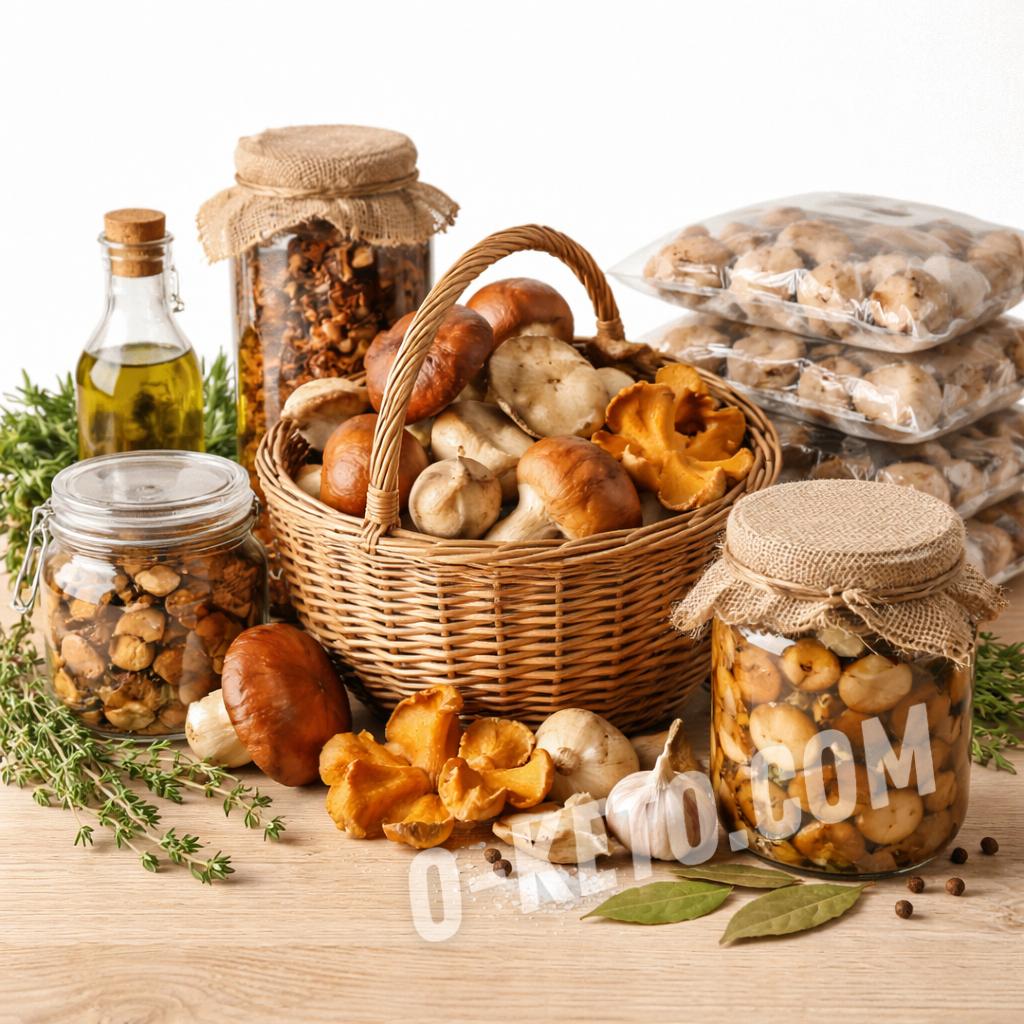

Mushroom harvesting allows you to preserve their taste and aroma for a long time. There are three main methods: drying, freezing, and salting. Each method has its own preparation and storage features.
The choice of harvesting method depends on the type of mushrooms and storage conditions. If the technology is followed, mushrooms retain their taste and are suitable for consumption for several months.
Drying Mushrooms
Drying is suitable for most edible mushrooms with dense flesh and low moisture content: porcini, aspen mushrooms, birch mushrooms, chanterelles, and honey mushrooms.
Champignons and oyster mushrooms are dried less often due to their high moisture content.
Preparation. Clean the mushrooms from forest debris with a brush or soft cloth. Washing under water is not recommended to avoid increasing moisture. If heavily soiled, a quick rinse followed by thorough drying is acceptable. The skin is removed only if necessary. If there are doubts about the cleanliness of the gathering place, mushrooms can be blanched for 3–5 minutes and well dried.
When drying, mushrooms are usually recommended to be sliced. Small specimens can be dried whole, medium ones can be cut in half, and large ones should be sliced into pieces about 3–5 mm thick. Uniform thickness of slices ensures equal drying speed and reduces the risk of mold. The stems of dense mushrooms are better cut separately.
Drying Methods:
- air drying — sliced pieces are spread in the shade in a well-ventilated area for several days;
- oven drying — at 50–60°C with the door slightly open for 4–6 hours;
- dehydrator drying — at about 50°C for 6–8 hours until completely dry.
Readiness and Storage. Dried mushrooms should be brittle, without moist areas. Store them in a tightly sealed glass jar or paper bag in a dry, cool, dark place. Shelf life is up to 1 year.
Before use, mushrooms are rinsed and soaked in warm water for 2–8 hours; the infusion can be used in dishes.
Freezing Mushrooms
Freezing allows you to preserve the structure and taste of mushrooms. Suitable varieties include porcini, aspen mushrooms, birch mushrooms, butter mushrooms, honey mushrooms, and chanterelles. It is not recommended to freeze varieties with watery flesh.
Preparation. Clean the mushrooms and cut them if necessary. Before freezing, they are blanched for 3–5 minutes or lightly sautéed, then completely cooled and dried.
Storage. Prepared mushrooms are portioned and frozen. They can be stored in the freezer for 6–12 months. Refreezing is undesirable.
Salting Mushrooms
Salting is a method of preservation using salt, which suppresses the growth of microorganisms and enhances flavor.
Salting Methods:
- cold salting — mushrooms are layered with salt without thermal processing and left for 2–3 weeks;
- hot salting — mushrooms are pre-boiled or blanched, then salted; this method is faster and reduces bitterness.
General Principles:
- use only fresh mushrooms without signs of spoilage;
- salt in glass or enamel containers;
- use coarse non-iodized salt;
- add 5–10% salt by weight of the mushrooms;
- layer with salt and spices;
- store finished mushrooms in the refrigerator.
Features of Salting Milk Caps. Milk caps are soaked in cold water for 2–5 days with regular water changes to remove bitterness, then boiled for 15–20 minutes and layered with salt and spices. The finished product acquires a dense texture and a characteristic sour-salty taste.


