


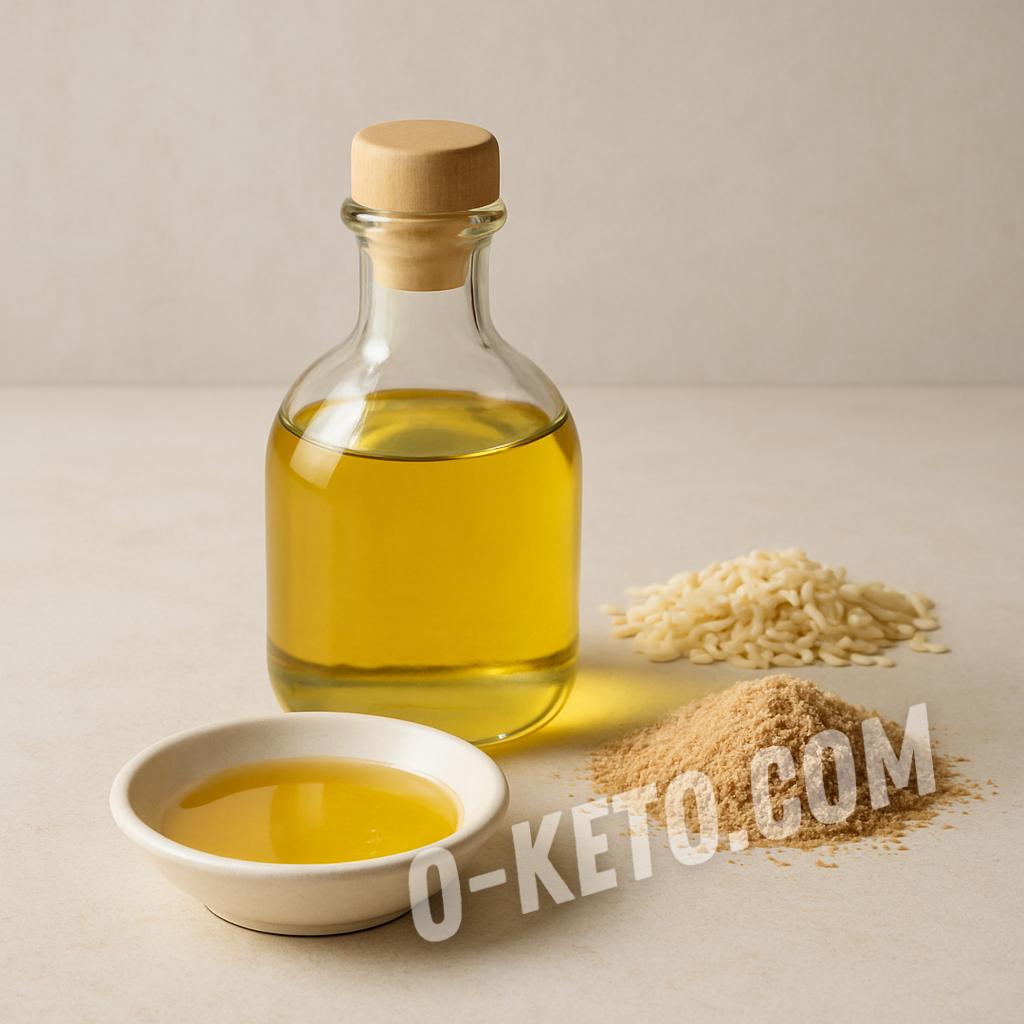

Rice bran oil is extracted from the outer bran and germ-rich fractions of rice grain. In cooking, it is valued mostly for practicality: the flavor is usually fairly neutral, and refined versions work well when a calmer oil is needed for frying, sauces, or baking. In many Asian kitchens it has long been used as a reliable everyday working oil for hot dishes.
For keto, the macro picture is simple: it contributes fat with virtually no carbohydrate. But as with other plant oils, the bigger question is not carbs alone, but how the oil fits into the broader fat balance of the diet. Rice bran oil can be useful as a technical cooking fat without automatically becoming the “best” oil for every purpose.
What kind of oil it is
Rice bran is not white rice itself. It is the outer and germ-adjacent layer of the grain where most of the oil is concentrated. That is why the finished oil has nothing in common with the starch load of cooked rice. The result is a fat product rather than a carbohydrate-heavy grain food.
Refined rice bran oil is usually mild and fairly neutral, which makes it convenient in dishes where the cook does not want the fat to dominate flavor. Less refined versions may show a more noticeable nutty or grain-like note. People also discuss tocopherols, tocotrienols, and gamma-oryzanol, but the actual amounts vary with processing and refinement.
How it fits into keto
From a ketosis standpoint, it is easy to place because it carries essentially no carbohydrate burden. The more relevant question is where it sits alongside olive oil, butter, avocado oil, coconut oil, and animal fats. Omega-6 content alone does not make the oil unsuitable; overall diet, freshness, and avoiding repeated high-heat use matter more.
Its main strength is practical neutrality. It works well when a dish needs a clean cooking fat and not a strong aromatic signature. That makes it useful, but not necessarily ideal as the only everyday oil in a keto kitchen.
How to use it
Rice bran oil is often useful when the goal is to preserve the taste of the dish itself rather than highlight the oil. Good uses include:
- frying vegetables, meat, or seafood at moderately high heat;
- homemade mayonnaise or soft sauces with a neutral profile;
- baking and savory dough mixtures;
- greasing pans or molds without a strong aroma;
- Asian-style dishes where olive or coconut flavor would be too assertive.
If someone wants strong flavor, rustic character, or a clearly cold-pressed personality, this oil may feel too restrained.
How to choose and store it
It helps to look at refinement level, bottle size, date, and the overall quality signals of the producer. For frequent frying, a refined version is often the more practical choice. Less processed oils may be more interesting in flavor, but they are also more sensitive to light, heat, and storage mistakes.
Store it tightly closed, away from direct light and heat. If it develops a stale nutty, paint-like, cardboard, or rancid seed smell, it has gone too far. As with other neutral oils, a large bottle only makes sense when it will actually be used quickly.
Practical limits
Rice bran oil is best viewed as a useful cooking tool, not as a full dietary philosophy by itself. It can work well in a keto menu, especially when a quiet high-use cooking fat is needed, but it makes the most sense as one option within a broader rotation of fats.
Sources
Key sources on the product composition, safety, and use:
- The impact of rice bran oil consumption on the serum lipid profile in adults: A systematic review and meta-analysis of randomized controlled trials
- Rice Bran Consumption Improves Lipid Profiles: A Systematic Review and Meta-Analysis of Randomized Controlled Trials


