


E142 (a green S)
A synthetic green dye that gives a cool emerald shade; in low-carb eating it is mainly a marker of bright industrial drinks, sweets and desserts.
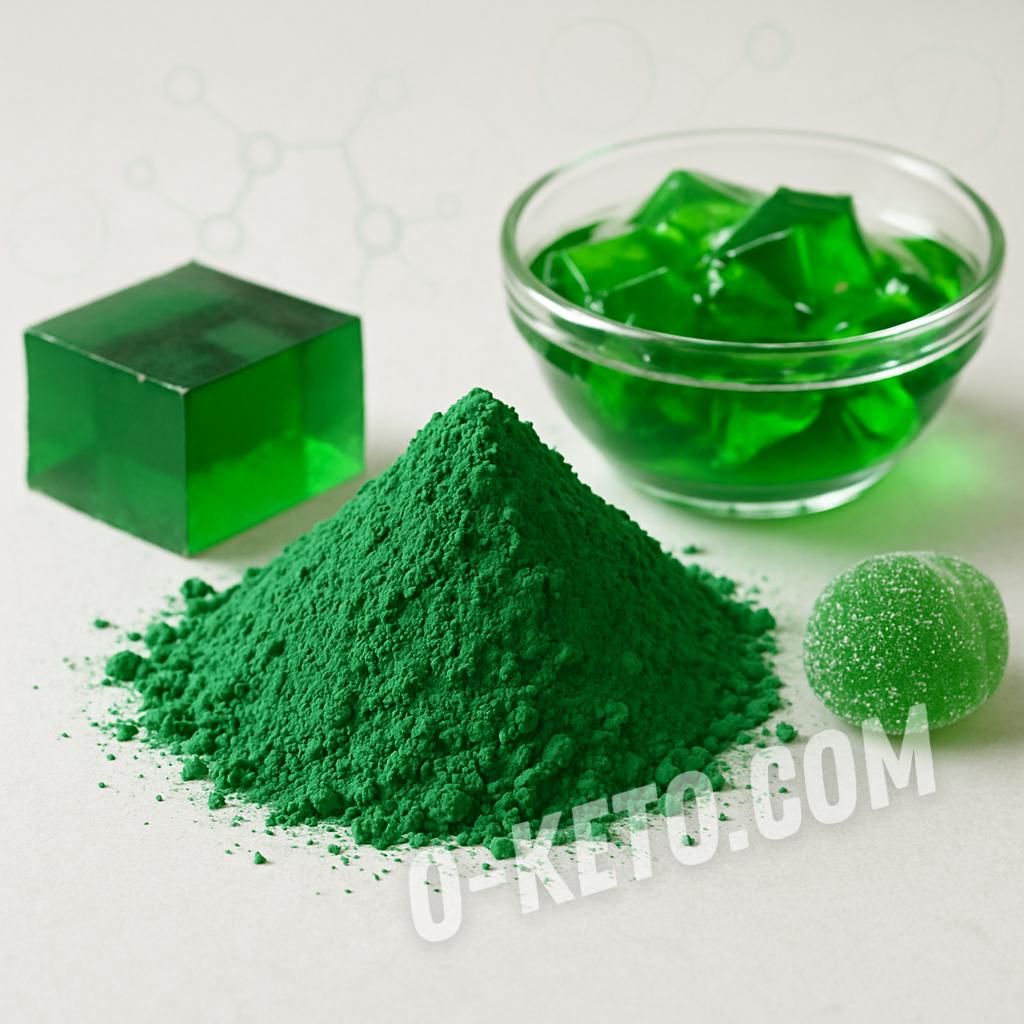
Green S, or E142, is a synthetic green food colour. It gives a cold, saturated shade that may look emerald, grassy or blue-green depending on the recipe and neighbouring ingredients. Unlike chlorophyll-based colours, E142 is not derived from leafy greens. It is a separate synthetic dye used by manufacturers to obtain stable colour in drinks, sweets, desserts, sauces and decorative products.
Nutritionally, E142 does not add flavour, protein, fat, vitamins or useful greens. It creates a visual image. For that reason it should be assessed not as a nutrient, but as one part of an industrial product. Green colour may suggest mint, lime, apple, herbs, pistachio or freshness, while the actual ingredient list may be water, acid, sugar or sweetener, flavouring and dye.
Where Green S appears
E142 may be found in bright drinks, sweet syrups, jelly desserts, confectionery coatings, candies, chewing products, ice cream, decorative sprinkles, sauces and some manufactured mixes. It may be used alone or with other colours to obtain a particular shade or standardise colour between batches. Visual appearance therefore does not always reveal which exact dye is responsible for the green colour.
Green S is almost never needed in ordinary home cooking. When dill, parsley, spinach, basil, arugula, broccoli or cucumber provide the green colour, they also bring minerals, fibre, plant compounds and their own flavour. When E142 provides the colour, it is only colouring. This distinction matters especially in products marketed as fitness, lime, mint or natural flavour.
Safety and acceptable intake
EFSA reconfirmed an acceptable daily intake for Green S of 5 mg per kilogram of body weight per day. This is a safety reference for chronic intake, not a recommendation to consume the dye. With occasional intake of coloured products, most adults are unlikely to approach that level. The situation becomes more relevant when bright drinks, sweets and desserts are consumed daily, especially by children.
E142 is not authorised in every jurisdiction, and this often creates confusion. Countries may differ in how they interpret data, historical use and permitted food categories. The practical message is simpler: authorisation in a country does not make a product nutritious, and lack of use elsewhere does not mean every trace is an immediate danger. Diet is judged by regularity, dose, composition and the role of the product.
Relevance for low-carb eating
E142 itself is not a carbohydrate. However, the products in which it appears are often connected with sweet taste and an ultra-processed matrix: drinks, syrups, gummy sweets, icing, dessert powders, candies and bright sauces. For LCHF, sugar, glucose syrup, fructose syrup, maltodextrin, starch, fruit concentrates, polyols and total energy are usually more important than the dye.
Sugar-free products need separate attention. A green drink with sweetener and E142 may formally be low in carbohydrate, but daily use can maintain cravings, replace water and real food, and irritate digestion through acids or large amounts of polyols. In that case the colourant is not the main factor, but it is part of a product designed for strong sensory stimulation.
Individual tolerance
Some people notice a connection between brightly coloured products and headache, itching, skin reactions, abdominal discomfort or a general worsening of wellbeing. This does not prove that E142 is the cause for everyone. In real products, the dye often appears alongside acids, preservatives, sweeteners, flavourings and other colours, so the reaction may relate to the whole mixture.
If the suspicion repeats, it is better to test the pattern than argue with the body. Removing the specific products for several weeks and watching symptoms can be useful. If needed, one product can later be reintroduced cautiously. This approach is more practical than banning all E-numbers in theory or ignoring repeated symptoms altogether.
How to read the label
On labels, Green S may appear as E142, Green S or Acid Green 50. In a low-carbohydrate diet, it is useful to look around that code for other colours and for the carbohydrate base. A product that is sweet, liquid, bright and easy to drink can become a regular source of stimulation even without many calories.
The practical choice is straightforward: get real green foods from food, and keep brightly coloured green sweets and drinks as rare exceptions. Then E142 does not occupy a meaningful place in the diet, and green colour is again connected with foods that actually provide minerals, fibre, volume and satiety.
If you have any questions about the term "E142 (a green S)", you can ask them to AI. Please note, a low-cost OpenAI model is used. It may answer questions about disease treatment with errors!


 1 / 4
1 / 4 1 / 4
1 / 4
 1 / 4
1 / 4 1 / 4
1 / 4 1 / 4
1 / 4