


E129 (a red charming AC, Allura Red AC)
Allura Red AC E129 is a synthetic red azo dye, often known as Red 40, used for bright red and berry-like shades. In low-carb eating, it matters as a marker of sweet ultra-processed products and possible sensitivity, not as a carbohydrate source.
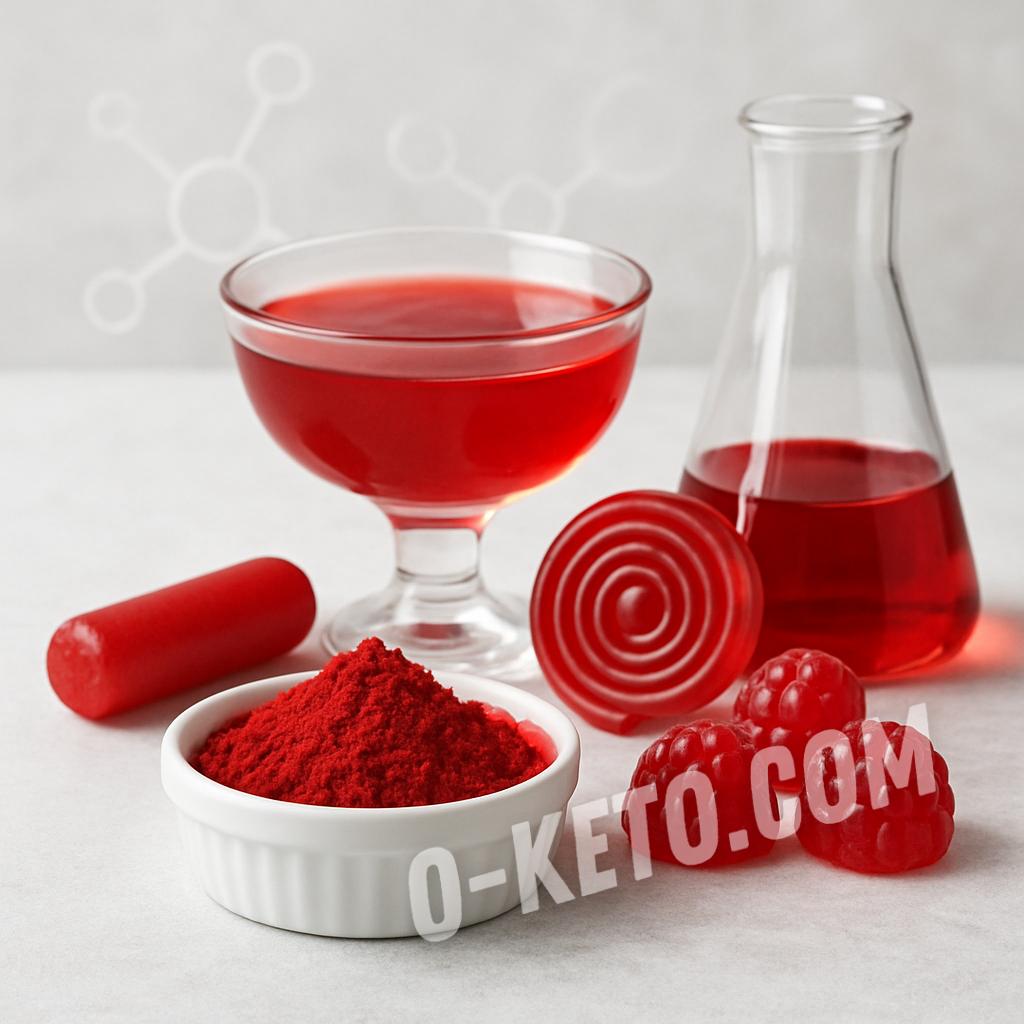
E129 is Allura Red AC, a synthetic red azo dye widely known as Red 40. It provides bright red, berry, cherry, and decorative shades in drinks, sweets, desserts, sauces, snacks, chewing products, and some supplements. It is one of the most recognizable modern red colorants. Its purpose is not nutritional value, but visual signaling: the product looks fruity, sweet, festive, or energetic. E129 should therefore be evaluated as a technological part of an industrial flavor image.
What this colorant is
Allura Red AC belongs to synthetic azo dyes. It differs from carmine E120, which is derived from cochineal, and from erythrosine E127, which belongs to another chemical group and contains iodine in its structure. E129 is often used where stable intense red color is needed, especially in products with a berry, cherry, fruit, or candy image. Like other colorants, it does not add real berries, vitamins, or health value. It makes the product visually convincing, while flavor is usually created by flavorings, acids, and sweet components.
Where E129 is found
E129 may appear in carbonated drinks, energy drinks, powdered mixes, candies, chewy sweets, jellies, desserts, ice cream, sauces, snacks, decorative glazes, lozenges, and vitamin forms. It can be used alone or together with yellow, blue, and other red colorants to create a specific shade. If a product is bright and sold through a berry or sweet image, E129 is not the only thing to check. Sugar, syrups, maltodextrin, starch, polyols, acids, caffeine, benzoates, and serving size often matter more for the metabolic effect.
Relevance for keto and LCHF
E129 is not a carbohydrate and should not directly raise glucose. However, products containing it often maintain sweet taste and high sensory intensity. For keto, that matters because stable appetite depends not only on grams of carbohydrate, but also on the habit of intense flavors. A sugar-free drink with E129 may formally provide no carbohydrates but still maintain sweet cravings. A candy or dessert with E129 may contain sugar or starch. This colorant does not define the keto status of a product, but it suggests that the ingredient list deserves careful reading.
Sensitivity and child-related labeling
E129 is one of the colors for which the European Union requires, in relevant uses, a warning about possible adverse effects on activity and attention in children. This does not mean every person reacts to Allura Red AC, and EFSA has evaluated its safety at permitted levels. But for families with sensitive children, and for people with hives, asthma, headaches, or reactions to bright drinks and sweets, E129 is worth tracking separately. Recording the exact code is better than drawing a broad conclusion about all red foods.
How to distinguish it from other red colorants
Red color on a package can come from different substances. E120 is carmine, E122 is azorubine, E123 is amaranth, E124 is Ponceau 4R, E127 is erythrosine, and E129 is Allura Red AC. Each has its own chemical and practical context. For vegans, E120 is especially important. For thyroid context, E127 stands out. For azo dyes and child-related labeling, E129 and neighboring synthetic colors matter. The exact code is more useful than the general word red.
Practical conclusion
E129 is not a carbohydrate source, but a marker of a brightly engineered product. If a product containing it is occasional, sugar-free, and well tolerated, the colorant itself may be secondary. If daily drinks, candies, lozenges, dessert mixes, or child-oriented products are involved, simpler alternatives and lower frequency are better. In low-carb nutrition, the foundation is not bright taste without sugar, but food that provides satiety, protein, fats, micronutrients, and stable glucose. A colorant should not mask the absence of real nutritional value.
If you have any questions about the term "E129 (a red charming AC, Allura Red AC)", you can ask them to AI. Please note, a low-cost OpenAI model is used. It may answer questions about disease treatment with errors!


 1 / 4
1 / 4

 1 / 4
1 / 4

 1 / 4
1 / 4 1 / 4
1 / 4