


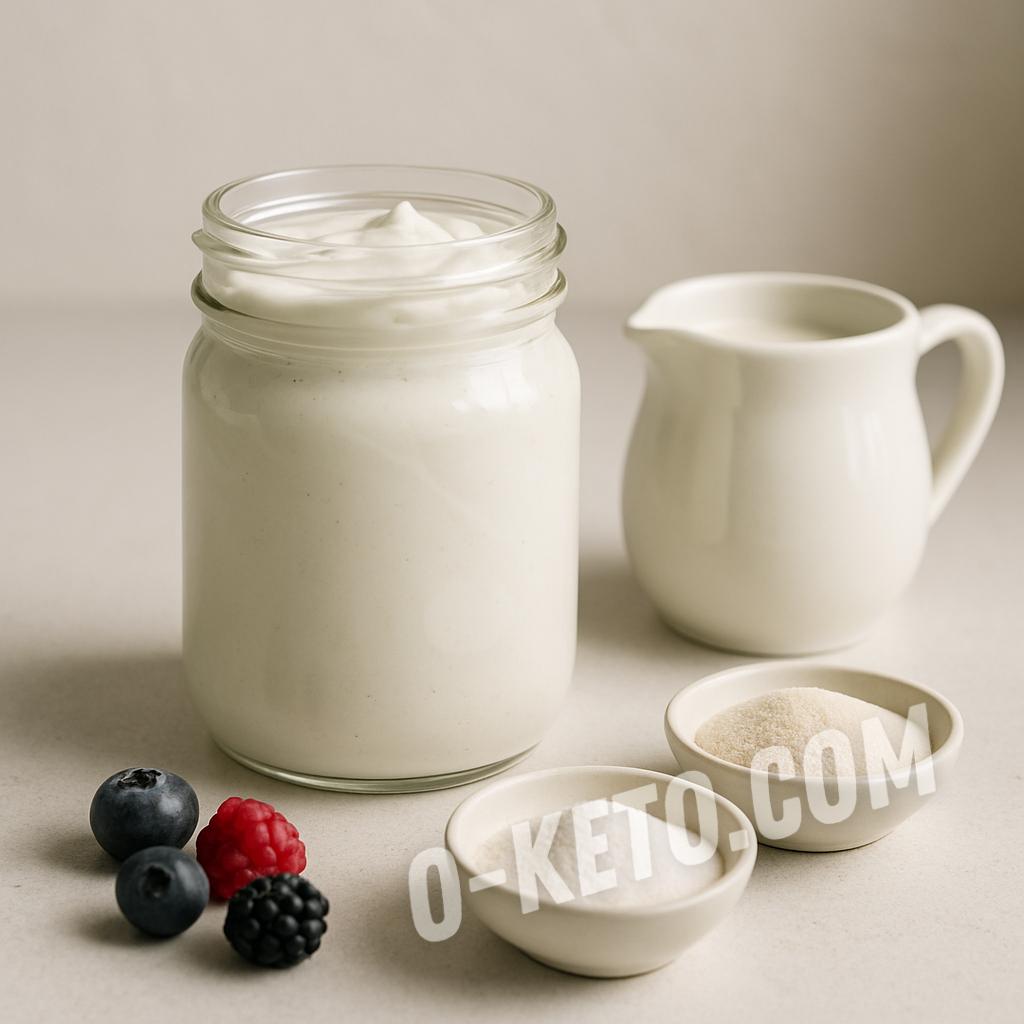

Homemade plant yogurt disappoints people for one repeating reason: they expect any nut milk or coconut milk to become thick on its own after a probiotic is added. In practice, that rarely happens. Plant milk does not behave like dairy milk. It can ferment, and the flavor can change, but without extra structural help it often stays fairly thin even when the taste becomes more cultured.
That means a good homemade plant yogurt is built from two separate tasks. First, you create a clean fermented base with the right mild tang. Second, you solve texture deliberately. This is where most mistakes begin. Some people add psyllium without thinking about mouthfeel. Others expect agar to fix everything automatically. Others rely on commercial plant milk and assume it will behave like a cultured dairy base. Others add too much fruit and end up with something much closer to a smoothie than to yogurt.
Once this logic is clear, the whole process becomes simpler. Homemade plant yogurt does not need to imitate a factory product perfectly. It needs to taste good, have a clean ingredient profile, and hold a texture that is pleasant enough to repeat regularly at home.
Why plant milk does not thicken by itself
In dairy yogurt, structure comes not only from fermentation but also from the protein system already present in milk. Plant milk usually does not have that same ready-made network. Even if you use a good probiotic and keep the mixture warm long enough, the result may still be a fermented but fairly fluid milk. The taste changes, but a true spoonable yogurt texture does not appear automatically.
This leads to one important conclusion: fermentation and thickening are two different jobs. First you build a cultured base with the right flavor. Then you decide what texture you actually want: firmer, softer, more like sour cream, more spoonable, or slightly looser.
What kind of base is easiest to use
The most controllable home version is usually a homemade nut milk. Almond, cashew, or nut butter based milk can all work, and they are easier to understand than many processed commercial cartons. Store-bought plant milk may seem convenient, but once opened it still does not keep very long, and it often contains stabilizers, emulsifiers, and other additions that do not always improve home fermentation.
If store-bought milk is used anyway, the safest approach is to choose the shortest ingredient list possible. The fewer extra additives it contains, the more predictable the fermentation tends to be. But in many kitchens it is actually easier to spend a few minutes making the milk than to troubleshoot an industrial formula later.
When to add the probiotic
The probiotic should not be added to a boiling or very hot mixture. First the milk base is brought to the right stage. If a thickener will be used, it is dissolved and heated properly first. Then the mixture is cooled to about 35 to 40 °C. Only after that is the probiotic added and the base is placed in a warm environment for fermentation. If the culture goes into a too-hot mixture, the whole process can fail at the beginning.
The exact fermentation time depends on the base and the temperature, but the practical goal stays the same as with other cultured foods: a mild clean fermented flavor, not a harsh overdeveloped acidity. It is better to stop when the taste is pleasant than to keep waiting for thickness that depends more on the texture system than on time alone.
Which thickeners work better

At home, people usually experiment with agar, pectin, and sometimes psyllium. But the eating experience is not the same. Psyllium often creates a slimy or draggy texture that may technically thicken the mixture but does not necessarily make it more pleasant. It can solve one problem while creating another.
Agar can build a firmer texture. If the process is handled carefully, the fermented mixture becomes dense enough to be spoonable and then can be blended again into a smoother final consistency. This works best for people who want a more stable yogurt body and do not mind a slightly more structured system.
Pectin gives a different result. It can create something softer, closer to a thick cultured sauce or a sour-cream-like texture. That can feel very pleasant in the mouth, but the fermented note may seem less vivid than in a simpler cultured base or in a different thickening system. In other words, pectin can win on elegance of texture while not always feeling like the most clearly fermented version.
Sometimes the best approach is to ferment first and thicken later
One of the most useful home strategies is to ferment the plant milk first without a thickener and only afterward turn it into the final yogurt texture by blending it with berries, a small amount of structural support, or another chosen ingredient. This often gives a cleaner taste and avoids the feeling that the whole product exists only because of a gelling agent.
After fermentation, the base can be blended with a small amount of berries, nut solids, or another suitable ingredient to create body. Many people prefer this route because it starts with a real fermented base and only then adjusts flavor and thickness.
Why yogurt often turns into a smoothie by accident
A very common mistake is adding too many berries or fruits. The flavor may become attractive, but the structure shifts toward smoothie territory. If the goal is yogurt rather than a fruit drink, the fruit part should act mainly as flavor, color, and aroma, not as the main body of the dish.
A useful home rule is simple: berries or fruit are often taken at roughly half the amount of the yogurt base. That helps preserve a real yogurt texture instead of turning the whole thing into blended fruit puree with cultured notes. Once the fruit amount becomes too dominant, the category of the dish changes even if the name does not.
How to think about sweetness and flavor variations
Once the fermented base is ready, flavor options become very flexible. Cherry, strawberry, peach, and many other fruit directions can work. But it is better to build a reliable plain base first and only then start layering flavors on top of it. If weak texture is hidden under too much fruit, the problem is only disguised, not solved.
Sweetener should also be added deliberately. Sometimes the fruit itself already carries enough flavor, and only a little is needed. The important point is that sweetness, fermentation, and texture are three separate variables. One spoonful of sweetener should not be expected to solve all of them at once.
Common mistakes
- expecting plant milk to thicken like dairy yogurt without extra help;
- adding the probiotic to a mixture that is still too hot;
- using psyllium and then disliking the slimy mouthfeel;
- treating agar or pectin as magic instead of matching them to the target texture;
- using too much fruit and ending up with a smoothie instead of yogurt;
- choosing store-bought plant milk with a long complicated ingredient list and expecting a predictable result.
When these mistakes are removed, homemade plant yogurt becomes much easier to understand. It stops being an awkward attempt to copy an industrial product and becomes its own practical home format.
Conclusion
Homemade plant yogurt works best when fermentation and texture are treated as separate issues. Plant milk rarely produces thick yogurt on its own, so body usually has to be built deliberately through agar, pectin, or later blending with berries and other ingredients. The most stable home method is usually to create a clean fermented base first, protect the probiotic by using the right temperature, and only then choose the final flavor and thickness.


