


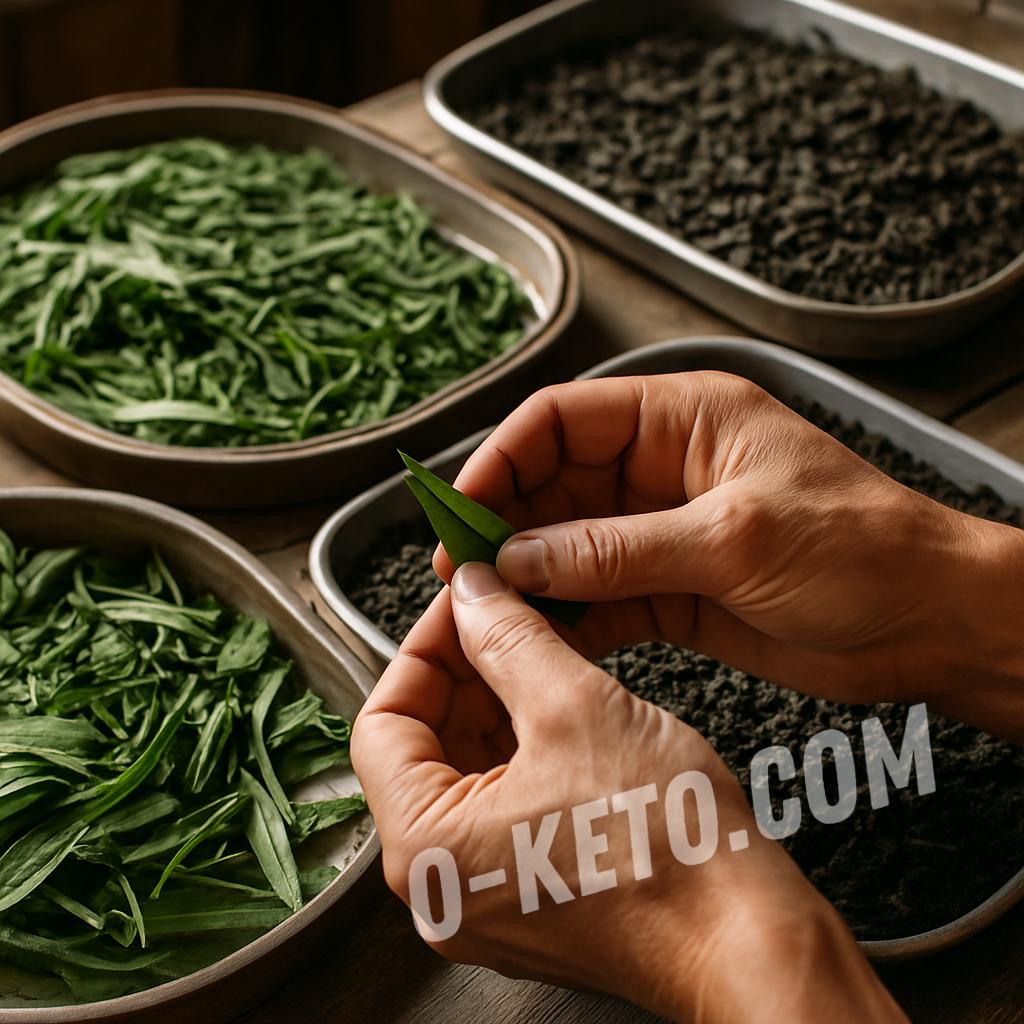

Homemade ivan tea is often reduced to one short formula: pick the leaves, crush them, leave them for a while, then dry them. In practice, a good result comes not from one magic trick, but from the correct sequence of steps. That is why for home preparation it is important not only to have fireweed leaves, but also to understand why wilting, rolling, fermentation, and drying matter and what each stage is actually doing.
If we look at the process realistically, ivan tea is not just “grass that was dried.” It is controlled processing of plant material. The goal is not simply to make the leaves darker at any cost, but to let them lose excess moisture, partly break their structure, start enzyme-driven aroma changes, and then stop the process in time with drying. Once this logic becomes clear, homemade tea turns out deeper, cleaner, and much more predictable in taste.
Starting point: choosing the raw material
The most important thing for homemade ivan tea is the quality of the fireweed itself. It is better to use clean material without dust, mold, insects, or random debris. Leaves that are too coarse, too old, or already overdried usually give a less interesting result, while very young leaves may not yet have the aromatic depth that people expect from a fermented tea. If the harvested fireweed is weak in smell, damaged, or dirty from the start, technology later will not fix it.
It is also useful to remember that different home tea variations can be made not only from leaves, but also from flowers, seed pods, and even tender stems. Still, the basic home method is usually built around the leaf, because it reacts most predictably to wilting, rolling, and later fermentation. For first attempts it is usually better to master the classic leaf version before moving on to experiments.
Wilting: why it matters
Wilting is not a decorative pause and not an old ritual that nobody understands. It is an important preparation stage. Its job is to reduce excess moisture in the leaves, make the material more flexible, and prepare it for the next step. If you start crushing or grinding fresh leaves immediately, they can behave too wet, roll poorly, and produce a less even aroma.
At home, wilting is usually done in shade or in a well-ventilated place, with the leaves spread in a layer that does not heat up or spoil underneath. The leaf should become softer and more pliable, but not dry out completely. If it is overdried at this stage, it becomes harder to trigger good aroma development later. If it stays too wet, you may get not a beautiful fermentation, but a dull stale smell.
A good practical sign is simple: after wilting, the leaf no longer feels sharply crisp, but it still keeps a living structure. It bends and twists more easily and does not snap as abruptly as a completely fresh leaf. In that condition, the material is usually ready for active mechanical handling.
Rolling: why the flavor often stays flat without it
The next key stage is rolling or another kind of mechanical treatment that breaks the structure of the leaf. The point is not just to create a pretty shape. When the leaf is rolled, kneaded, or crushed, some cells are damaged, juice spreads through the mass, and the internal enzymes gain more contact with oxygen and plant tissue. That is what helps the future tea shift from a coarse grassy smell toward a softer, fruitier, floral, or spiced profile.
At home, people use different methods. Some work by hand, some prefer rougher twisting, and some use a grinder for a more intense result. The more strongly the leaf is damaged, the more active the later fermentation usually becomes. But there is no universal rule that harder treatment is always better. Very aggressive processing can create a very dark and sharp profile, while gentler handling may preserve more delicate notes.
What matters is that after rolling, the leaf is truly prepared for the next stage. If it is barely bruised and has released almost no juice, fermentation may stay weak and superficial. If the material has already become a shapeless wet mass with a heavy smell, that means time and temperature later will need especially careful control.
Fermentation: what is really happening here
In everyday language, “fermentation” in ivan tea often means the whole resting stage after rolling. In practical terms, it is controlled change in plant material, when smell, color, and taste start moving under the influence of the leaf’s own enzymes and the surrounding conditions. For a home maker, an academic argument about terminology matters less than the ability to see when the process is going well and when the material is simply drifting toward spoilage.
During fermentation, the leaves are usually kept in a container or in a moist mass that retains humidity, but the batch must not turn into a suffocating, dirty, overheated lump. The main guide here is aroma. In a good process, the smell moves away from raw grassiness toward a warmer, softer, fruit-floral or bread-like profile. If the smell becomes sour, musty, moldy, or unpleasantly heavy, that is not the result you want from good homemade tea.
Fermentation that is too short often gives a flat and weak drink. Fermentation that is too long can push the aroma toward harshness and overworked heaviness. That is why at home it is more useful not to obey a fixed number of hours blindly, but to watch the material itself: how the aroma changes, how the leaf darkens, whether the mass overheats, and whether excess dampness or stickiness appears. Good fermentation is not maximum duration. It is a well-caught moment.
Drying: how to stop the process in time
Drying in ivan tea technology is not only about storage. It also stops the active changes that developed during fermentation. If the material is not dried in time and dried well enough, the aroma can keep moving in the wrong direction and the tea may become less clean in taste. So drying is not an afterthought. It is the stage that fixes the result.
At home, drying can be done in a dehydrator, in an oven over low heat, or by other gentle methods that do not scorch the leaf. The goal is not to overdry it into a burnt brittle herb, but also not to leave hidden moisture inside. Tea that is not fully dry can spoil later in the jar, especially if it is packed away too early.
A good result is tea that is dry, loose, and no longer feels damp inside the batch, while still keeping a pleasant aroma. After drying, it is useful to cool the tea completely and only then transfer it to storage. Warm tea sealed too soon can create condensation and damage the work of all previous stages.
The most common mistakes at home
One of the most common mistakes is rushing. People either underwilt the leaf, barely roll it, or leave it to ferment “by feel” without really tracking the smell. Another common mistake is overheating. If the mass is too dense, too wet, or held in unsuitable conditions, the aroma quickly becomes heavy and dirty. A third mistake is poor drying, when the tea looks ready on the outside but still keeps hidden moisture inside.
Another problem is judging the process only by color. A dark leaf does not automatically mean good tea. Material can darken under overworked or clumsy handling too. It is much more reliable to watch aroma, flexibility, drying evenness, and the cleanness of the final taste. The less meaningless fuss and the more attention to the real state of the leaf, the better the result usually is.
How to store the finished tea
After complete drying and full cooling, ivan tea is best stored in a dry closed jar away from moisture, strong smells, and direct light. The container should be clean and dry, and the tea should not be warm when it is packed. If leftover moisture gets trapped in storage, even a good batch can be damaged.
Some home teas benefit from resting after drying because the taste becomes calmer and more integrated. But that works only if the batch is truly dry and clean. If there is any doubt that the tea still contains moisture, it is better to dry it again than to hope the jar will somehow fix the problem.
Main practical point
Good homemade ivan tea does not come from one secret temperature or one magic number of hours. It comes from each stage doing its own job: wilting removes excess water and makes the leaf flexible, rolling breaks structure and prepares the material for aroma change, fermentation deepens the flavor, and drying fixes the result in time. If you keep that logic in mind, even a simple homemade batch turns out much better than a vague attempt to “dry some herbs and hope for the best.”


