


When a person is tired, overstimulated, sleeping badly, or rushing through the week, eating easily becomes chaotic. A real breakfast disappears, the day runs on coffee and accidental snacks, and by evening there is strong hunger, sweet craving, and no energy left for cooking. In that situation it is often more useful to build a gentle, predictable menu for several days than to search for one magical anti-stress food. The goal is not to treat the nervous system with a perfect plate. The goal is to remove extra food swings and reduce the fatigue of making decisions under pressure.
The word gentle matters here. It means the meals are not too heavy, but not empty either. They contain real protein, some warmth, understandable fats, small portions of fermented foods, and enough advance preparation that each meal does not need to be invented from nothing. This approach is especially useful during busy weeks, recovery days, poor sleep, and periods when it is better not to provoke extra swings with sugar, too much caffeine, or random grazing.
What makes a menu genuinely gentle
An anti-stress menu usually falls apart when it has too little structure. If the refrigerator contains only vegetables and herbs but no protein, no warm base, and no prepared building blocks, people almost always start grabbing whatever is easiest. A gentle menu is therefore built not on abstract health language, but on a few stabilizing elements: enough protein, some warm food, clear fat sources, moderate fermented foods, and components that can be combined quickly.
Protein is useful for more than fullness. It makes a meal more stable, especially in the morning and through the middle of the day, when many people otherwise drift into coffee, sweets, or endless nibbling. Warm meals and broths reduce the feeling of randomness and are often easier to tolerate in a tired state than a cold snack plate with no real anchor. Fermented foods are usually most useful as small additions: a couple of spoonfuls of sauerkraut, a little kimchi, or a splash of brine in a sauce rather than a giant bowl of sour food on an empty stomach.
Repeatability is part of gentleness too. The menu should not demand heroics. If the food is too complicated to prepare and assemble, most people will abandon the system within a day or two and slide back into chaos.
Which things are worth preparing for two or three days at once
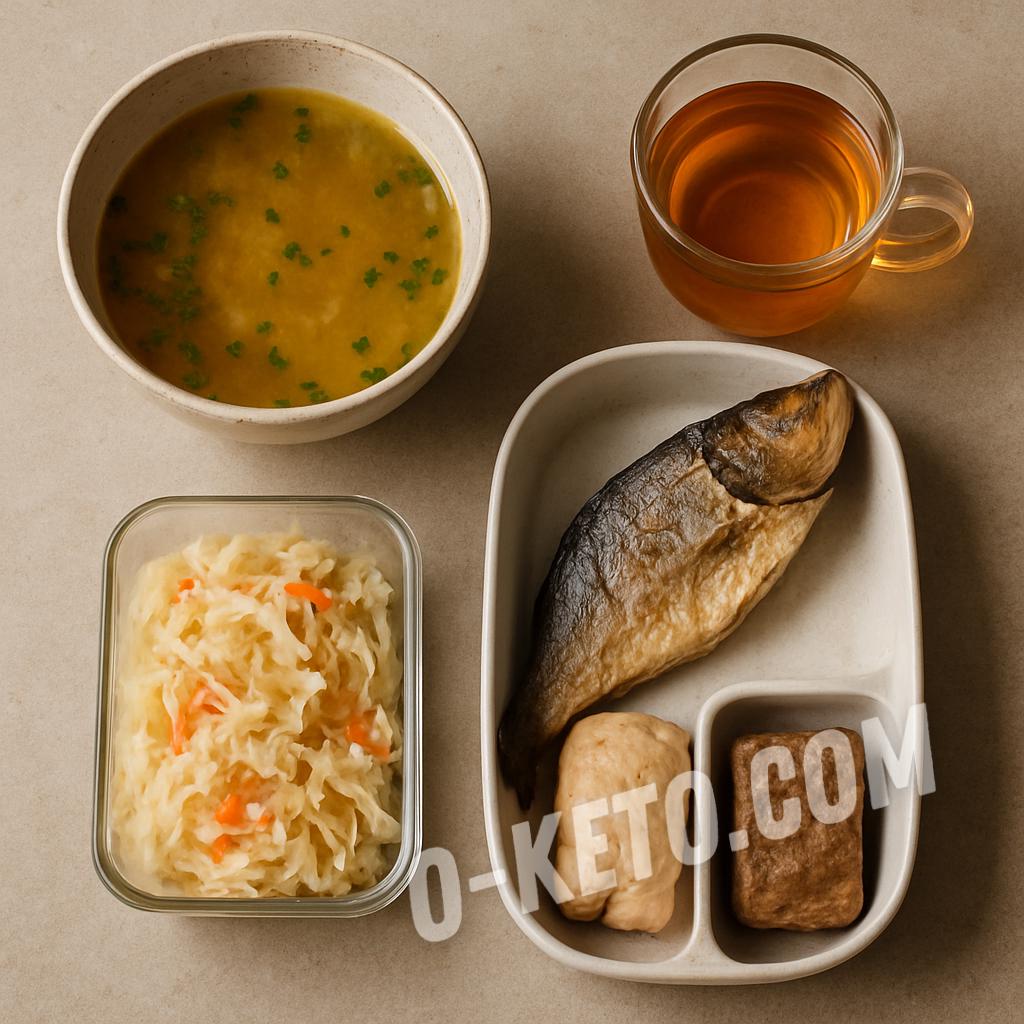
The most useful pattern is not a rigid full meal plan for every hour of life, but a small set of versatile bases that can be recombined. Two or three protein preparations, one warm base, one vegetable preparation, a jar of fermented vegetables, and one richer finishing component are often enough.
| what to prepare | why it helps | examples |
| ready protein | reduces chaotic hunger and gives each meal a real anchor | roasted turkey, chicken thighs, fish, eggs, a cottage cheese pâté |
| warm base | makes it easy to create lunch or dinner without new cooking | bone broth, chicken broth, a cream soup, fish soup |
| vegetable side | adds volume and variety without forcing improvisation | roasted vegetables, stewed cabbage, cauliflower, zucchini |
| fermented component | adds acidity and a small living flavor accent | sauerkraut, fermented cucumbers, kimchi, mixed fermented vegetables |
| fat-rich addition | finishes flavor and satiety without relying on sweets | avocado, olive oil, a creamy sauce, pâté, a coconut-based sauce |
This alone lowers food stress sharply. Instead of an empty refrigerator, the person sees several nearly complete answers. That matters most in the middle of the day and in the evening, when willpower is usually weaker than it is in the morning.
How to spread food through the day
If the aim is calmer eating, it usually helps to begin the day with a real protein breakfast instead of a naked coffee. This does not have to be huge. A warm egg dish, a soft omelet, fish pâté with vegetables, a baked casserole, leftover soup, or a small warm plate built from prepared protein and vegetables can already do the job. The key is that breakfast is not only a sweet drink or a fruit pause with no anchor.
During the day it is practical to use a plate-building pattern: protein, a warm or room-temperature vegetable component, a little fermented food, and an understandable fat source. For example, turkey with roasted zucchini, a few spoonfuls of sauerkraut, and a sauce. Or fish with cauliflower, a little kimchi, and olive oil. These combinations are not glamorous, but they work in real life.
In the evening many people feel better with warm food. Soups, broths with soft protein, stewed dishes, fish with vegetables, warm savory spreads, and not-too-heavy plates often work better than dry snacks or cold improvised meals. If appetite is unstable under stress, a warm bowl of broth with meat, egg, or fish is often easier to tolerate than a large raw plate.
Where adaptogens fit into this kind of menu
A common mistake is trying to make every meal adaptogenic. That is usually unnecessary. It is more practical to keep one controlled point in the day where the addition truly fits the flavor and does not make the meal harder to eat. Most often that means a warm drink, a coconut milk latte, a mug of cacao, a mushroom broth, a cream soup, or a thicker sauce that already welcomes a deeper creamy or mushroom-like note.
For example, the evening may include one warm drink with ashwagandha or tulsi, while the daytime meals remain straightforward. Or the main adaptogen moment may be a lunchtime cream soup, while the rest of the day stays simple. This is better for both habit and flavor. The whole diet does not turn into a therapeutic project, and the person does not get tired of monitoring every spoonful.
It is also worth remembering that adaptogens do not have to be a daily obligation. Many gentle anti-stress menus improve already from stable protein, warmer food, and less eating chaos. Additions come second to the overall shape of the day.
Which mistakes make the menu heavier instead of gentler
One of the most common mistakes is preparing only vegetables and greens, but not preparing protein or a warm base. Then there is still no real meal, and the person ends up filling the gap with random foods. Another mistake is trying to eat too much cold, raw, fibrous food during a period when digestion is already irritated and appetite is unstable. In those phases, softer and warmer textures are often easier to handle.
A third mistake is turning fermented foods into the center of the menu. Small portions usually work better than giant bowls of sour food. A fourth is replacing meals with coffee, energy drinks, endless tea, or sweetened beverages. That may feel controlled for a few hours, but it does not solve the problem of empty meals. A fifth is overplanning. If the menu starts to look like a complex logistics project with too many sauces, perfect containers, and too many moving parts, it becomes tiring fast.
When this approach is especially useful
A gentle anti-stress menu is particularly useful in weeks when a person needs to lower the number of decisions and avoid adding extra swings to hunger and energy. That includes high-workload periods, days after poor sleep, recovery phases after illness, times of stepping away from constant sweet snacking, or simply very demanding weeks when food needs to become more predictable rather than more exciting.
At the same time, it is helpful to stay realistic. If there is marked anxiety, strong appetite loss, ongoing sleep disturbance, significant weakness, abdominal pain, or other persistent symptoms, food structure alone is not the whole answer. But as a daily support layer, this style of planning is valuable because it makes eating not perfect, but calmer and more doable.
Takeaway
A gentle anti-stress menu for several days usually works best when it is built around simple supports: prepared protein, a warm broth or soup, one vegetable preparation, a modest amount of fermented food, and one or two richer finishing elements. Then each meal comes together with less friction, and the risk of drifting into coffee, sweets, and accidental snacking becomes lower.
The point of this menu is not trendiness or heroic control. The point is to remove some of the extra noise from eating, cut the number of stressful decisions, and make food more predictable on days when personal resources are low. That is why prep, protein, warm meals, and moderate fermentation usually help more than trying to improvise from nothing every time.
Sources
- Effect of Short- and Long-term Protein Consumption on Appetite and Appetite-regulating Gastrointestinal Hormones: A Systematic Review and Meta-analysis of Randomized Controlled Trials
- Dietary Protein and Appetite Sensations in Individuals with Overweight and Obesity: A Systematic Review
- Probiotics and Prebiotics – World Gastroenterology Organisation Global Guidelines
- The International Scientific Association for Probiotics and Prebiotics Consensus Statement on Fermented Foods
- Dietary Guidelines for Americans, 2025-2030 – U.S. Department of Agriculture and U.S. Department of Health and Human Services
- Sleep and Health – Centers for Disease Control and Prevention


