Home nut fermentation looks more complicated than it really is because several steps are happening inside one method at once: soaking, rinsing, blending, adding a probiotic, and holding the mixture warm for a period of time. From the outside that can seem like unnecessary work, but the end result is genuinely different from ordinary raw nut puree. The flavor changes, but so does the structure. The base becomes softer, smoother, and more cream-like, and it develops a mild cultured tang that simple soaked nuts do not have.
Cashews and peeled almonds are the most practical starting nuts for this kind of work. They are fatty enough, they blend well, and after fermentation they produce something that feels less like nut butter and more like a plant-based curd, soft cheese, or cultured cream. That base can then be used for spreads, sauces, desserts, yogurt-style mixtures, and soft plant cheeses. So it helps to understand not only the order of steps, but why each part matters and where people usually go wrong.
What changes after fermentation
If you only soak nuts and blend them with water, you get an ordinary nut base. It can still taste good, but it behaves differently. The flavor stays more raw and straightforward, sometimes slightly floury or green, and the structure often feels simply oily and heavy. After fermentation, the flavor becomes calmer and more integrated. A gentle cultured acidity appears, and the base feels less aggressively nutty.
The texture also changes. A well-fermented nut base becomes softer, smoother, and easier to turn into a spoonable spread, soft cheese, dessert cream, or homemade plant yogurt. For many people, that textural change is the main reason to ferment nuts at all. This is not just soaked nuts left longer. It is a different product in practical culinary use.
Some people also find that a fermented nut base feels easier to eat than a dense raw nut puree. It is better to describe this carefully: soaking, rinsing, and fermenting often make the mixture taste gentler and behave more softly in everyday use, especially for people who do not enjoy very dense and heavy raw nut pastes.
How the process begins
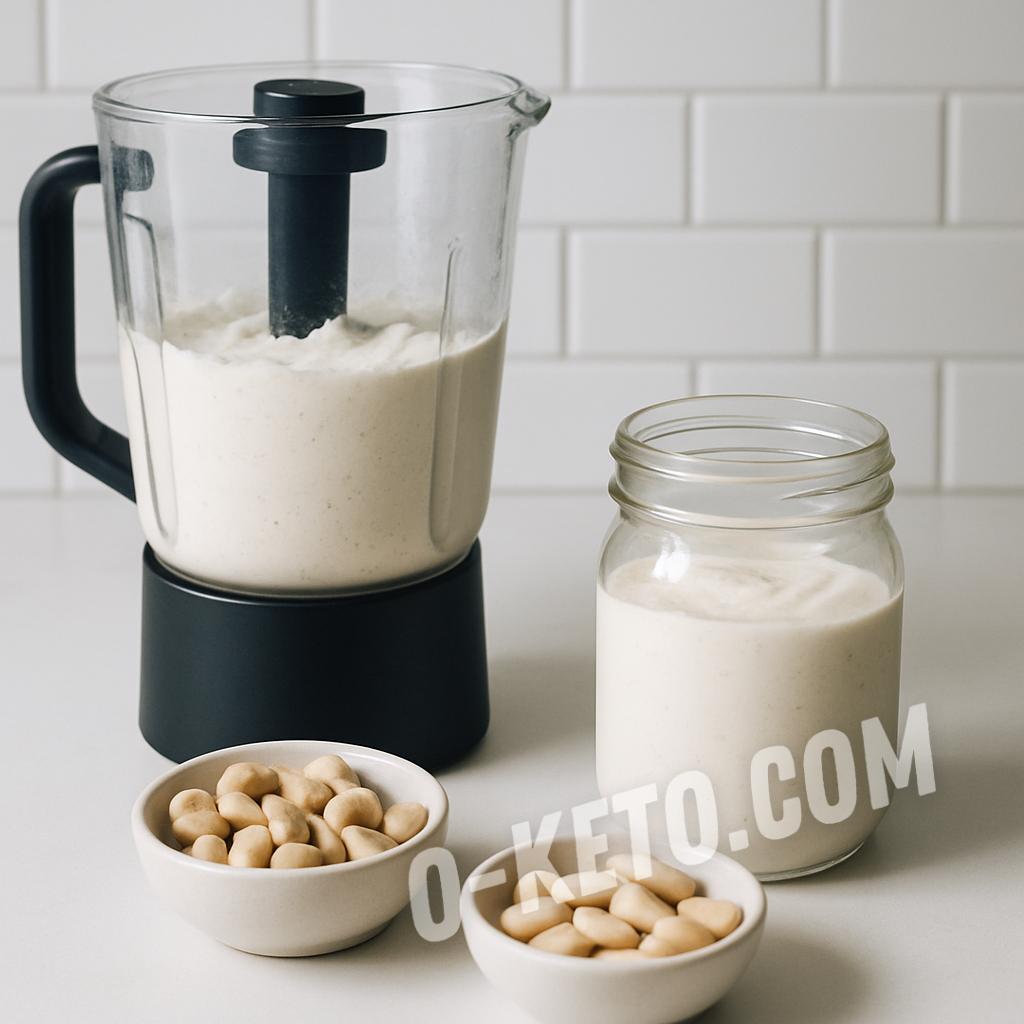
Cashews usually begin with rinsing and soaking. Almonds are often easier to work with after blanching and peeling first, then soaking. Almonds tend to need a slightly different rhythm than cashews and usually do not need to ferment as long.
After soaking, the nuts are rinsed again and sometimes additionally washed more carefully. In home kitchen practice, some people use a very small amount of hydrogen peroxide or a little baking soda in the soaking or rinsing water. The important point is not a ritual around peroxide itself. The practical goal is cleaner raw material before blending. The real structure of the method still depends on soaking, blending, probiotic culture, and warm fermentation.
After that, the nuts are blended with water until they become a thick creamy base. Cashews usually become a moist curd-like mixture quite easily. Almonds often stay a bit rougher, especially if the blender is weak or the peeling was incomplete.
Why probiotic culture and warmth matter
Without a probiotic and a warm rest, this is only nut cream. The actual fermentation begins when a probiotic is added and the prepared mixture is kept warm long enough for the cultured flavor to develop. A practical temperature range for this kind of home process is usually around 35 to 40 °C. If the oven has a lamp-only setting without active heating, that often works well. If not, the temperature has to be controlled carefully. Too cool and very little happens. Too hot and the flavor and structure can go in the wrong direction.
For cashews, a practical time window is often around 12 to 16 hours. A longer run usually gives a stronger cultured tang, but there is no benefit in pushing the process too far. Almonds often need less time, often around 8 to 12 hours, because they can move faster into a sharper profile. The goal is a clean mild cultured flavor, not an overly harsh acidic mass.
Why overnight fermentation is convenient
Many people are intimidated only by scheduling. In practice, this kind of fermentation fits normal life quite well if the steps are separated intelligently. One of the easiest methods is to soak the nuts in the evening, rinse and blend them later that evening, then ferment the mixture overnight. By morning or late morning, the base is usually ready to use.
There is another practical trick as well. If you do not want to organize the whole process around one exact window, soaked and prepared nuts can be handled ahead of time and frozen. Later they can be thawed, rinsed quickly with warm water, blended, inoculated, and fermented when convenient. That makes the workflow much easier in a busy week.
What kind of container works best
Glass jars and ceramic containers are usually the most convenient options for home fermentation. Glass is easy to clean, holds warmth reasonably well, and lets you see the mixture. It is also practical to rinse the container with boiling water before use, especially in warm weather when you want a cleaner starting environment.
Plastic is usually less pleasant for a process like this. It is not the ideal material for a warm cultured mixture that will later be eaten without strong reheating. Even when it technically works, glass or ceramic usually feels more predictable and cleaner in use.
How cashews and almonds behave differently
Cashews are usually the easiest nut to start with. They blend fast, create a soft creamy body, and after fermentation they become especially convenient for plant curd, spreadable cheese, or dessert bases. Almonds are good for a firmer and more structured result, but they usually need more care: peeling, slightly different water handling, and a shorter fermentation window.
That is why many home versions use either pure cashew or a mix. Cashew gives softness and body, while almond changes the flavor and makes the structure feel a bit drier and more defined. The best choice depends on the final use. For a creamy cultured spread, cashew is usually the friendliest option. For a more structured base, almond can be useful too.
How the fermented base is used later
The simplest version is to salt the finished base, add dried herbs or garlic, and turn it into a homemade cultured cream cheese. If a little more water is added and the mixture is blended again, it becomes more like a thick sauce or sour-cream-style spread. The same base can go into plant yogurts, dessert curds, no-bake cheesecakes, soft plant cheese bars, and creamy fillings.
So the purpose of fermenting nuts is usually not the process itself. It is the cultured base that opens many later recipes. Once the texture and flavor are stable, one batch can support both savory and dessert directions.
Common mistakes
- fermenting too long and pushing the flavor into unnecessary sharpness;
- using a temperature that is too hot;
- blending poorly prepared nuts and getting a rough uneven texture;
- using too little water and making a mass the blender cannot process smoothly;
- expecting cashews and almonds to behave the same way in time and structure;
- thinking the process is complicated instead of adjusting it to a realistic daily schedule.
Most problems here are solved with organization rather than rare ingredients. Once a person finds a comfortable evening schedule, a working jar, and the right warmth, the method stops feeling difficult.
Conclusion
Home nut fermentation changes the product in a real practical way: the flavor becomes milder and more cultured, the structure becomes softer and creamier, and the base becomes much more useful for spreads, sauces, yogurts, and desserts. Cashews are usually the easiest place to begin, while almonds make more sense once the timing and texture logic are already understood. The process depends on clean preparation, probiotic culture, warmth around 35 to 40 °C, and sensible fermentation time rather than on any complicated laboratory mindset.