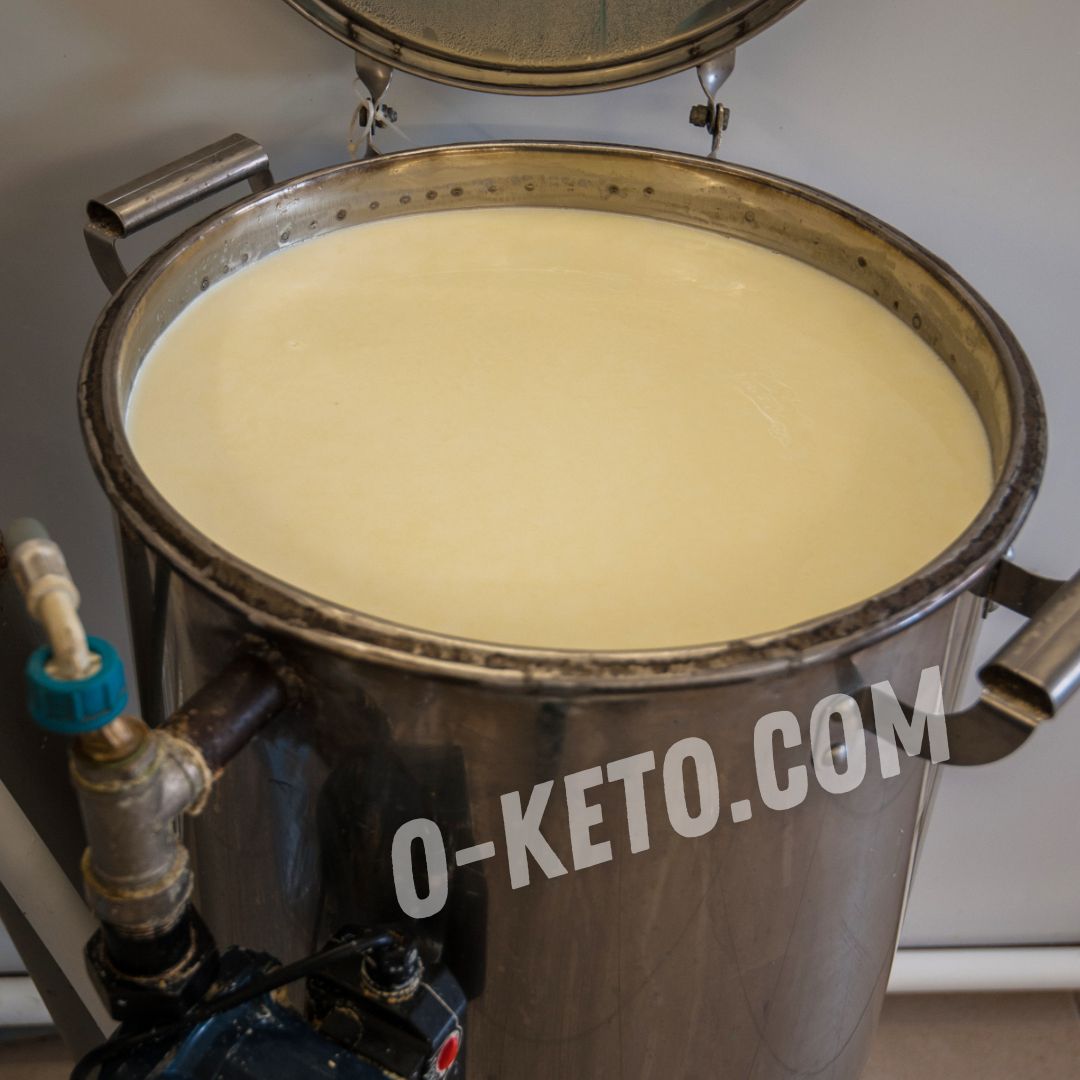

One of the key stages in cheese production is adding the starter culture. Starter bacteria determine the speed of acidification, help milk move toward proper curd formation, influence flavor, aroma, elasticity, and the behavior of the curd during later steps. If the culture is chosen for the wrong cheese style, added to milk that is too hot or too cold, or simply works too slowly, that almost always shows up later: the curd may be weaker, whey may separate poorly, and the finished cheese may move either toward excessive acidity or toward a flat, overly milky profile.
So the question is not only which culture to use, but also how exactly to add it, how long to allow for activation, and how to assess culture performance during the make.
What mesophilic and thermophilic cultures are
Starter cultures are bacterial cultures that ferment milk and gradually convert lactose into lactic acid. Mesophilic cultures are active at more moderate temperatures, commonly in the 20-40°C range, while the working zone for many home cheeses is closer to 30-34°C. Thermophilic cultures feel more comfortable at higher temperatures, often around 38-45°C, and are therefore better suited to technologies where the curd is heated more strongly later on.
The distinction matters for more than just temperature. Mesophilic cultures more often give a softer, creamier, calmer profile, while thermophilic cultures tolerate heat better and are more commonly involved in dense, stretchy, or long-aged cheeses. In practical cheesemaking, the combination of culture, temperature, and acidification speed largely determines how predictably the milk will behave.
Why starter culture is added
Starter culture is added for several reasons at once.
- Acidifying the milk. Bacteria convert lactose and gradually lower pH. That affects rennet performance, curd strength, and whey separation.
- Building flavor and aroma. Different strains create different profiles, from neutral and creamy to more nutty, cultured, or sharper.
- Creating the right texture. Some cultures are better for soft cheeses, while others help produce a denser curd and a drier body for aging.
- Controlling microflora. A healthy active starter occupies the environment faster and reduces the chance that random microbes will spoil flavor and texture.
The culture does not work separately from the rest of the process. It is closely linked to milk quality, pasteurization, calcium chloride, rennet timing, and the temperature schedule. That is why the same culture can perform well in one batch and poorly in another if milk quality or process conditions change.
How to add starter culture
In summer there is often no benefit in stretching out the starter wake-up phase for too long. If the milk already holds its working temperature well and the room is warm, the culture usually starts without much delay. In that situation it matters more to distribute it evenly than to prolong the waiting step and quietly accelerate total acid development before you even notice it.
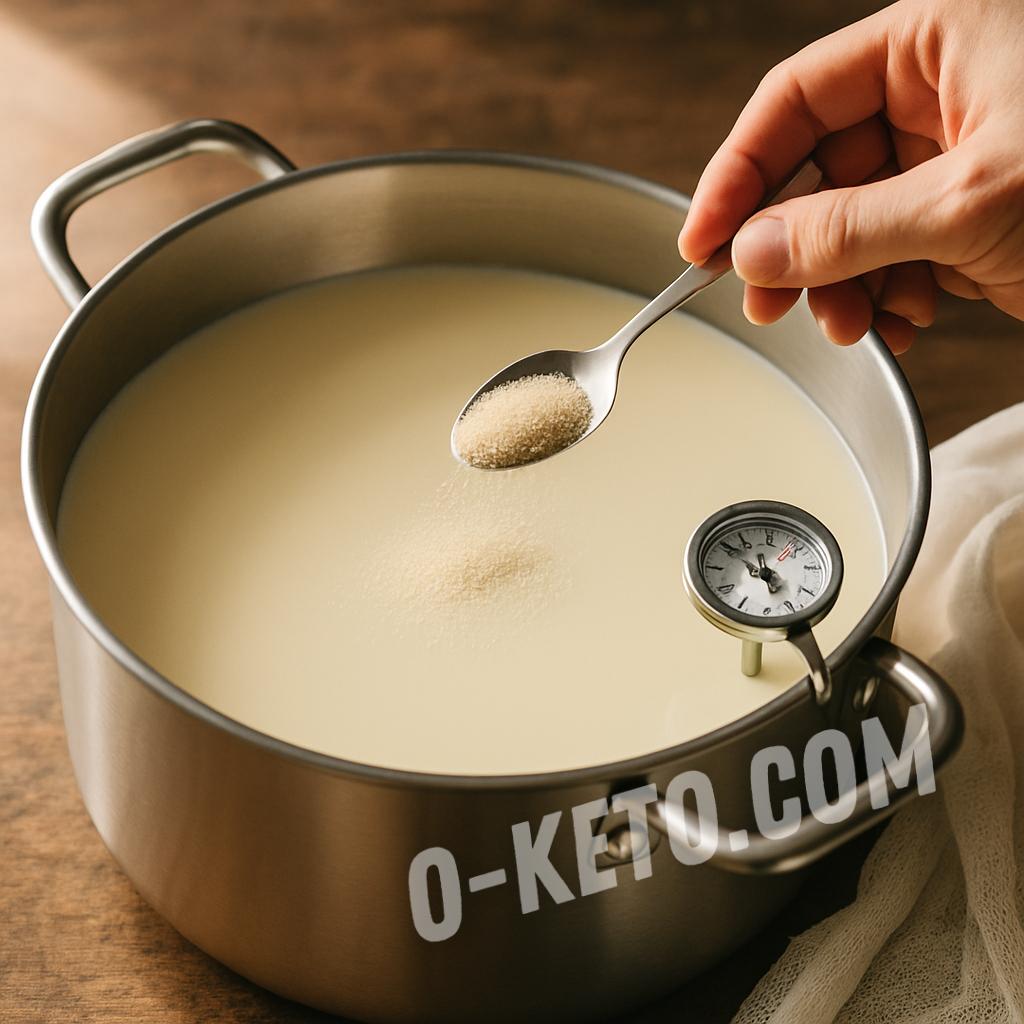
The process begins with preparing the milk. It is brought to a temperature suitable for the specific culture and recipe. For mesophilic cultures this is often around 30-34°C, while for thermophilic cultures it is commonly around 38-43°C. From that point on, calm and careful handling matters.
If you keep the culture in the freezer, let it warm slightly in the unopened package. After measuring what you need, return the remainder to the cold immediately so the culture does not go repeatedly through unnecessary freeze-thaw cycles.
Dry DVI cultures are usually sprinkled in a thin even layer over the milk surface and left for 2-3 minutes so the powder can hydrate. The milk is then stirred gently with a ladle or paddle to distribute the culture through the full volume. Dumping everything into one spot and whipping aggressively reduces even distribution and introduces unnecessary air.
Liquid cultures or prepared working cultures are added in a way that allows them to spread quickly and evenly through the milk. After addition, the culture should usually have a little time to begin working before rennet is added, if that is what the technology requires.
What working cultures are and when they matter
Besides direct inoculation from a dry packet, cheesemakers also use working cultures, meaning starter cultures that have been grown in advance. This is convenient when cheese is made regularly and a maker wants more predictable performance without opening a fresh dry packet every time. A working culture gives more control over activity, but it also requires cleanliness, good storage, and an understanding that the starter itself ages and can weaken.
For many beginners, direct inoculation from a fresh packet is usually simpler and safer because contamination risk is lower and there are fewer variables in activity. Working cultures make more sense when you already understand your process well and can track acidification by time, texture, and curd behavior rather than only by guesswork.
Acidification speed and why it matters so much
In summer this becomes even more sensitive. Warm-weather milk often reaches the vat with a higher microbial load, and after the starter is added both the room and the milk itself stay in a bacteria-friendly temperature range for longer. As a result, the same culture that felt calm in winter may acidify much faster in summer and push the curd toward a drier, sharper direction earlier than expected.
The practical conclusion is simple: do not copy winter timing blindly into summer work. It is better to watch the real speed of acid development, curd strength, and grain behavior than to trust the clock alone. If the same milk begins to acidify faster than usual, that does not automatically mean the starter dose was wrong; often the seasonal background of the milk itself has changed.
One of the main jobs of a culture is not simply to sour the milk, but to do so at the right speed. If acidification is too slow, rennet may perform worse, the curd may be weaker, and the curd may lose more fat and protein into the whey. If acidity develops too quickly, the curd can start drying and tightening too early, and the finished cheese may move toward a harsher acidic flavor.
Acidification speed depends on culture activity, temperature, milk quality, antibiotic residues in milk, how long the milk was stored before the make, and how accurately the heat schedule was maintained. In home cheesemaking, it is important not only to remember target temperatures, but also to observe how the milk behaves in reality. If recent batches from the same milk have become noticeably more acidic or, on the contrary, take much longer to reach the expected stage, it is a reason to re-check dose and conditions.
Which type of culture to choose
It is best to use the type of culture specified in the recipe. Still, it is useful to understand the logic behind the choice.
Mesophilic cultures suit cheeses that do not require strong heating and are not stretched or processed in very hot water. They are common in soft and semi-hard technologies. Typical examples include cheddar, gouda, camembert, brie, feta, and many creamy cheeses.
Thermophilic cultures are needed where the curd is heated more strongly and where heat tolerance matters. They are typical for parmesan, gruyère, emmental, pecorino, mozzarella, and other cheeses with more intensive thermal treatment.
Some recipes use mixed schemes in which mesophilic and thermophilic cultures work together. This can help combine the desired acidity, flavor, and texture. But such substitutions should be made only when you understand why the combination is needed, not simply because another packet happened to be available.
How to choose cultures for blue cheeses
Blue cheese does not mean one universal starter choice for the whole family. Even within blue-veined cheeses, the technological goals differ a lot. If the cheese is meant to be drier and to develop internal openings, as in stilton or shropshire styles, the starter needs to guide the curd toward a more gathered and relatively dry body. If the goal is a softer cheese with openings, as in many dana blue, roquefort, or dorblu-style cheeses, the culture should support a moister and more plastic texture. And for soft veined cheeses such as gorgonzola and a number of Italian, Spanish, and Portuguese blue cheeses, it is especially important not to overdry the paste or drive acidity too fast.
In practice, that means the starter choice for a blue cheese begins not with the word blue, but with the style question: dry or soft, with openings or with veins, more crumbly or more creamy. The same base culture may help mold develop well in one cheese and ruin the moisture-texture balance in another. That is why blue cheeses need cultures chosen for the specific body, moisture level, and acidification pace rather than an abstract “starter for mold cheese.”
Why you cannot choose a substitute only by formal composition
The most common substitution mistake is to look only at the formal list of bacteria on the package. In practice that is not enough. Even if two cultures list similar microorganisms, that does not mean they will behave the same way in milk or produce the same cheese. In cheesemaking, not only the bacterial species matters, but also the strain, the speed of acidification, the intensity of proteolysis, the effect on aroma, and the fit with a specific technology.
That is why a cheese made by the same make sheet but with a different culture can shift noticeably in both flavor and structure. This is especially obvious in soft and semi-hard cheeses, where aroma profile and ripening behavior become noticeable quickly. In hard cheeses, technology has a stronger effect on density and drying, but the culture still determines a major part of the final taste.
Different manufacturers may publish almost identical compositions while using different strains within those same bacteria. And strains differ in what they actually do. One thermophilic streptococcus may drive more active protein breakdown and deeper flavor, while another may produce a calmer and more even result. The name on paper looks the same, but the cheese matures and tastes differently. That is why evaluating a substitute only by the species list is too rough and too unreliable.
Why culture is chosen by function rather than by name
In a good recipe, a starter culture is chosen not because “a mesophile was available” or “this is also a thermophile,” but because it performs a specific function. Some cultures are used for basic acid development, others build stronger aroma, others help produce the right elasticity, and others act as supplementary ripening cultures. When that logic is ignored, the cheese often does not turn out ruined, but it does stop being the intended style.
It is more useful to identify the cheese family first and only then pick the culture. In the pasta filata group, for example, a similar outward technology does not mean the cultures will be the same. Caciocavallo is usually built on a non-viscous thermophilic streptococcus, while suluguni more often requires a meso-thermo scheme. If both cheeses are made on the same culture, external shape differences may remain, but their flavor and internal character can become much closer to each other than desired.
The same rule applies to author-driven recipes. If a recipe uses a certain culture set to build a specific creamy, nutty, more piquant, or more neutral profile, a mechanical substitution can pull the cheese in another direction. That is why culture should be chosen not by “something similar was found,” but by the actual technological role it performs in that make.
Common mistakes when adding starter culture
- Milk that is too hot. Some bacteria weaken or die, and the culture can no longer deliver the needed acidification speed.
- Milk that is too cold. The culture takes too long to wake up and the entire process shifts later.
- Adding rennet too early. The culture has not yet begun working properly, and the milk enters coagulation in a less favorable state.
- Uneven distribution of powder. One zone works faster, another more slowly, and the batch becomes less homogeneous.
- Using an old or badly stored culture. It may fail to deliver expected activity even at the right temperature.
- Blindly replacing a mesophilic culture with a thermophilic one or the reverse. Sometimes that does not create a disaster, but often it shifts acidity and texture away from the target.
Starter culture storage
Unopened culture should be stored in a cool, dry place away from light and humidity. After opening, it is best to close the package tightly and minimize contact with air. In many cases the refrigerator is optimal, while the freezer may be better for long-term storage if the producer allows it.
What matters most is not simply freezing, but stability. Frequent warming and re-cooling cycles reduce activity. If the package is large, it is often more practical to divide it into several small airtight portions in advance.
What can replace starter culture
At home, in the absence of specialized cultures, some people use sour cream, kefir, or natural yogurt with live cultures. But these are not full equivalents of professional starters. They are compromises, and they are less predictable in both acidification speed and microflora composition.
Sour cream and kefir are more suitable for simple soft home cheeses and fresh curd-style products. Natural yogurt can partly replace a thermophilic culture in some soft technologies, but it does not guarantee exact repetition of the intended result. If the goal is repeatable production of a specific cheese with a defined texture and flavor, a specialized starter culture is almost always the more reliable choice.
Sources
- Mesophilic and Thermophilic Cultures Used in Traditional Cheesemaking
- Lactic Acid Bacteria in Raw-Milk Cheeses: From Starter Cultures to Probiotic Functions
- Use of Starter Cultures in Foods from Animal Origin to Improve Their Safety
- Symposium review: Interaction of starter cultures and nonstarter lactic acid bacteria in the cheese environment
- Flavour formation by lactic acid bacteria and biochemical flavour profiling of cheese products
- Lactic acid bacteria as starter cultures: An update in their metabolism and genetics