


E122 (azorubine, carmoisine)
Azorubine, also called carmoisine, is a synthetic red azo dye used for raspberry, cherry, and pink shades. In low-carb eating, E122 matters not as a carbohydrate, but as a marker of sweet ultra-processed products and possible sensitivity.
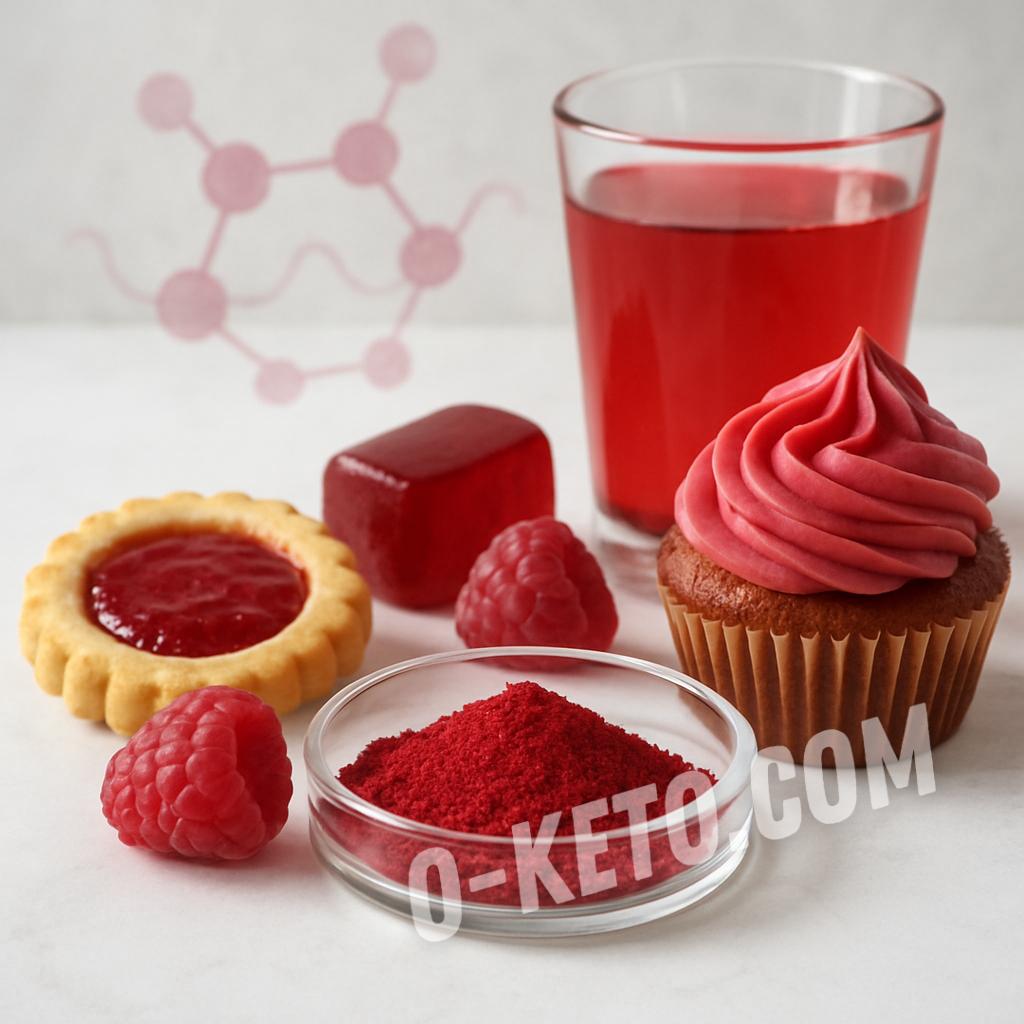
E122 is azorubine, also known as carmoisine, a synthetic red azo dye. It provides red, raspberry, cherry, and pinkish shades in drinks, desserts, sweets, sauces, chewing products, and some supplements. Unlike carmine E120, azorubine is not derived from insects. It is a purely technological colorant used for product appearance. Its role is to create stable red color, not to add berries, vitamins, protein, or other nutritional value.
What this colorant is
Azorubine belongs to water-soluble synthetic azo dyes. It is convenient for manufacturers because it provides a bright and fairly stable color that can be used alone or with other colorants. Red shades often create expectations of strawberry, raspberry, cherry, pomegranate, or berry filling. But color does not tell you how much real fruit is present. In an industrial formula, fruit may be replaced by flavoring, acidity by citric acid, sweetness by sugar or sweetener, and E122 simply supports the visual impression.
Where E122 is found
E122 may appear in carbonated drinks, syrups, jellies, gummies, hard candies, chewy sweets, desserts, ice cream, yogurt-like products, sauces, decorations, and some medicinal or vitamin forms. It often appears in products with a berry or fruit image. If a product is bright red, sweet, and flavored, the colorant is not the only thing to evaluate. Sugar, syrups, starch, maltodextrin, polyols, acids, benzoates, other colors, and serving size matter. These factors more often determine effects on appetite and glucose.
Relevance for keto and LCHF
E122 itself is not a carbohydrate and should not directly raise glucose. But products in which it appears are often built around sweet taste. In low-carb nutrition, the problem may not be azorubine itself, but the product it makes more attractive: a sweet drink, lozenge, jelly, dessert, sugary sauce, or starch-containing mix. Even a sugar-free product may maintain the habit of bright sweet taste. E122 should therefore be read as a signal to inspect the ingredient list more carefully, not as a standalone criterion of keto compatibility.
Sensitivity and warning
Azorubine belongs to the group of colors for which the European Union requires, in relevant uses, a warning about possible adverse effects on activity and attention in children. This does not mean every child or adult reacts to E122. But if someone already has hives, asthma, reactions to bright sweets, headaches, itching, or behavioral changes after certain drinks and candies, azorubine is worth tracking. It is useful to record specific colorant codes, because a reaction to E122 does not automatically mean a reaction to carmine, curcumin, or riboflavin.
Do not confuse it with other red colorants
E122 is easy to confuse with other red codes: E120, E123, E124, and E129. These are different substances. E120 is carmine from cochineal, E123 is amaranth, E124 is Ponceau 4R, and E129 is Allura Red. For a person with vegan restrictions, E122 differs from E120 because it is not insect-derived. For a person sensitive to synthetic azo dyes, the opposite may be true: E122 may matter more than carmine. It is better to check the exact code and name, not only the fact that the color is red.
Practical conclusion
E122 is a colorant for visual identity, not proof that a product contains berries or has health value. For keto and LCHF it usually does not add carbohydrates, but it often accompanies foods that work poorly for stable appetite: sweet drinks, jellies, candies, and dessert mixes. If the product is occasional, sugar-free, and well tolerated, azorubine may be a secondary detail. If such products appear daily or cause symptoms, reducing them and checking the ingredient list is wiser. Red color should prompt label reading, not trust in a fruit image.
If you have any questions about the term "E122 (azorubine, carmoisine)", you can ask them to AI. Please note, a low-cost OpenAI model is used. It may answer questions about disease treatment with errors!


 1 / 4
1 / 4


 1 / 4
1 / 4 1 / 4
1 / 4 1 / 4
1 / 4 1 / 4
1 / 4