


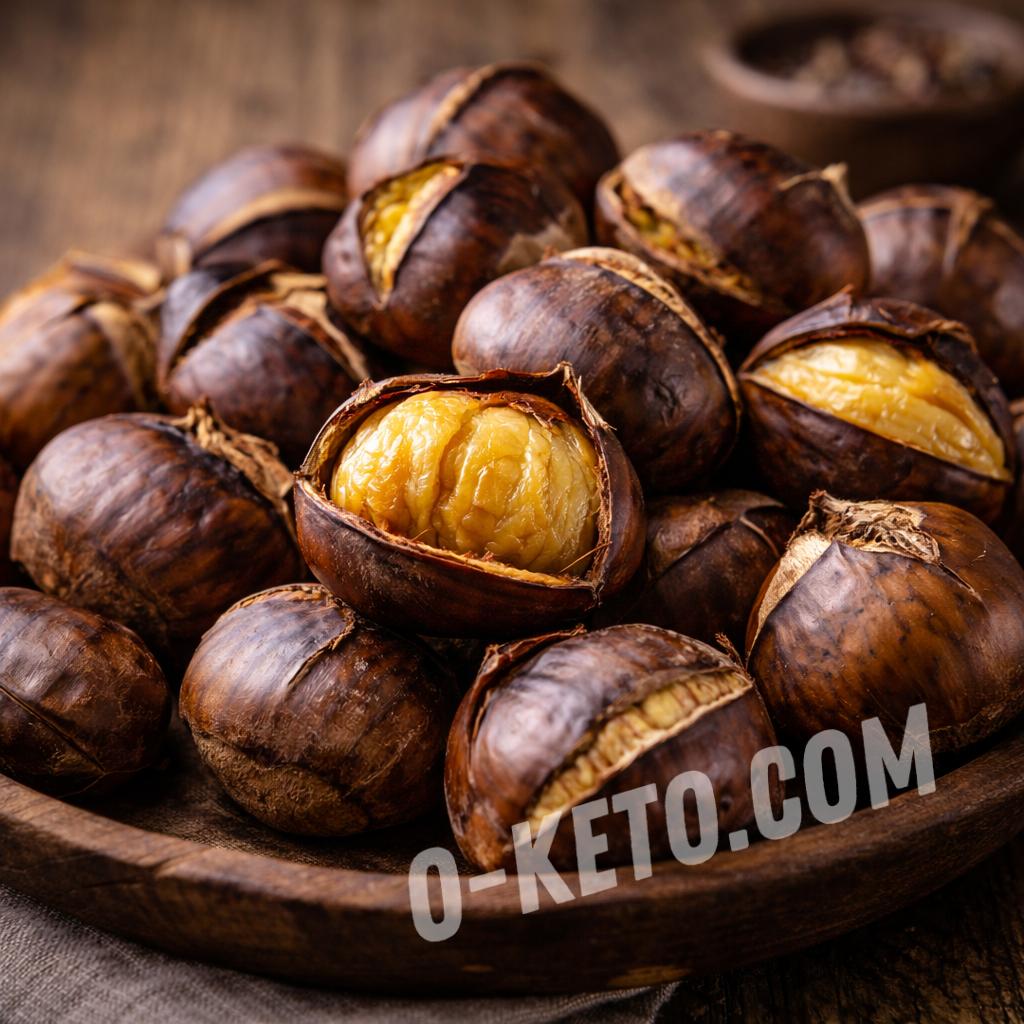

Roasted chestnuts are a seasonal food with a soft floury texture, a sweet taste, and a warm nutty aroma. They are sold on the streets in Europe, Asia, and the Caucasus, and they can be prepared at home in the oven, in a dry pan, or over an open fire. Despite being grouped with nuts in everyday speech, chestnuts are very different from almonds, hazelnuts, or pecans: they are low in fat and rich in starch.
Historically, chestnuts were more than a treat. In mountain regions of Europe, they were dried, ground into flour, added to bread, soups, and fillings. That explains their nutrition profile: chestnuts are closer to a starchy side dish than to a fatty nut. After roasting, the shell comes off and the flesh becomes soft, dense, and mildly sweet, somewhere between potato, sweet root vegetable, and nut.
Nutrition
In 100 g of roasted chestnuts, there are usually about 200-210 kcal, 2-3 g of protein, 1-2 g of fat, and roughly 44-46 g of carbohydrates, part of which is fiber. They contain potassium, magnesium, copper, B vitamins, and a little vitamin C, but the main macronutrient is starch. For that reason, chestnuts should not be judged like high-fat nuts.
The glycemic index of chestnuts is often listed in the medium range, around 50-60. The actual response depends on portion size, cooking level, and the rest of the meal. For practical use, the main point is enough: even a small bowl of roasted chestnuts brings a noticeable amount of carbohydrates.
Keto and LCHF
Roasted chestnuts are usually not suitable for strict keto. In 100 g, they may contain about 45 g of carbohydrates, which means one serving can use up or exceed a daily limit. Even when some carbohydrate comes with fiber, the starchy base remains. Chestnuts are better treated as a high-carbohydrate seasonal food, not as a keto nut.
On a more flexible low-carb approach, a small tasting portion may be possible if it is planned in advance. In that case, do not combine chestnuts with bread, grains, sweet sauces, potatoes, or desserts. A calmer plate would be a little chestnut next to meat, poultry, greens, mushrooms, or cheese, where the starchy element remains a small accent.
How they are prepared
Chestnuts must be scored before roasting. If the shell is left whole, steam builds inside and the chestnut can burst. Usually a cross-shaped or long cut is made on the rounded side, then the chestnuts are cooked in the oven, in a covered pan, or over fire. After cooking, they are often covered briefly with a towel: the steam helps loosen the shell and inner skin.
A cooked chestnut should be soft, but not wet or rubbery. If the flesh is hard, it is undercooked; if it is dark, dry, and bitter, it may be overdone or burned. Chestnuts are easier to peel while warm. Once fully cooled, the inner skin often sticks more firmly.
How to choose
Raw chestnuts for roasting should feel heavy for their size, smooth, glossy, and free from holes, mold, or soft spots. Light chestnuts that rattle inside are often dried out. If the shell is wrinkled and spotted, quality is already dropping. For even cooking, choose chestnuts of similar size.
Ready roasted chestnuts should smell sweet and nutty, without the smell of old oily smoke, mold, or sour dampness. Street-roasted chestnuts are best eaten right away: after sitting for a long time, they become dry, peel worse, and lose aroma. At home, cook only as much as you can eat within one or two days.
How to use them
Roasted chestnuts are eaten as a hot snack, added to side dishes, poultry fillings, mushroom dishes, stewed cabbage, meat sauces, and savory purees. In desserts, they pair with cream, vanilla, cocoa, and rum, but for a low-carb diet those versions are usually too high in carbohydrates, especially if sugar is added.
In savory dishes, chestnut works well with duck, turkey, pork, mushrooms, rosemary, thyme, butter, and soft cheeses. Its flavor is gentle, so strong spices can easily cover it. If you want to keep the chestnut character, use salt, pepper, a little fat, and one or two herbs rather than a complicated seasoning blend.
Storage and substitutes
Raw chestnuts keep worse than dry nuts because they contain more moisture. Store them in the refrigerator in a bag with a little air exchange and check them regularly for mold. Cooked chestnuts should go into a closed container and be eaten quickly. For longer storage, peeled flesh can be frozen, but after thawing it is better for purees and fillings than for neat whole presentation.
If you need a keto option with a nut-like role, chestnut is usually replaced not by a similar flavor but by a food with a different macro profile: pecans, macadamias, almonds, or walnuts. If you need the soft starchy texture specifically, there is no full low-carb substitute; cauliflower puree can play a similar role in savory dishes, but the taste will be completely different.


