


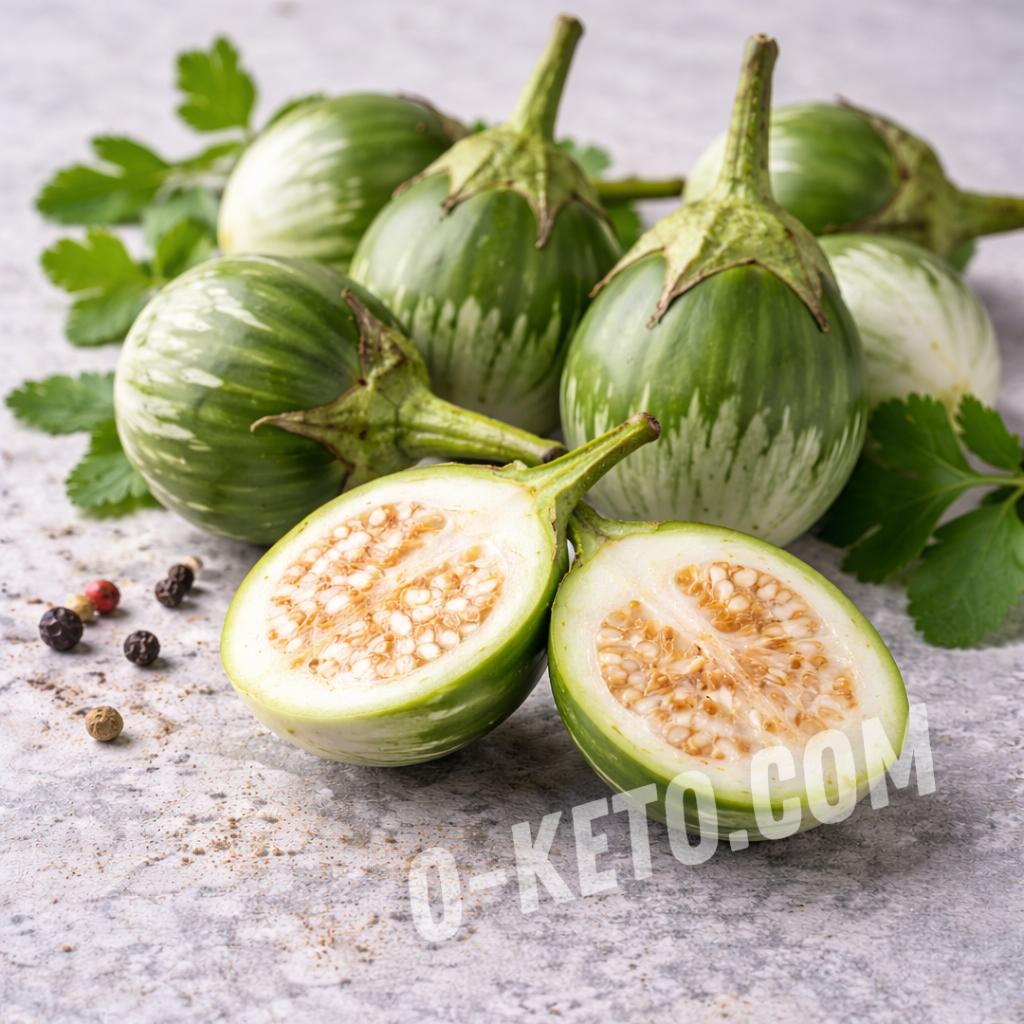

Thai eggplants are small round fruits often used in Thai cooking and other Southeast Asian cuisines. They can be green, white-green, yellowish, or tiny like peas. Their taste is grassy and slightly bitter, while the flesh is firm, so in curries and soups they do not fall apart as quickly as many large eggplants.
These eggplants are valued not for sweetness but for texture. They add crunch or firmness, absorbing coconut milk, fish sauce, curry paste, chili, and garlic. In Thai cooking, they may be cooked until soft or left slightly firm so the sauce still has a fresh vegetable note.
Varieties
The best-known Thai eggplants are round green fruits about the size of a small plum. They are often cut into quarters and added to green curry. White-green striped varieties are usually milder. Yellowish fruits are often more mature, with firmer skin and stronger bitterness. Pea eggplants are a separate type: tiny fruits added to hot pastes and sauces.
All these options belong to the nightshade family, so culinarily they are closer to eggplants, peppers, and tomatoes than to herbs or root vegetables. They should be replaced with products that similarly hold shape and absorb sauce.
Nutritional value
In 100 g of fresh Thai eggplants there are usually about 20–30 kcal, around 1 g of protein, less than 0.5 g of fat, and about 5–6 g of carbohydrates, some of which is fiber. Exact values depend on variety, ripeness, and fruit size. The glycemic load of a normal serving is low if the eggplants are not cooked in a sweet sauce.
They contain potassium, magnesium, folates, vitamin C, vitamin K, plant fibers, and phenolic compounds. But in keto cooking their main role is practical: they add volume and firm texture without requiring grains, noodles, or a starchy base.
Are they suitable for keto?
Thai eggplants can be used in keto and LCHF if the portion and sauce are controlled. A 100–150 g serving usually fits a low-carb plate, especially when paired with protein and fat: chicken, beef, shrimp, fish, eggs, coconut milk, or ghee.
The main keto issue is not the eggplants themselves but ready pastes and sauces. Curry paste, fish sauce, oyster sauce, or marinade may contain sugar, starch, or syrups. When buying ready Thai mixes, it is better to read the ingredients and at home balance the dish with unsweetened coconut milk, spices, and protein.
How to cook them
Round Thai eggplants are usually cut into halves or quarters and quickly placed in salted water so the cut sides do not darken. The water is drained before cooking. In curry, they are added closer to the middle of cooking: they soften but do not turn into puree.
If bitterness is too noticeable, the fruits can be soaked in salted water for 20–30 minutes. For stir-frying, high heat and a short time work best: the eggplants should brown outside and remain firm inside. In coconut milk soups, they pair well with lemongrass, galangal, lime, cilantro, chili, and basil.
In dishes with long simmering, Thai eggplants should not be overcooked. If added too early, the skin separates and the flesh loses firmness. For a neater texture, add them after meat and dense vegetables, but before tender greens and fresh basil.
How to choose
Choose firm fruits with smooth skin, without soft spots, cracks, or wrinkles. Green eggplants should look fresh, with a resilient calyx. Very large and yellow fruits may be more bitter and seedy. For curry, similar size is convenient because the pieces cook evenly.
If the fruits are bought for raw or half-crisp serving, freshness matters especially: the skin should have a slight shine, and the calyx should not be dry. Older eggplants more often have tough seeds and rough bitterness that is harder to reduce even by soaking.
How to store them
Thai eggplants are stored in the refrigerator in a bag or container with some airflow. It is better to wash them before cooking, not in advance. After cutting, the flesh darkens quickly, so pieces are used at once or briefly placed in cold salted water.
What can replace them?
The closest replacement is small firm eggplants cut into large pieces. In curry, zucchini, green beans, mushrooms, or bell pepper can also work, but flavor and texture will differ. Pea eggplants in hot pastes can simply be skipped if only the overall aroma of the dish is needed.


