


Bile duct bend
A bent or kinked gallbladder is an anatomic variant or deformation that is not always harmful by itself, but may influence gallbladder emptying, tolerance of fatty meals and bile stagnation risk when it matches real symptoms.




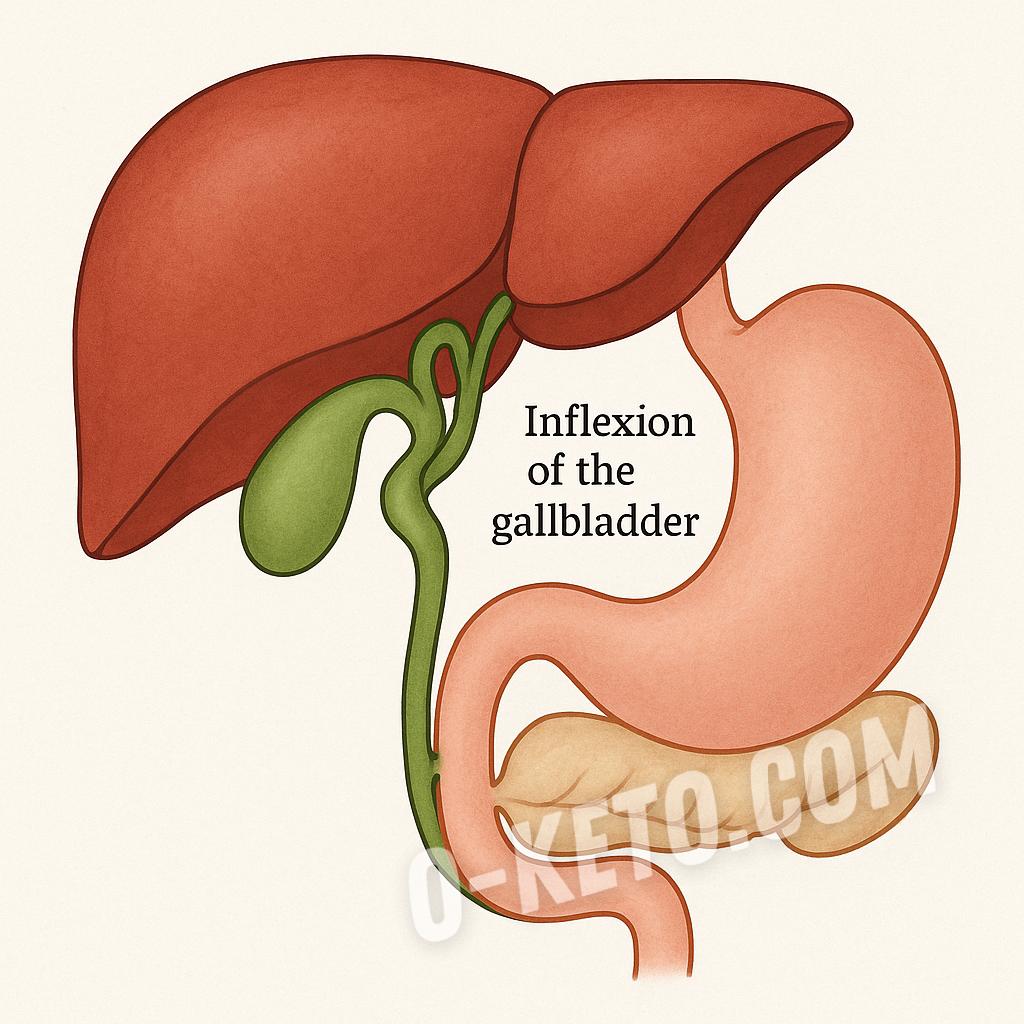
A bent or kinked gallbladder is a change in shape that is often reported on ultrasound and can worry people simply because of the name. It is important to understand, however, that a bend does not automatically mean disease and does not explain every symptom after eating. In some people it is an incidental anatomical feature with no major consequence. In others it may coexist with poorer gallbladder emptying, bile stagnation, meal-related discomfort and greater sensitivity to eating pattern. That is why its importance is defined not only by imaging, but by how the gallbladder actually behaves in daily life.
Why it is not always a diagnosis
Gallbladder shape may reflect a congenital variant or may be influenced functionally by contractions, inflammation, adhesions and other factors. The mere fact that an ultrasound report mentions a bend does not prove a real disorder. Often the actual problem is not shape itself, but less effective emptying, delayed bile flow and the buildup of heaviness, bitterness, nausea or poorer tolerance of heavy meals. That is why it is important to separate a structural description from clinically meaningful bile-flow dysfunction.
A common mistake is to blame every right-sided digestive symptom on the bend without checking for other causes or complications.
Which symptoms may really be related
If the bend interferes with normal emptying, a person may feel heaviness after meals, pressure under the right rib cage, bitterness, nausea, worsening after very fatty food and episodes of more obvious discomfort. Yet these complaints are not unique to a kinked gallbladder and may also occur with bile stasis, inflammation, stones, dyskinesia and other disturbances. It is therefore important to match symptoms with ultrasound findings, liver-related markers, meal tolerance and overall GI motility rather than assume the shape alone explains everything.
That is what helps distinguish an incidental finding from a situation in which gallbladder function is genuinely impaired.
What influences daily tolerance
Large heavy fatty meals, overeating, long gaps without food, rapid weight change and a generally stagnant routine may all make symptoms more noticeable. In some people low stomach acid, slow gut motility, low activity level or already existing bile-flow problems contribute as well. Nutrition should not turn into permanent fear of every gram of fat, but the idea that shape never matters at all is not always honest either when certain patterns repeatedly trigger discomfort.
In practical terms it is more useful to look for a routine in which the gallbladder handles load more evenly than to fight one specific food forever.
How to read imaging with neighboring data
An ultrasound phrase by itself means little without clinical context. It matters whether there are signs of bile stasis, wall change, sludge, stones, bilirubin or enzyme shifts, pain episodes and digestive complaints. If none of that is present, the bend may remain simply a description of shape. If symptoms and neighboring markers do line up, then the relevant discussion is not the word “bend” itself, but the functional state of gallbladder emptying and bile flow.
This is another example in which an imaging description should never live separately from symptoms and the rest of the evaluation.
When a closer review is needed
A closer review is needed with recurrent right-sided pain, nausea, poor food tolerance, signs of bile stagnation, inflammatory episodes, stones or years of attributing everything to “the bend” without real clarification. The most sensible way to see this finding is as a possible anatomical-functional factor that is not always dangerous by itself, but becomes important when it truly correlates with stasis, pain and impaired gallbladder emptying.
Common interpretive mistakes
A frequent mistake is to either fear this finding as a major disease or dismiss it completely without considering symptoms. A bend becomes relevant not because of its name, but because of whether it correlates with poor emptying, stasis, pain or meal intolerance. It is the clinical match, not the wording alone, that turns a shape description into meaningful information.
If you have any questions about the term "Bile duct bend", you can ask them to AI. Please note, a low-cost OpenAI model is used. It may answer questions about disease treatment with errors!


 1 / 4
1 / 4


 1 / 4
1 / 4
 1 / 4
1 / 4