Homemade sauces rarely fail for mysterious reasons. Most of the time something went wrong at one of a few predictable moments: the fat was added too quickly, the base was too hot or too cold, the emulsion was weak before the fat even went in, the sauce was reduced too far, or the final seasoning was corrected too late and too aggressively. The useful part is that many of these problems can still be reversed. A sauce that looks broken is often repairable if you respond to the right kind of failure instead of stirring harder and hoping for luck.
This matters even more in low-carb and keto cooking because many homemade sauces are built from sensitive ingredients such as butter, cream, egg yolks, yogurt, cheese, stock, olive oil, or mayonnaise-style emulsions. These ingredients give body, satiety, and flavor, but they also react strongly to temperature, order of mixing, and reheating. Once you understand the logic behind the most common mistakes, sauces become far less fragile than they seem.
Why sauces split and how to prevent it
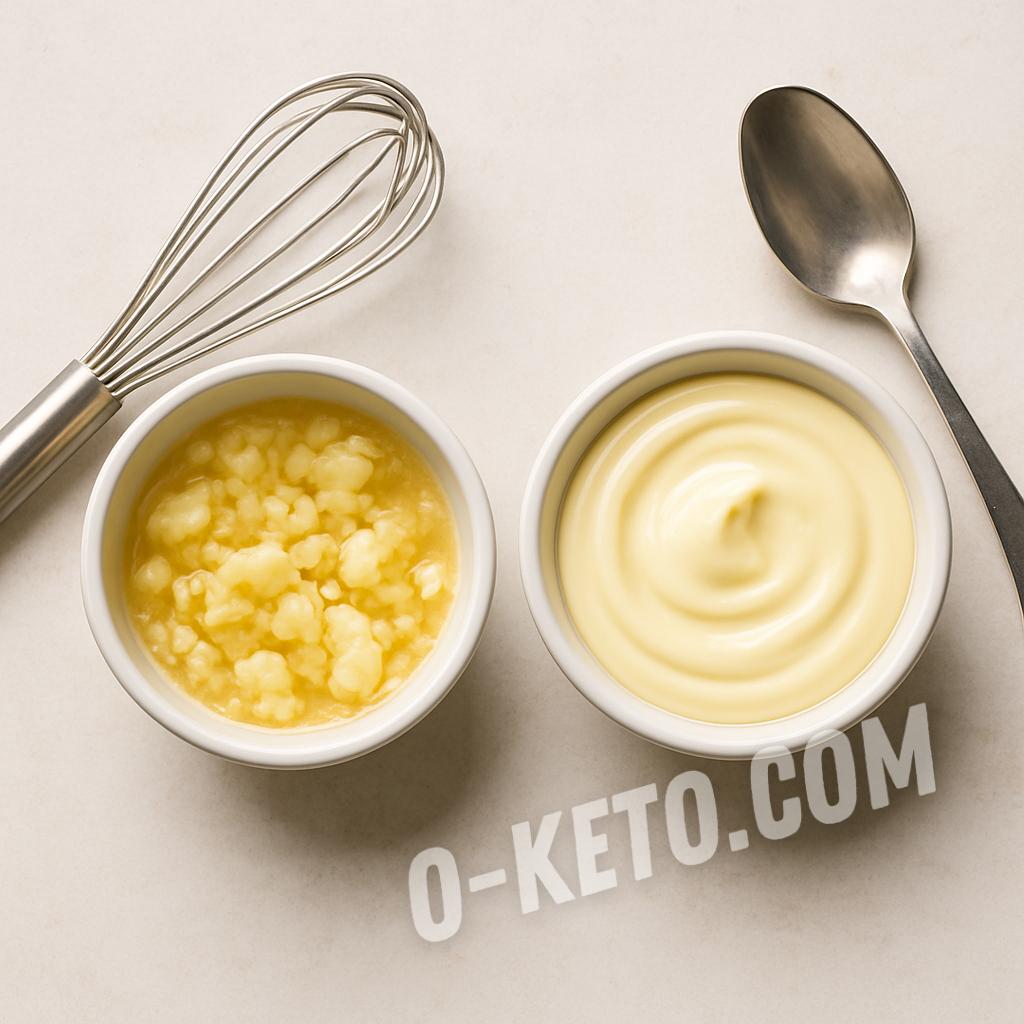
Splitting almost always means that the emulsion failed. In cold sauces such as mayonnaise, aioli, or vinaigrette, the usual reasons are fat added too quickly, ingredients at very different temperatures, or an underdeveloped base that was never stable enough to hold the oil. In hot emulsified sauces such as hollandaise, splitting often comes from overheating, adding butter too fast, or letting the sauce cool enough that the fat begins to set and separate from the water phase.
Prevention is mostly about patience. Cold emulsified sauces work best when the ingredients are close in temperature and the base is mixed well before the fat is introduced. Oil should enter gradually, especially at the beginning, when the emulsion is just forming. Hot emulsified sauces need gentle heat, not aggressive boiling. Once the temperature climbs too high, even a good mixture can become grainy or split.
How to rescue a split cold sauce
If a mayonnaise-style sauce breaks, the most reliable fix is to build a new base. Start with a fresh yolk, a little mustard, or even a spoonful of water, whisk it until smooth, and then slowly add the broken sauce as if it were the oil phase of a new emulsion. What failed a minute ago can become useful again once it is fed into a stable structure.
When the break is mild rather than total, a smaller correction can work. One teaspoon of cold water and energetic whisking sometimes pulls the sauce back together. This approach is not universal, but it is worth trying before rebuilding from scratch. The key is to avoid dumping in a lot of liquid at once, because then the problem shifts from splitting to thinning the sauce too far.
How to deal with a split hot sauce
Hot sauces need gentler rescue. If a hollandaise-like sauce breaks, it usually helps to create a warm soft base instead of trying to force the old one back together with more heat. A practical home method is to warm a little heavy cream until hot but not boiling, place it in a bowl, and then gradually whisk in the broken sauce. Slow incorporation matters more than power here.
If the sauce split because it cooled too much, warm it first on a water bath or steam bath instead of putting it over direct high heat. Direct heat often finishes the damage. Once restored, a hot emulsified sauce is still not a good candidate for long cold storage and repeated reheating. These sauces are structurally delicate even when they look smooth again.
When the sauce is too thin or too thick
A sauce that is too thin usually was not reduced enough or never developed enough structure. With meat sauces, mushroom sauces, cream sauces, or stock-based sauces, reduction is usually the first real solution. The useful test is not the timer but the way the sauce behaves on a spoon. Many sauces also thicken more as they cool, so it is easy to panic too early and overcorrect.
When a sauce is too thick, it should be loosened with the right warm liquid for that sauce: stock, water, cream, milk, wine, or lemon water depending on the formula. Add it in small amounts and mix fully each time before deciding whether more is needed. Emulsified sauces are often loosened best with room-temperature water, while hot cream or stock sauces respond better to warm liquid so the texture does not take a temperature shock.
How to remove lumps
Lumps usually appear when flour or another thickening phase was added to a base that was too hot, or when the roux was not properly cooked before liquid entered the pan. The ingredient itself is not always the whole problem. The transition between stages is what usually fails. If the sauce already has lumps, straining it through a fine sieve is often the cleanest first step.
Blending is another option, especially when the sauce is otherwise flavorful and only the texture failed. The tradeoff is that blending can make a sauce slightly thinner, so after blending it may need a short controlled reduction. The more reliable preventive habit is to cook the roux properly and combine it with a base that is not violently hot at the moment of mixing.
How to correct a sauce that is too sour, too salty, or too hot
Too much acidity, salt, or heat is rarely fixed by one magic addition. It is usually corrected through balance. Excess acidity is softened by fat: butter, heavy cream, cream cheese, rich yogurt, mascarpone, or a little more oil if the sauce format allows it. In low-carb home cooking, a tiny amount of allulose or erythritol can round the edge without turning the sauce sweet, but sweetness should remain a subtle correction rather than a new dominant taste.
For oversalting, the safest strategy is to increase the total volume with an unsalted version of the same style of base. That could mean more unsalted stock, extra cream, soft cheese, more yogurt, or a second unsalted tomato base. Excess heat is also usually softened by fat rather than by water alone. The most important habit is to adjust one axis at a time and taste after every small correction.
Burning, flat flavor, and reheating damage
A scorched sauce usually comes from high heat, a thin pan, or reduction without enough stirring. If that happens, transfer the sauce immediately into a clean vessel without scraping the bottom. A little cream or butter can sometimes soften a faint burnt note, but once the smell is strongly scorched, the defect is often only being hidden, not truly removed.
A flat sauce is a different problem. It may not be damaged at all. It may simply lack salt, acidity, fat, or umami. Mushroom sauces often need a little more butter or a drop of sugar-free soy sauce. Meat sauces may benefit from stronger stock or pan juices. Cheese sauces may need a more expressive cheese. The useful rule is to correct one dimension at a time instead of throwing several strong ingredients in together.
Storage and reheating can create a second wave of failure even after good cooking. Hot emulsified sauces split easily when chilled and reheated. Sauces stored in loose containers pick up outside smells. Uneven microwave heating can make delicate cream or butter sauces grainy. In most cases, it is safer to cool cooked sauces promptly, store them in sealed containers, and reheat them slowly over low heat or on a water bath.
Conclusion
Most homemade sauce mistakes come down to a few patterns: rushed fat addition, poor temperature control, uncontrolled reduction, and chaotic final balancing. Once you identify which pattern caused the problem, the fix is usually straightforward: build a new emulsion base, warm gently, reduce carefully, loosen with the correct liquid, strain, blend, or rebalance with fat and a larger unsalted base. Sauces reward calm, staged decisions much more than aggressive last-minute rescue. The more deliberate the process, the easier it is both to prevent failure and to repair it when it happens.