For many people, interest in Ayurveda begins with a very ordinary kitchen question: why does the same food feel good one day and too heavy or too flat on another. Sometimes we want a warm, grounding meal. Sometimes we want something cooler, fresher, and lighter. In winter, stews, soups, richer textures, and warming spices often feel more satisfying. In summer, salads, herbs, yogurt sauces, and shorter cooking feel easier. This is exactly where Ayurvedic principles can be useful in home cooking, even if you do not adopt the entire worldview behind them.
If we remove the grand claims and keep only the practical parts, there is a lot of sensible kitchen thinking here. Ayurveda often invites people to pay attention to seasonality, perceived warmth or coolness, the balance of richness and freshness, and how spices shape the feel of a dish. That does not make it a substitute for medical care, and it does not mean spices should be treated as treatment. But it can be a useful framework for cooking more attentively.
What is actually useful in ordinary cooking
The most practical idea is simple: not every ingredient, texture, and cooking method feels equally suitable in every season and every situation. A home menu can be shaped not only by calories or shopping lists, but also by comfort and response. Warm, moist, gently cooked foods often feel more supportive in cold weather, during stress, or when digestion feels sensitive. Fresher and lighter meals can feel better in heat and during periods when heavy food becomes tiring.
This is not a language of absolute rules. It is more like a habit of asking better kitchen questions. Do I want a warming dish or a cooling one? Does this meal need more depth and fat, or more herbs and acid? Would cumin, coriander, cardamom, fennel, mint, cinnamon, ginger, or black pepper make this dish feel more complete? That kind of thinking makes home cooking more flexible and often more enjoyable.
Why seasonality matters
Seasonality matters for more than produce quality. It also affects appetite, mood, and the kind of food that feels satisfying. In autumn and winter, many people naturally lean toward soups, braises, roasted vegetables, fish, eggs, richer sauces, broths, and warming spices. In spring and summer, salads, fermented vegetables, herbs, cool sauces, seafood, and shorter cooking times often feel better.
In everyday life, you do not need to rebuild your whole menu every three months. Small shifts are enough. In colder months, add more warm textures, hot dishes, ghee or butter, gentle spices such as cumin, ginger, cardamom, and cinnamon. In hot weather, lean more on crunchy vegetables, herbs, yogurt-based sauces, lemon, mint, cilantro, fish, and lighter preparations. Seasonal movement keeps the kitchen from becoming dull.
Warm and cool dishes are not only about serving temperature
In Ayurvedic language, warm and cool foods often mean more than hot versus cold from the refrigerator. Some foods feel warming, dense, and activating. Others feel refreshing, light, and calming. Even if you do not use traditional terminology, this can still be useful in the kitchen because it encourages you to notice how a meal feels after eating it.
A thick soup, spiced stew, warm cauliflower with ghee, omelet with turmeric and ginger, or baked fish with coriander can feel cozy and grounding. A cucumber salad with herbs, a cool yogurt sauce, mint, lemon, chilled seafood, or a fresh dairy-based dish may feel lighter and more refreshing. The point is not to classify everything permanently. The point is to adjust the meal to the season and to your current state.
This matters especially at home, where the same ingredient can be turned in different directions. Fish can be bright and fresh with herbs and lemon, or more warming with butter, ginger, and gentle spices. Cucumbers can become part of a cool salad or a quick warm saute with aromatics. One product can support very different moods depending on how you build the dish around it.
How to use spices without turning everything into one blend
One of the most useful everyday ideas in Ayurvedic cooking is that spices are not just a dry garnish. They are part of how a dish is tuned. Some spices make food feel warmer and deeper. Others make it feel brighter or more digestible. But that works only when spices support the main product instead of drowning it.
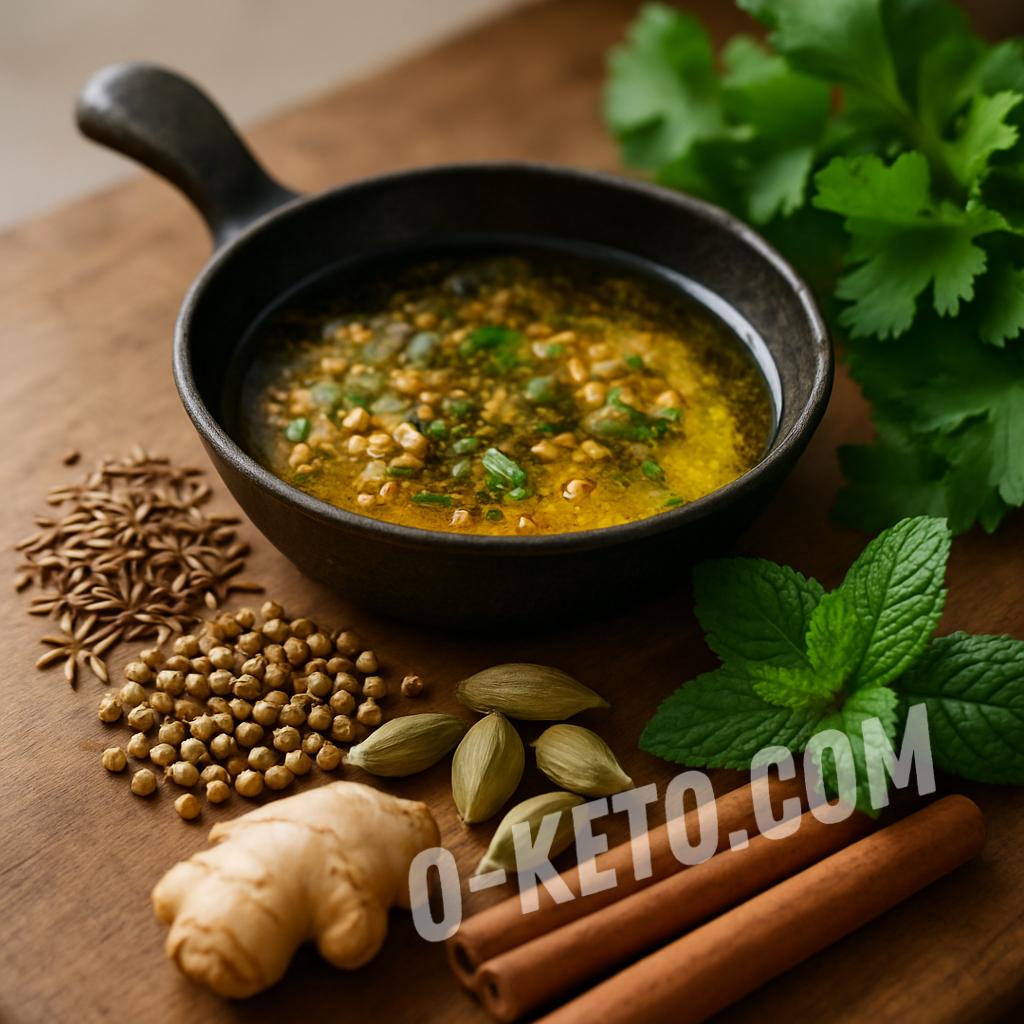
For home cooking, a small active spice shelf is often enough: coriander, cumin, fennel, cardamom, cinnamon, ginger, turmeric, black pepper, mustard seed, paprika, mint, parsley, cilantro, and dill. Seeds and harder spices can be gently warmed in ghee, butter, coconut oil, or olive oil so their aroma opens more fully. Powders usually belong a little later so they do not burn. Fresh herbs often work best at the end, when the goal is freshness rather than heat.
This approach also fits low-carb cooking well. When there is less sugar, flour, and heavy processed sauces, spices become one of the main ways to create interest in eggs, fish, poultry, vegetables, salads, and homemade dressings. They do not need to be treated as healing agents to be genuinely useful. Good flavor is already real value.
Fat as a flavor carrier
A very practical kitchen lesson is that many spices bloom better in fat than in water alone. Ghee, butter, coconut oil, and good olive oil act as flavor carriers. When cumin, coriander, mustard seed, or fennel are gently warmed in fat for a short time, their aroma often becomes rounder, deeper, and more integrated.
That does not mean every dish should be heavily fried. The point is gentle blooming, not aggressive heat. For eggs, vegetables, chicken, fish, soups, and warm salads, even 20 to 40 seconds over moderate heat can be enough to wake the spice up before adding the rest of the ingredients. This is one reason warming dishes often feel especially satisfying in colder seasons.
How to adjust meals to season and state
Most home kitchens do not need a complicated doctrine. A few simple questions before cooking are enough. Do I want warmth and density, or freshness and lightness? Do I need a deeply satisfying meal, or just something clean and easy to digest? Would this dish benefit from heat and spice, or from herbs, acid, and a cooler profile?
- in cold weather, soups, braises, roasting, warm sauces, ginger, cumin, cinnamon, and black pepper often feel more natural;
- in hot weather, fish, seafood, herbs, yogurt sauces, crunchy vegetables, lemon, mint, and shorter cooking often feel easier;
- after heavy meals, simpler dishes and softer spice profiles may feel better than overloaded combinations;
- during fatigue, comforting textures such as broth, omelets, stewed vegetables, fish, and warm sauces are often easier to enjoy;
- when freshness is needed, herbs, acidity, cool sauces, and crisp vegetables can rebalance the meal.
These are not medical instructions. They are kitchen observations. Their value is that they can be tested in everyday life without forcing ideology onto the plate. If a dish leaves you feeling weighed down, it can often be simplified. If a meal feels flat and lifeless, it may need more warmth, fat, spice, or freshness.
Where caution matters
Interest in Ayurveda sometimes pushes people to read about warming and cooling foods as if they were ready-made treatment plans. That is where restraint matters. If someone has reflux, gastritis, gallbladder disease, pregnancy, medication use, or strong food sensitivity, spices and food experiments should be handled more gently. Hot, sharp, or concentrated spice use can irritate the gastrointestinal tract even when the theory sounds attractive.
The healthiest path is to borrow practicality without borrowing extremism. Paying attention to season, tolerance, texture, spice, and cooking method is useful. Trying to replace real medical care with spice logic is not. Home cooking works best when observation and moderation stay in charge.
Practical conclusion for ordinary kitchens
If Ayurvedic principles are used without mysticism, they come down to a very grounded idea: food should fit not only the recipe, but also the moment. In colder periods, warmth, fat, softer textures, soups, and gentle warming spices often help. In warmer periods, freshness, herbs, acidity, lighter textures, and cooler dishes become more appealing. Seeds and harder spices can be bloomed in fat, powders used moderately, and fresh herbs saved for the end.
That makes everyday cooking more flexible. It helps people use seasonal produce better, diversify eggs, fish, meat, vegetables, and sauces, and reduce the need to build flavor only with sugar, flour, or heavy bottled dressings. The main value is not in promises of miracles, but in learning to cook with more attention and better taste every day.