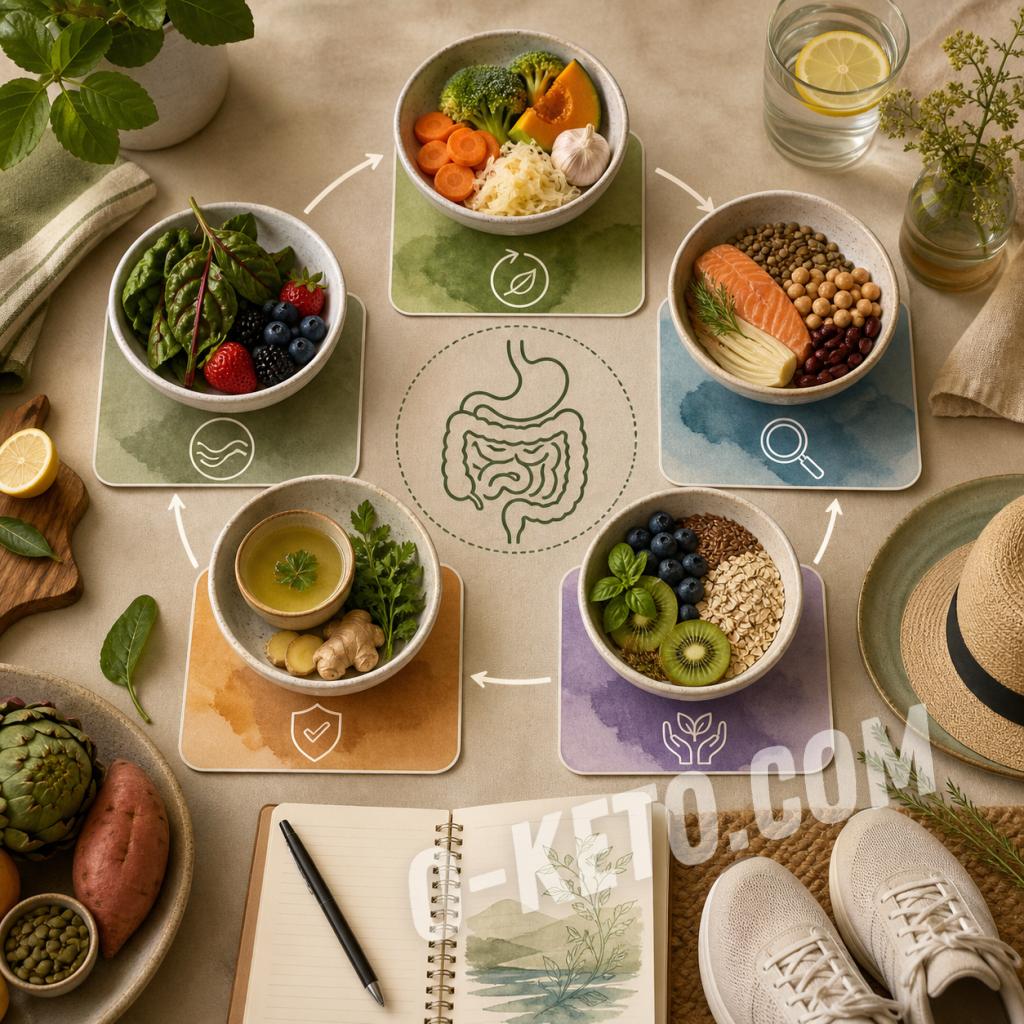

The 5R program is a sequence used in integrative approaches to digestive complaints. Its value is not in giving every person the same list of supplements, but in reviewing food, symptoms, medicines, sleep, stress, and diagnosed disease step by step. This can be a useful way to avoid starting ten products at once, but it is not an official universal treatment protocol.
The practical idea is simple: first clarify what problem actually exists, then remove only justified triggers and test changes gradually. When the sequence is replaced by a long list of “antimicrobial,” enzyme, and detox products, 5R becomes a collection of unproven prescriptions.
What 5R means
The name comes from five English words: Remove, Replace, Reinoculate, Repair, and Rebalance. Different schools use the stages differently, so the name alone does not tell you which products or restrictions will be recommended.
A safer way to use the idea is to treat 5R as five questions about the same situation. Is there a documented factor worth removing? Is there a specific deficiency or digestive problem to replace? Is a probiotic actually needed? What is a diagnosed cause and what is only a proposed mechanism? How do sleep, movement, stress, and meal patterns affect symptoms?
Remove: remove only justified factors
The first stage may involve reducing alcohol, highly processed foods, unnecessary supplements, or a specific food that appears to trigger symptoms. That can be reasonable when the connection is clear and the restriction has a defined time limit. It is not reasonable to automatically label dairy, gluten, soy, legumes, vegetables, or all fermentable carbohydrates as harmful simply because they appear on a generic exclusion list.
An elimination diet is a test of a hypothesis, not a lifelong verdict on a food. Remove one suspected factor for a defined period, write down what result you are evaluating, and then reintroduce the food carefully. For irritable bowel syndrome, a low-FODMAP approach may be used as a short, structured strategy followed by reintroduction rather than permanent avoidance of fruit, legumes, and many vegetables.
Do not stop prescribed medicines on your own. If a side effect is suspected, discuss a change with the clinician who prescribed the medicine. Bloating, a coated tongue, or tiredness do not by themselves prove an infection, parasite, or overgrowth of a particular bacterium.
Replace: replace a specific deficiency
This stage makes sense when there is a clear reason for replacement: a documented enzyme deficiency, a significant nutrient deficiency, or a medically established digestive disorder. For example, lactase can help a person with lactose intolerance, but that does not make enzyme capsules necessary for everyone who feels heavy after a meal.
Do not use hydrochloric acid, bile products, or broad digestive-enzyme blends as a universal way to “start the stomach.” Their effects depend on diagnosis, dose, medicines, and mucosal health. A long list of enzymes taken to break down a presumed biofilm or “remove toxins” is not the same as evidence-based treatment of the cause.
Reinoculate: do not seed the gut blindly
The intestine is not a sterile container that needs to be filled with a preselected set of bacteria. The microbiome changes with diet, medicines, infections, sleep, age, and disease, and one test does not provide a simple good-versus-bad score. In practice, gradually expanding tolerated food diversity and obtaining fiber from suitable foods may matter more than choosing a random probiotic.
Probiotics are not interchangeable. Their effects depend on the strain, dose, condition, and goal. The American Gastroenterological Association does not treat probiotics as a universal answer for most digestive conditions: evidence exists for some specific situations, but it cannot be transferred to every product on a store shelf.
Fermented foods and probiotic supplements are not the same thing. Kefir, yogurt, or fermented vegetables may fit a diet when tolerated, but the word “fermented” does not guarantee a particular live strain or a therapeutic effect. If a food worsens pain, diarrhea, or bloating, there is no reason to continue it simply for the idea of “repopulation.”
Repair: treat the cause instead of promising a “sealed gut”
5R materials often use phrases such as “repair the lining,” “close the gut barrier,” or “heal increased permeability.” A biological mechanism may be worth studying, but a change in a laboratory marker does not automatically mean that a supplement cured disease, removed pain, or prevented complications.
It is more useful to understand repair as treatment of an established cause: celiac disease, inflammatory bowel disease, an infection, gallstone disease, a nutritional deficiency, or another condition confirmed by an appropriate evaluation. Glutamine, zinc carnosine, collagen, and other substances should not become universal substitutes for diagnosis. Their usefulness and safety depend on the specific question, not on a general promise about the mucosa.
Rebalance: restore support in everyday life
The final stage connects digestive complaints with ordinary routines. Poor sleep, ongoing strain, little movement, irregular meals, and eating too quickly can worsen symptoms even when the food list looks “perfect.” No complex protocol is required here: stabilize sleep, add manageable movement, eat more calmly, and observe reactions to real portions.
This does not mean that stress invents symptoms or that a walk treats disease. It means that background factors affect appetite, motility, sleep, and the ability to follow a diet. Once the basics are steadier, it becomes easier to see what is actually food-related and what needs medical investigation.
Which 5R prescriptions should not be copied alone
Be particularly cautious with protocols that immediately propose anti-biofilm enzymes, systemic enzymes for inflammation, binders for “detox,” colloidal silver, or antiparasitic and antifungal combinations without a documented infection. Unpleasant sensations after starting such a plan do not prove that “pathogens are dying.” They may reflect a side effect, a drug interaction, or worsening of the underlying condition.
Do not buy a course based only on a symptom list or increase doses because a “therapeutic” effect is promised. Before a complex plan, list medicines and supplements, check contraindications, and define the result that should be measured. Without a defined result, benefit cannot be assessed honestly.
How to use the 5R idea in practice
Start with a one- or two-week diary: record meal times, portion contents, pain, stool, bloating, sleep, and medicines. Do not change food, supplements, and routines all at once, or you will not know what affected you. Choose one testable hypothesis, set a time limit and an outcome, and then reintroduce the restricted item when that is safe.

If a symptom does not change, do not keep intensifying the protocol. Reconsider the original hypothesis and discuss the next step with a qualified professional. If you improve, still aim to restore as many tolerated foods as possible and keep only restrictions with a clear reason.
How 5R relates to keto
A ketogenic diet can be part of an individual plan, but the 5R idea is not a reason to add endless restrictions to an already limited menu. On a low-carbohydrate diet, pay attention to adequate protein, energy, fiber, electrolytes, and food diversity. If diarrhea, constipation, pain, or unintentional weight loss continue, investigate the cause instead of automatically removing another food group.
A low-FODMAP diet and keto are different tools. They are sometimes combined briefly and for a specific reason, but the menu can become too narrow very quickly. Reintroduce foods according to tolerance and let diagnosis, goals, and nutritional adequacy guide the plan rather than the number of exclusions.
When to see a doctor
Do not rely only on food experiments when there is blood or black stool, fever, repeated vomiting, dehydration, severe nighttime pain, anemia, noticeable unintentional weight loss, or new persistent symptoms. These signs require evaluation of the cause and may be unsafe to manage with prolonged self-imposed restriction.
Conclusion
5R is most useful as an order of questions: what truly needs to be removed, what is confirmed to need replacement, whether targeted microbiome support is needed, which cause requires treatment, and which habits support recovery. This prevents a hypothesis from being confused with a diagnosis and makes it less likely that dozens of products will be started at once.
The safest version is limited change, a diary, gradual food reintroduction, and an objective review of results. Supplements and treatment plans should match a specific problem and be assessed with a clinician rather than follow from a fashionable protocol name.
Sources
- Gut Microbiome — American Gastroenterological Association
- Role of Probiotics in the Management of Gastrointestinal Disorders — American Gastroenterological Association
- Low-FODMAP Diet — American College of Gastroenterology
- ACG Clinical Guideline: Management of Irritable Bowel Syndrome
- 5R Protocol for Gut Health — British Association for Nutrition and Lifestyle Medicine