


Gallstone disease
Gallstone disease means stones form in the gallbladder or bile ducts; what matters is not only the ultrasound finding, but pain, bile flow, inflammation and the risk of complications.




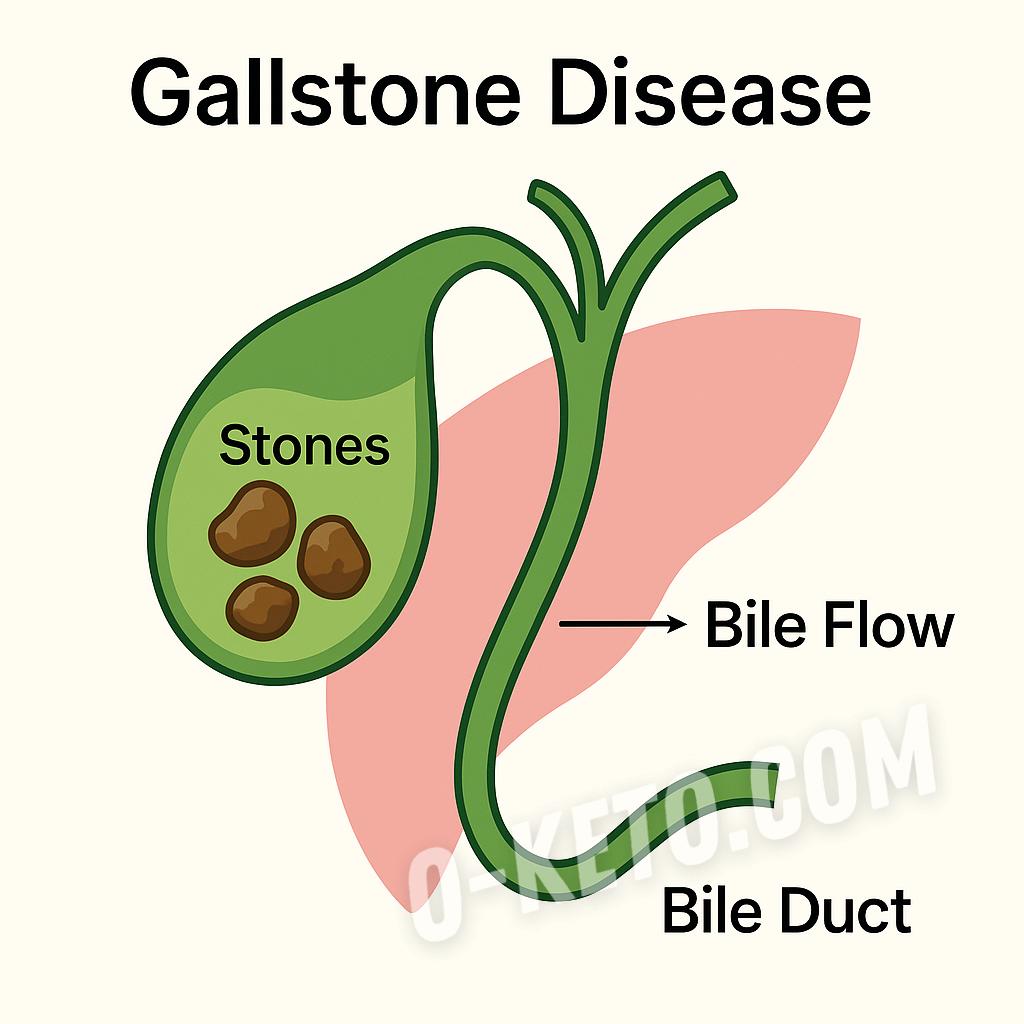
Gallstone disease is a condition in which stones form in the gallbladder or bile ducts from components of bile. In some people they remain silent for a long time, while in others they become the cause of biliary colic, nausea, inflammation or impaired bile flow. For that reason the important issue is not only the ultrasound finding itself, but whether the stones cause symptoms, obstruct drainage or increase complication risk. The same “gallstone on ultrasound” can be an incidental finding in one person and a trigger for repeated painful attacks in another.
Why gallstones form
Gallstones form when bile composition and gallbladder function change in a way that allows its components to precipitate more easily. Excess weight, insulin resistance, rapid weight shifts, dietary pattern, pregnancy, hormonal factors and impaired gallbladder motility can all contribute. In some people there is also a strong genetic component involving cholesterol handling and bile acid balance. That is why gallstone disease should not be reduced to the simplistic idea that “fatty food created the stones.”
One especially important risk period is rapid weight loss, because sudden weight reduction can alter bile composition and increase stone formation.
How it may present
Typical biliary colic feels like pain, pressure or cramping in the right upper abdomen or upper central abdomen, often after meals and sometimes radiating to the back or right shoulder blade. Nausea, heaviness and poor tolerance of food may join in. Yet not every right-sided discomfort is caused by stones, and not every stone causes symptoms. Sometimes the disease first becomes obvious when a complication develops, such as acute cholecystitis, duct obstruction, jaundice or pancreatitis.
This is why symptoms always need to be interpreted together with ultrasound findings, liver markers and inflammatory signs rather than in isolation.
What matters beyond the ultrasound
Besides the presence of stones, it is important to assess their number and size, gallbladder wall changes, bile duct status, bilirubin, liver enzymes, fever, pain pattern and signs of systemic inflammation. Sometimes stones are present but not fully responsible for the symptoms, while in other cases a small migrating stone can cause a major obstruction. That is one reason why “I have stones but I can still tolerate them” is not always a safe conclusion without clinical context.
If jaundice, fever or persistent escalating pain appear, the focus is no longer ordinary digestive discomfort but the possibility of a real biliary complication.
Diet and metabolic context
Nutrition affects bile metabolism, but not through the crude myth that “fat itself is the problem.” In some people very heavy meals do worsen symptoms, yet in many cases irregular eating, repeated overeating, large weight swings and insulin resistance matter at least as much. A low-carbohydrate approach is not automatically equivalent to gallstone disease, but rapid weight loss on any dietary pattern requires caution, especially if biliary symptoms have happened before.
In practical terms, the name of the diet matters less than a stable routine, avoidance of dramatic weight swings and attention to recurring right upper abdominal pain.
When urgent assessment is needed
Urgent assessment is needed with strong prolonged pain, fever, chills, yellowing of the skin or eyes, vomiting, dark urine, pale stool or suspicion of pancreatitis. In those situations gallstone disease may already mean blocked flow, infection or pancreatic involvement. The most sensible way to see this condition is as a disorder of bile composition and gallbladder function in which symptoms, drainage and complication risk matter far more than a neat line in an ultrasound report.
Common mistakes with gallstones
A frequent mistake is to assume that if attacks are rare, the problem can be ignored completely. Yet even infrequent typical biliary pain, especially if it is becoming stronger or changing its pattern, deserves attention to bile flow and complication risk. Another mistake is to reduce everything to a vague ban on fat without examining weight pattern, meal rhythm, insulin resistance and rapid body-mass shifts. In some people chaotic weight loss and metabolic instability create a more important background than any single food item. It is usually more useful to ask whether the stones are truly symptomatic, whether drainage is being disturbed and whether the situation is moving toward cholecystitis, obstruction or pancreatitis rather than fighting one “bad meal” in isolation.
Another dangerous mistake is trying to “flush” the gallbladder with large amounts of olive oil, lemon juice, herbs or laxatives. There is no reliable evidence that this procedure removes or dissolves gallstones. The soft green lumps sometimes seen in the stool afterward may consist of oil, juice and other ingredients from the mixture, so they should not be interpreted as passed gallstones. A cleanse can cause nausea, vomiting, diarrhea and abdominal pain, and in people with stones it may trigger an attack. Suspected gallstones require medical assessment and an evidence-based plan, not repeated home flushes.
Sources
- Gallbladder cleanse: A “natural” remedy for gallstones? — Mayo Clinic.
If you have any questions about the term "Gallstone disease", you can ask them to AI. Please note, a low-cost OpenAI model is used. It may answer questions about disease treatment with errors!


 1 / 4
1 / 4
 1 / 4
1 / 4

 1 / 4
1 / 4 1 / 4
1 / 4