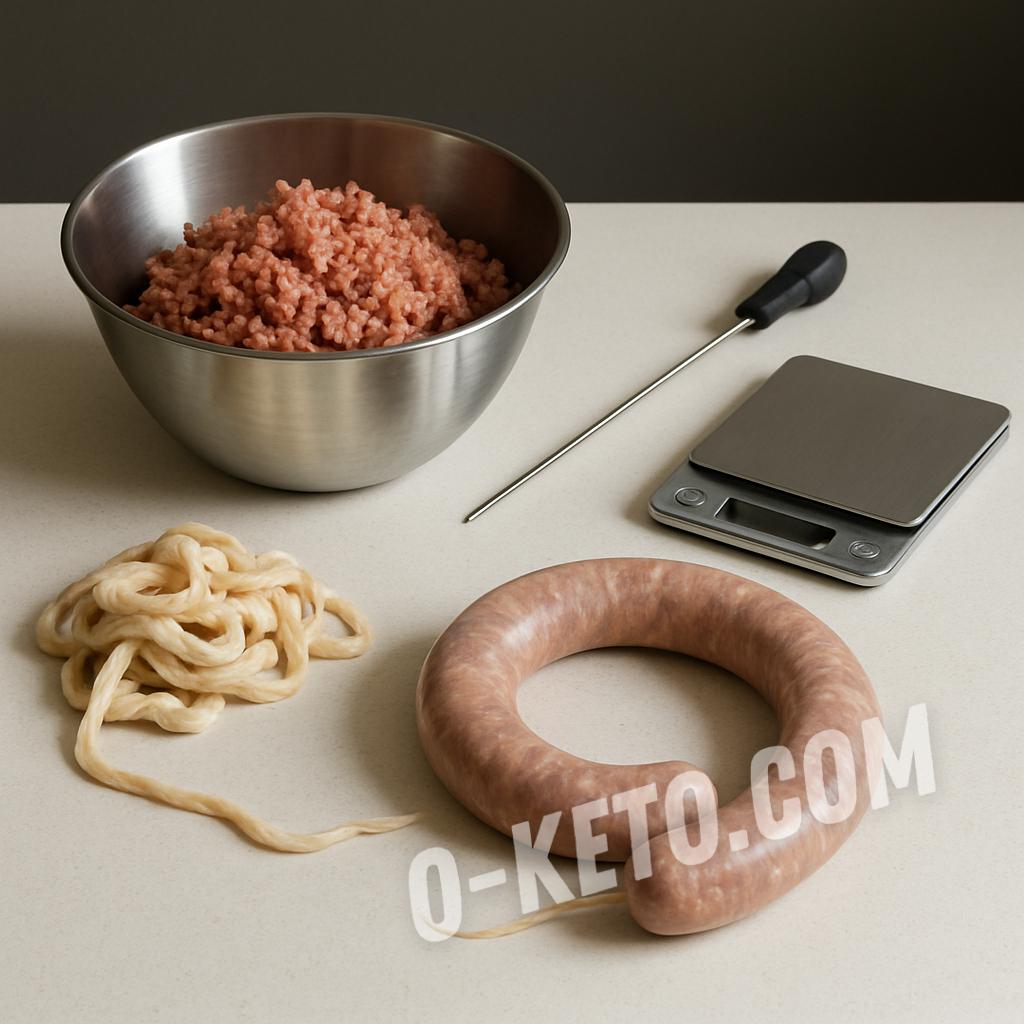

Homemade sausage becomes reliable not because the recipe contains many spices, but because the technique is controlled: cold mince, accurate salt, proper stuffing, resting, gradual heating, internal temperature control, and fast cooling. If one step is skipped, the casing may burst, the sausage may leak broth and fat, crumble on slicing, or show a dull gray cut.
The main rule is simple: sausage needs precision. Use scales, a probe thermometer, chilled ingredients, a clean casing, and a slow temperature rise without shocks.
What to prepare before starting
Prepare the equipment before grinding the meat, because sausage mince should not sit warm on the table. The colder the raw material stays during work, the lower the risk of fat separation, loose texture, and poor flavor.
- kitchen scales for salt, spices, and additives;
- a probe thermometer for the internal temperature of the sausage;
- a grinder, cutter, food processor, or stand mixer;
- a sausage stuffer or stuffing attachment;
- a suitable casing without damage or expired storage;
- a refrigerator at 2-4°C for curing, resting, and maturing.
If the recipe uses water, cream, or broth, chill the liquid in advance. For emulsified sausages, part of the meat is often lightly frozen so the fat does not melt during processing.
Stages of making homemade sausage
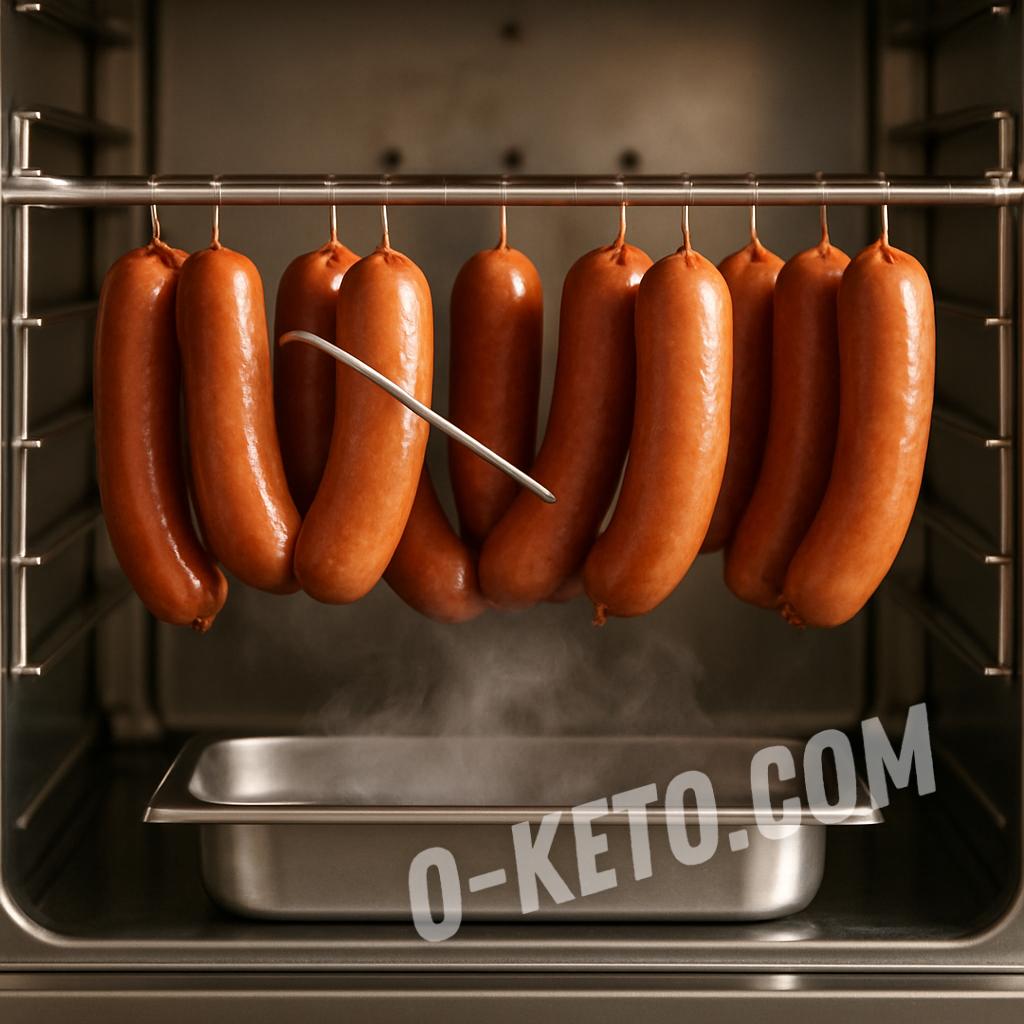
Different recipes vary, but the basic logic is the same. First the meat is salted and mixed, then stuffed into a casing, stabilized, and only then heat-treated.
| Stage | What happens | Why it matters |
| Salting and mixing | Salt, spices, and liquid are added, then the mince is mixed until sticky | Protein binds moisture and fat, creating structure |
| Mince maturation | The mince rests 12-24 hours at 2-4°C | Salt distributes evenly and flavor becomes smoother |
| Stuffing | The mince is packed firmly but not overfilled | Voids are reduced and the sausage keeps shape |
| Resting | Stuffed links are held before heating | The casing and filling stabilize |
| Warming and drying | The sausage warms gradually and the surface dries | This prevents thermal shock and improves casing color and adhesion |
| Cooking with steam or moist heat | The sausage is brought to its target internal temperature | The product becomes safe and fully cooked |
| Showering and cooling | The finished sausage is cooled quickly with cold water and then refrigerated | The casing stays smoother and moisture losses are lower |
For cooked sausages, frankfurters, and similar products, a gradual scheme is common: gentle warming, then drying, then heating around 80°C with steam until the center reaches about 69-72°C. Sous-vide follows the same logic: do not throw a very cold sausage straight into aggressive heat.
Resting, warming, and drying before the main heat
Resting after stuffing is not just a pause between the stuffer and the oven. During this time the mince settles more evenly inside the casing, the casing tightens slightly, and the protein mass becomes more stable. For simple cooked sausages, resting may take 1-2 hours or overnight in the refrigerator, while larger batons and whole-muscle products may need longer.
After refrigeration, the sausage is usually allowed to warm slightly at room temperature. The point is not to make it truly warm, but to reduce the sharp contrast between an icy center and a hot oven. If a very cold baton goes straight into strong heat, the outer layer can overheat before the center is ready.
Drying follows next. The surface should become dry rather than wet with condensation. A dry casing handles the next stage better, wrinkles less, and takes color more evenly. In a home oven this is usually a gentle dry phase until the inside reaches roughly 28-35°C, unless the recipe gives another target.
Browning, steam, and when to insert the probe
After drying, many sausage recipes move to a browning stage. This is not frying in the usual kitchen sense, but a controlled increase in heat so the surface sets, color develops, and the casing adheres neatly to the mince. It bridges the dry start and the final cooking phase.
Once the outside has set, boiling water is often poured into the lower tray. The steam softens the heat, reduces surface drying, and helps finish the sausage without harsh overheating of the casing. In a home oven this is a practical way to create gentler heat than dry air alone.
The probe is not always inserted at the very first minute. In very soft, emulsified, or liquid-style fillings it is often safer to let the sausage set a little first, then insert the thermometer into a control baton. If you pierce too early, juice or part of the filling can escape through the opening. In denser products the probe can go in earlier, but it still has to reach the center without touching the pan or mold.
A useful working sequence is simple: dry heat first, then a setting or browning stage, then the main finish with steam or boiling water in the tray until the target internal temperature is reached. The center temperature, not just the timer, determines doneness.
How to work with salt and curing
Undersalting causes more than bland flavor. It weakens storage stability, increases spoilage risk, and interferes with proper sausage structure. Oversalting is unpleasant too, but a small excess is often easier to soften in taste than an undercured sausage is to fix.
| Product | Salt guideline | Comment |
| Cooked or cooked-smoked sausage | 10 g curing salt plus 5-10 g regular salt per 1 kg raw material | 10 g curing salt is the base point, then flavor is adjusted with regular salt |
| Whole-muscle product with heat treatment | 10 g curing salt plus 10 g regular salt per 1 kg raw material | Larger pieces need more time for even curing |
| Dry-cured or raw-smoked sausage | 25-30 g curing salt per 1 kg raw material | Here salt is critical both for taste and for drying safety |
| Wet brining | 70-80 g salt per 1 l water and 1 kg product | Pieces need turning and mixing in the forming brine |
If water, cream, or broth is added to the mince, the final salinity drops. When adjustment is needed, it is regular salt that is corrected for the liquid, while curing salt remains tied to the meat itself.
Mince temperature matters more than speed
One of the most common causes of failed sausage is overheated mince during grinding and mixing. When the mass gets too warm, protein and fat stop working well together: the structure loosens, fat separation appears during cooking, and slices may crumble.
A practical range for many home-cooked sausages is to keep the mince cold and avoid going much above 10-12°C during active processing. For emulsified sausages, work even more carefully: partially freeze the meat, add icy liquid gradually, and pause to chill if needed.
Stuffing and casing
The casing has to be prepared according to its type: natural casing is rinsed and soaked, while fibrous or collagen casings are handled by their own instructions. Do not use casing that is expired, damaged, or repeatedly frozen and thawed.
Stuff firmly, but not brutally. Overstuffing raises the risk of bursting, while loose stuffing leaves voids, wrinkles, and an uneven cut. Air should be removed early: prick visible bubbles with a thin needle and smooth the mince before the resting stage.
Cold shower and stabilization after the oven
Once the sausage reaches its target internal temperature, it should not simply sit on the counter and coast. Most cooked sausages are showered with very cold water for about 10-30 minutes, depending on size. This stops carryover cooking, tightens the casing, and helps prevent deep wrinkles.
After showering, the sausage is usually dried on a rack so extra surface moisture can drip off, and only then moved into the refrigerator. The next step is stabilization. Even a fully cooked sausage does not show its final structure immediately on the first cut: moisture and fat still need time to redistribute.
That is why many home sausage batons are held in the refrigerator for another 8-12 hours, sometimes longer. After this stabilization, the slice is usually cleaner, the flavor is calmer, and the sausage cuts much better than it does straight after cooling.
If you use collagen sheets or tubular collagen casings, they do not need long soaking. Usually a brief contact with water is enough: smooth a sheet with a wet hand, or dip a tubular casing quickly, squeeze it lightly, and put it onto the stuffing tube right away. Excess soaking does not make it more reliable, while rough handling and overstuffing increase the risk of tearing.
With home sausages, it is especially important not to force the filling into the casing as tightly as possible. Overly hard stuffing creates tension in the casing wall and later leads to cracks, juice loss, and uneven shape during heating. It is much better to aim for an even, elastic fill and to keep the meat mixture cold and workable.
Common mistakes and what they mean
A defect usually points not to random bad luck, but to a broken stage in the process. The look of the baton and the slice often tells you where the failure happened.
| Problem | Likely cause | What to change next time |
| Burst casing | Overstuffing, heating too fast, overheating, poor casing, or burrs on the stuffing tube | Stuff more moderately, inspect the tube, raise heat gradually |
| Wrinkled casing | Voids, weak stuffing, cooling in air without showering | Mix better, stuff more evenly, cool in water for 15-30 minutes |
| Slime on the casing | Microbial spoilage from poor temperature, humidity, or hygiene | Control the refrigerator, cleanliness, storage time, and cooling regime |
| Sticking marks and pale patches | Baton touching baton, poor surface drying, chamber too humid | Hang freely and dry before smoking or browning |
| Broth-fat separation | Overheated mince, too much liquid, too much fat, or aggressive heat | Keep the mince cold, avoid excess liquid, heat more gently |
| Crumbly slice | Overcooking, protein overheating, very lean formula, moisture or fat loss | Watch the internal temperature and do not cook longer than needed |
| Voids | Air in the mince, no pricking, gas-forming microbes, or too much fermentable sugar | Remove air, prick batons when appropriate, keep the process clean |
| Weak pink color | Old curing salt, too short a cure, fast heating, or no warming stage | Use fresh curing salt, allow enough cure time, do not rush browning |
Quick checklist
It is often more useful to keep a few control points in sight than to memorize a long list of failures. These points prevent most home sausage problems.
- weigh salt and spices instead of adding them by eye;
- keep the mince cold and chill equipment if needed;
- mix until sticky, but do not overheat the mass;
- stuff firmly without voids and without overstuffing;
- include a real resting and warming stage before the main heat;
- dry the casing before adding steam;
- do not rush to insert the probe into a very soft baton before it sets;
- use steam or boiling water in the tray during the main finishing stage when the recipe calls for it;
- after cooking, shower, cool, and let the sausage rest in the refrigerator.
Good homemade sausage is not magic and not a secret spice. It is clean raw material, cold mince, correct salt, careful casing work, and a thermometer that keeps you from guessing.