




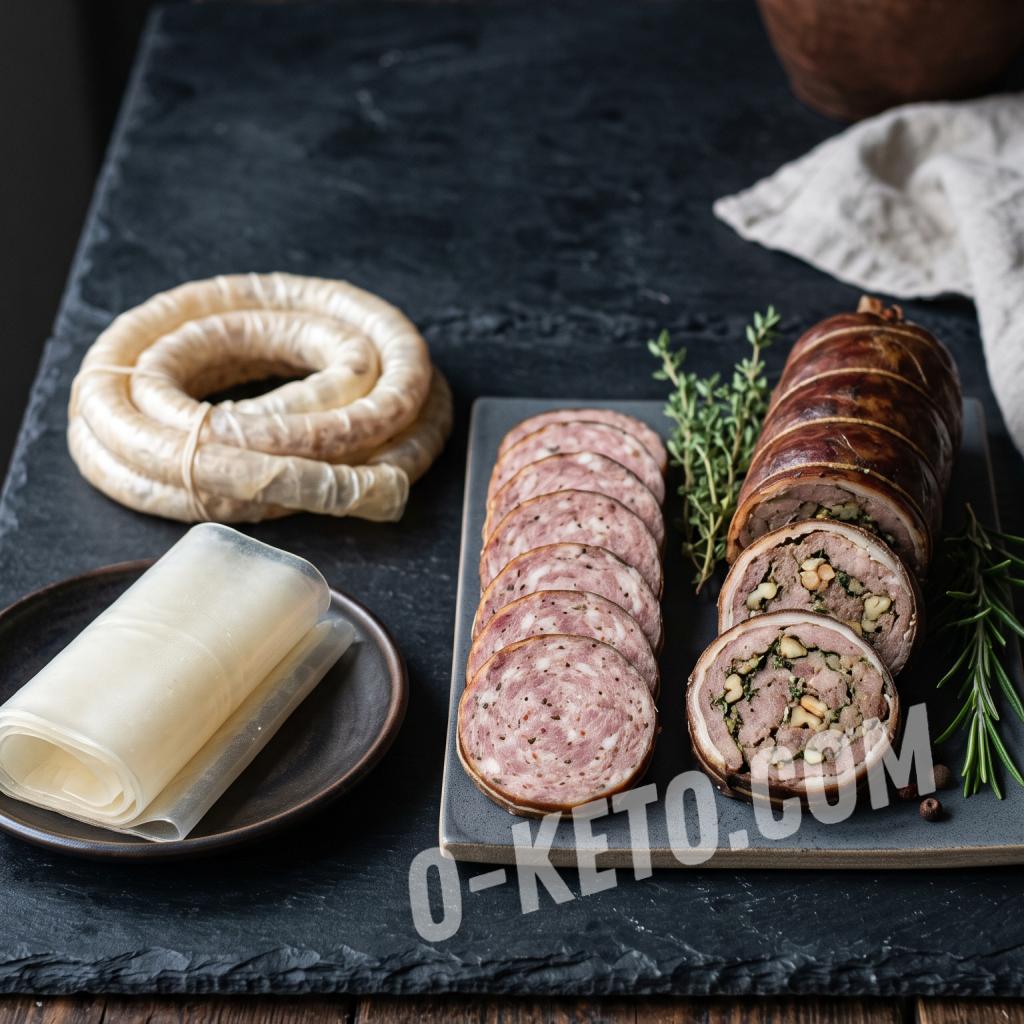

Collagen materials in home cooking are often treated as something either too professional or unnecessarily complicated. In reality they are much more practical than mysterious. Collagen sheets and collagen casings are useful because they help shape a roll, keep the filling together, create a cleaner slice, simplify stuffing, and make the final result more predictable during sous vide cooking, gentle smoking, poaching, or a short grill finish.
How collagen sheets differ from collagen casings
The first thing to understand is that there are two different formats. An open collagen format is basically a sheet or edible film. It works well for larger rolls, fish or meat roulades, and portioned cylinders where the outside needs to hold the form. A closed collagen format is a tubular casing in different diameters. That one is better for sausages, small links, frankfurter-like pieces, larger cooked sausages, and more compact charcuterie-style products.
Because of that difference, the workflow should not be the same. When the goal is to wrap a whole formed roll, a sheet is usually the right tool. When the goal is to stuff a mince or sausage mixture into a defined tubular shape, the casing is the right one. Small diameters are usually more practical for home sausages, while wider diameters suit larger cooked loaves or thick roulades.
How to hydrate collagen before using it
Neither format needs long soaking. This is one of the most useful practical points, because many people instinctively handle collagen as if it were natural intestine casing or another material that needs extended hydration. In practice, a very brief contact with water is enough. A sheet is usually just smoothed on the board with a wet hand. A tubular casing is dipped quickly, removed at once, lightly squeezed, and then fitted onto the stuffing tube. Long soaking does not reliably improve the process and can make the workflow fussier than it needs to be.
For collagen sheets it is worth calculating the cut size before you start rather than cutting by guess. In a home kitchen that simple habit reduces waste and prevents the frustration of a piece that is too short for a full wrap. A practical rule is to size one dimension by the intended length of the product plus some allowance, and the other by roughly two product diameters so the roll can close and tighten properly. Beginners are usually better off with a little extra margin instead of pushing the size too tightly.
Storage matters too. If part of the sheet remains after cutting, it is worth sealing the rest quickly in a zipper bag, pushing out excess air, and keeping it refrigerated. That helps preserve a stable working texture and reduces the chance that the material dries out before the next batch. It sounds like a small detail, but small storage habits often decide whether collagen feels cooperative or frustrating in ordinary home use.
Which mistakes most often damage collagen
The most common beginner problem is rough handling and overpressure. Collagen works best when treated gently. If you pull too aggressively, stretch the tube too hard, or force the filling in with maximum pressure, the material can tear. This is especially common with homemade sausages: people often think tighter stuffing always means a more professional result, but in practice it can increase the risk of rupture, trapped air, juice loss, and uneven heating later on.
Another practical point is not chasing extreme length when using collagen casings. Collagen is less elastic than natural casings, so very long pieces with twists can become more troublesome. For many home cooks it is easier and safer to work with shorter links of moderate length, because air can be moved toward the ends more easily and the finished contour stays neater. That matters even more if the product will later be lightly smoked or finished briefly over high heat.
If you notice large air pockets after stuffing, it is better to correct them instead of hoping they will disappear. Trapped air is not only a cosmetic issue. It can ruin the slice, weaken the structure, and make the piece more vulnerable during heating. In practice it is usually better to push air gently toward the end and release it near the knot with a very small puncture than to prick the casing randomly all over.
How to handle collagen casings during stuffing
With tubular collagen casings, the focus shifts toward the filling. It is useful to cut the casing with a little extra length for tying the ends and to keep the sausage mixture cold and workable. The cold temperature is not only about safety. A warm filling is more likely to lose structure, create a broth-like weep, and sit unevenly inside the casing. That is why chilled filling, calm stuffing, and moderate pressure usually give the cleanest home result.
Collagen does not magically make food taste better on its own. Its job is structural: shape, neatness, repeatability, and a cleaner presentation. That is why it shines most in recipes where form really matters: roulades for slicing, fish or meat spirals, home sausages, cooked charcuterie rolls, and sous vide products that need to stay tidy before a quick final finish. If the dish does not need shape or a clean cut, collagen may simply be an unnecessary extra step.
Conclusion
The home-cooking summary is straightforward. Use collagen sheets for rolls and larger formed pieces, and tubular collagen casings for sausages and sausage-style products. Hydrate both only briefly, keep the filling or main product cold, avoid rough tension and overstuffing, and correct trapped air carefully instead of aggressively. When handled that way, collagen stops feeling like an intimidating professional tool and becomes a very practical home technique for cleaner, more stable results.


