




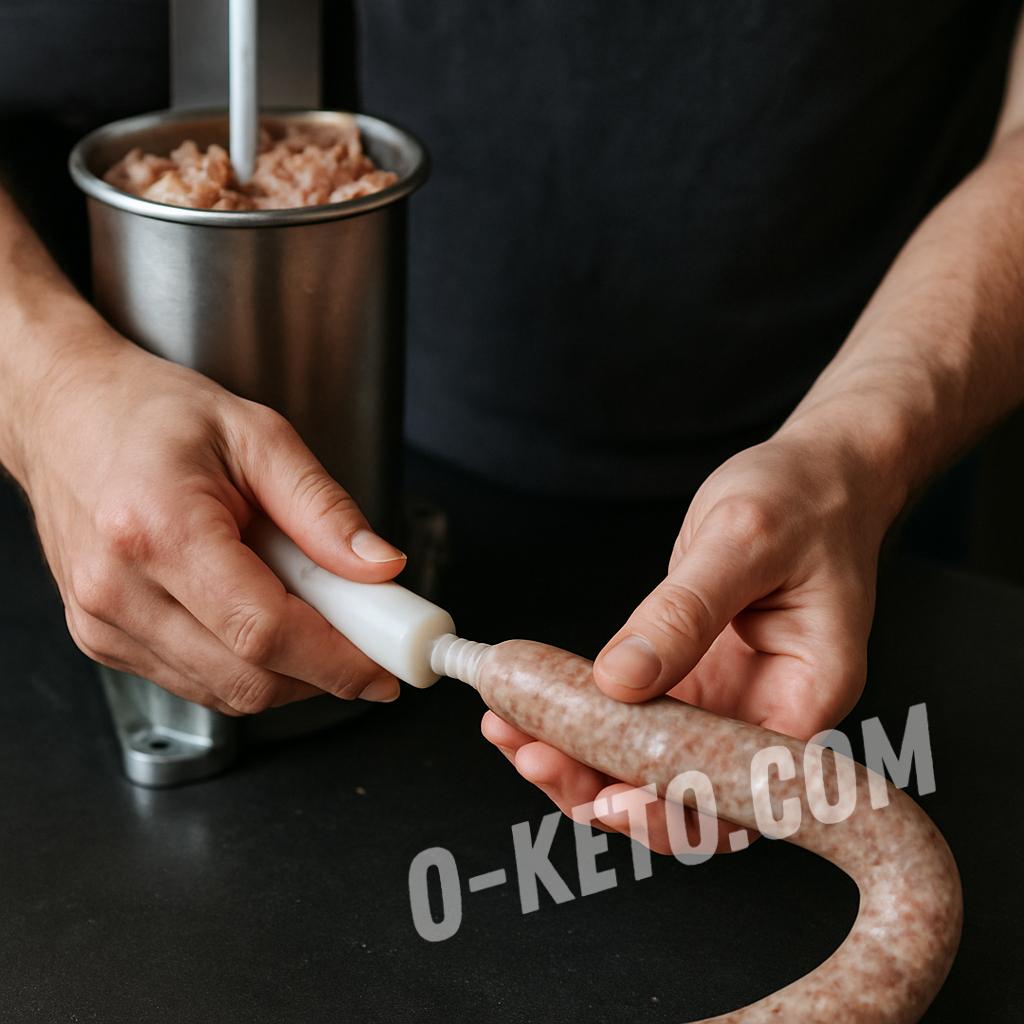

Natural casing works well for kupaty because it gives a thin bite and familiar sausage shape. Tearing, air gaps, and leaking juices usually happen during stuffing. The cause is rarely one mistake: poorly prepared casing, warm mince, and overfilling often combine.
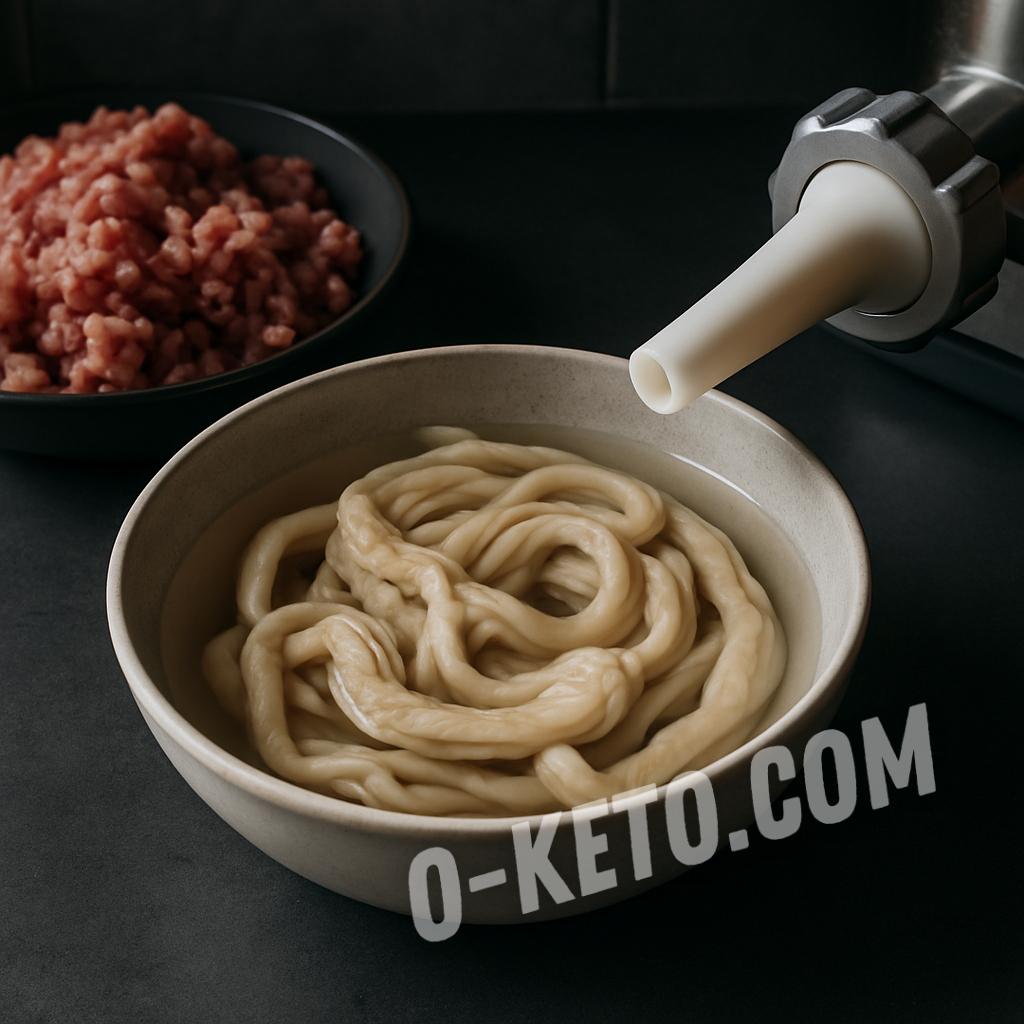
Preparing the casing
Salted casing should not be placed on the nozzle straight from the package: salt, dry folds, and stiff spots can make stuffing uneven. Cut the length you need, rinse the casing under lukewarm running water to remove surface salt, and inspect it along its full length. Cut out any section with a hole or tear.
Before stuffing, follow a few basic steps:
- soak salted casing in clean water until pliable; a common guide is water around 30 °C for at least 30 minutes, but exact conditions depend on the product;
- if the casing is unsalted or seems questionable, soak it in 20% brine for 30–40 minutes;
- after soaking, run clean water through the casing to check that it is open and rinse away residual salt.
Temperature and soaking time vary by manufacturer, so follow the instructions for your specific casing. Keep it submerged in water until you are ready to use it. Very hot water is unnecessary: the goal is to restore elasticity, not heat or cook the casing.
Keep the mince cold before stuffing
Kupaty mince should be cold, homogeneous, and sticky. Warm loose mince moves unevenly, fat smears, and empty spaces appear inside the casing. A useful working target is to keep the mince below 8-10°C during mixing.
Check the mince before stuffing by these signs:
- the mass holds together instead of crumbling;
- water is bound into the mince and not standing in the bowl;
- spices are evenly distributed;
- the mince feels cold but is not frozen solid;
- the mixed mince rested in the refrigerator for about an hour.
How to tie the first end and which knots are practical
Many stuffing problems start with the very first end of the casing. If it is closed weakly, some filling and air escape. If it is tightened unevenly, the end can slip from the nozzle at the worst moment.
For home kupaty, a complicated butcher’s knot is not necessary. A simple reliable version is usually enough:
- leave a short tail of casing before starting;
- tie it with one firm knot;
- add a second locking knot over the first one;
- if the tail is long and slippery, fold it back toward the knot and catch it once more with string.
This kind of double knot is easy to repeat and holds even wetter fillings well. If you make separate portion links, the end after twisting is also better fixed with a real knot rather than left on twist alone when the casing feels especially slippery or thin.
What to do with a more fluid filling
Not every kupaty filling behaves like a dense coarse mince. Chicken, emulsified, blood-based, or other softer mixtures need calmer handling and do not tolerate harsh pressure. The more fluid the mixture, the more important it is not to rush by force.
If the mass is noticeably softer than usual, several tricks help:
- chill the mince more thoroughly before stuffing;
- give it a short rest in the refrigerator after mixing;
- use a funnel, stuffer, or smoother-feeding nozzle instead of forcing it through in jerks;
- support the casing by hand and fill it in small even portions;
- avoid overstuffing because fluid filling expands even more eagerly during heating.
If the filling barely holds shape, make shorter batons and work in small batches. That is neater than trying to fill a very long casing at once and then fighting leaks and bubbles.
Nozzle and stuffing speed
Use a sausage stuffer or a sausage nozzle on a meat grinder. A stuffer usually gives more even pressure, but a grinder nozzle can work if the process is slow. The nozzle must match the casing: too wide stretches it, too narrow makes feeding harder and creates voids.
A practical stuffing sequence is:
- slide the casing fully onto the nozzle, leaving the end free;
- do not tie the end immediately, so the first air can escape;
- feed the mince slowly and evenly;
- support the casing by hand without pulling it sharply;
- watch that the mince flows continuously, not in broken bursts.
If the mince moves with difficulty, do not simply increase pressure. Stop and check the nozzle, mince temperature, and casing folds. Excess pressure tears casing more often than it fixes the problem.
How tightly to fill
Kupaty should hold their shape without being filled like a hard cord. During heating, mince expands, moisture turns to steam, fat softens, and an overfilled casing can split. This is especially common with grilling or sudden boiling water.
Use these density cues:
- the sausage springs back slightly when pressed but does not feel hard;
- the casing is not stretched until translucent;
- twisting portions does not make the casing crack or whiten;
- there are no large gaps between mince and casing;
- the shape holds without aggressive tying.
For sausages that will be heat-treated and then grilled, a little spare room is better than maximum filling. Moderate even stuffing usually gives a juicier result.
When you can puncture the casing and when you should not
Small air bubbles are almost inevitable, especially during a first attempt. In ordinary dense kupaty, large visible pockets can be pricked with a thin needle before heating, otherwise the bubble expands and finds a weak point.
But not every baton should be heavily pricked. If the filling is fluid, very delicate, or still unset, extra punctures work against you. Juice, fat, or part of the filling can escape through those holes and leave the link misshapen.
The practical rule is simple:
- dense kupaty with obvious air pockets can be pricked locally with a thin needle;
- emulsified, chicken, or more fluid batons are usually better left unpricked unless there is a real need;
- if a puncture is necessary, make it only at the large bubble, not across the whole surface;
- a knife is the wrong tool because it cuts the casing too roughly.
Do not turn the sausages into a sieve. Remove only the air pockets that are truly likely to expand during heating.
Resting after stuffing
Stuffed kupaty are better rested in the refrigerator. Resting helps the mince settle inside the casing, stabilizes shape, and lowers the risk of tearing during heat treatment. For example, simple chicken and Georgian-style kupaty can rest for about 2 hours, while chorizo-style sausages may rest for 10–12 hours.
Do not pile the sausages tightly during this stage. Pressure and sharp bends weaken the shape. Lay them on a tray or rack and cover so the surface does not dry out.
Why casings tear
A tear almost always has a specific cause. Before the next batch, check the whole process:
- the casing was dry, poorly rinsed, or damaged;
- the nozzle had a sharp edge or wrong diameter;
- the mince was warm and poorly bound;
- the casing was overfilled;
- large air pockets remained inside;
- sausages were grilled immediately after stuffing without resting;
- heating was too aggressive for a tightly stuffed casing.
Good kupaty stuffing is control of pressure, temperature, and casing elasticity. When the casing is prepared, the mince is cold, air is released where appropriate, and filling is moderate, natural casing works reliably.


