


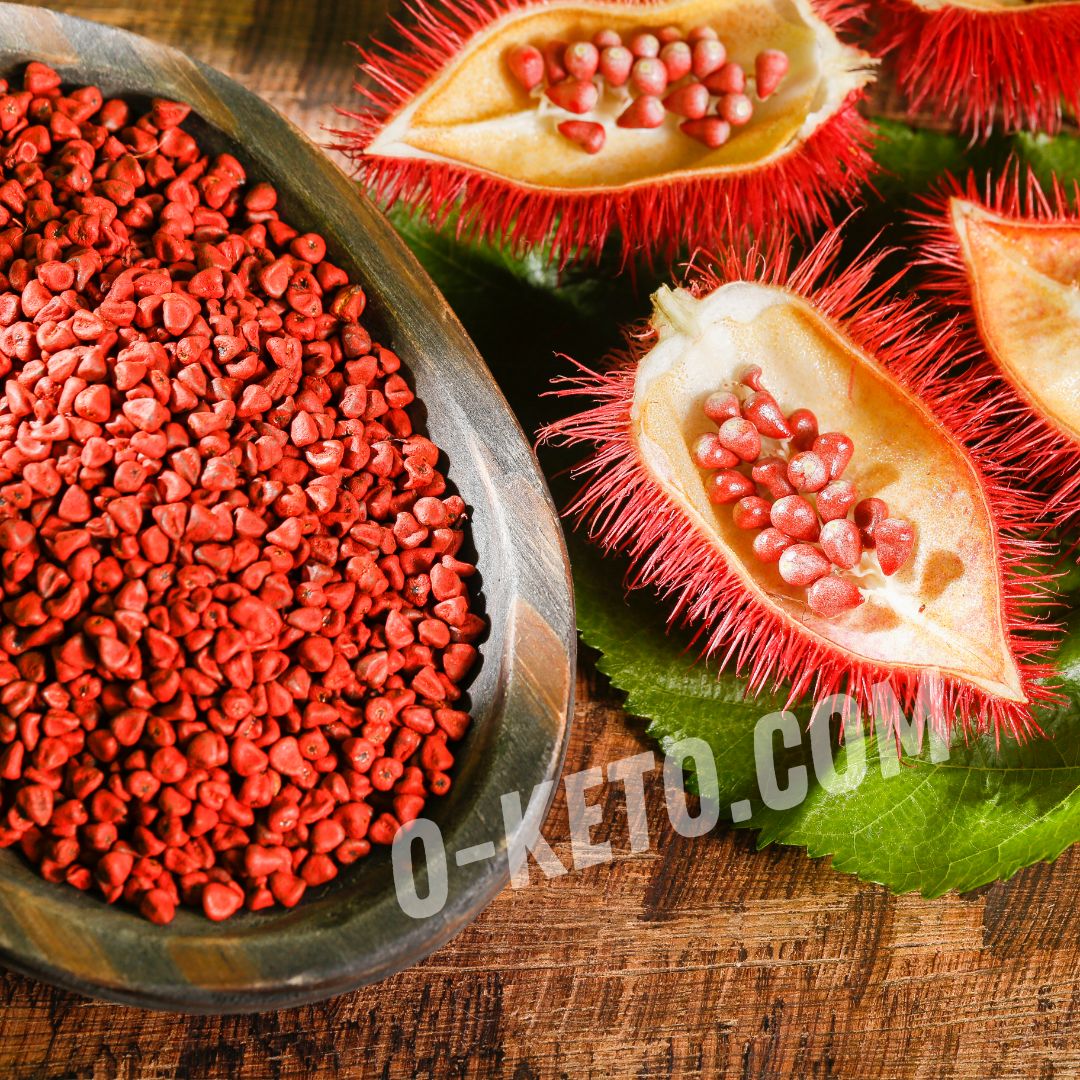

Annatto is an orange-red food color and mild spice made from the seeds of Bixa orellana, also called achiote. It is used in Latin American and Caribbean cooking and in food production: for coloring cheeses, oils, sauces, rice dishes, marinades, sausages, fish products, and snacks.
The main feature of annatto is color. It can give shades from yellow to deep orange and reddish, depending on form, dose, and what it is dissolved in. The taste of the seeds is mild, earthy, slightly peppery, and nutty, but in a small dose annatto usually works as a color accent rather than a separate spice.
Origin and composition
Annatto comes from the seeds of the tropical tree Bixa orellana, common in Central and South America. The seeds are coated with a bright pigment. The main coloring compounds are the carotenoids bixin and norbixin. Bixin is more connected with fatty systems, while norbixin is more convenient for water-based systems, so different annatto forms are used in industry.
The older text mentioned vitamin A, vitamin E, and calcium. Such components may appear in raw-material tables, but the real cooking dose is too small to treat annatto as a nutrient source. Its practical role is color, light aroma, and a technical function in a recipe.
Place in keto and LCHF
Plain annatto fits keto and LCHF because it is used in very small amounts and adds almost no carbohydrates. It can color butter, cheese sauces, meat marinades, chicken, fish, sugar-free mayonnaise, seasoned oil, and vegetable dishes.
The product form matters. Whole seeds, ground powder, or oil extract are usually easier to fit into a low-carb diet. Ready blends with annatto may contain sugar, starch, flour, maltodextrin, salt, flavor enhancers, or dried vegetables. In that case, the full label matters, not just the word “annatto”.
How to use
Annatto seeds are often warmed in oil so the color moves into the fat. The seeds are then strained out, and the colored oil is used for marinades, sauce, frying onion, chicken, fish, or vegetables. The oil should not be overheated: at high heat the seeds can become bitter.
Powder is more convenient, but easier to overdose. Start with a small pinch and stir it into fat or liquid until the color is even. Dry powder can leave spots, especially in thick sauces. In cheese and cream sauces, add annatto gradually because the color develops as it disperses.
Where it appears
Annatto is used for color in cheddar, processed cheeses, butter, margarine, some meat products, smoked fish, sauces, and snacks. In home cooking, it is especially useful when a warm orange shade is wanted without tomato paste, a large amount of paprika, or a sweet sauce.
In marinades, annatto pairs well with garlic, lime, vinegar, cumin, coriander, oregano, chili, olive oil, and salt. For keto dishes it can be used with chicken thighs, pork, white fish, shrimp, cauliflower, zucchini, and cheese sauces.
How to choose
The seeds should be dry, red-brown, without mold, mustiness, or foreign odor. Powder should have an even warm color and should not be stuck in hard lumps. If the smell is dusty or rancid, the product is old or was stored poorly.
For extracts and ready colorings, check the carrier: oil, water, alcohol, emulsifiers, or other additions. This matters not only for carbohydrates but also for the recipe: water-based color mixes poorly with fatty sauce, while oil-based color is more convenient for butter, mayonnaise, and marinades.
Limits and storage
Annatto is usually used in a small dose. Individual reactions are possible, as with any spice or food additive, so a new product is better tried in a small portion. If annatto is part of a processed food, a reaction may be related not to annatto but to cheese, sausage, sauce, or other additions.
Store seeds and powder in a tightly closed jar, in a dry dark place, away from the stove. Powder loses aroma and color faster than whole seeds. Oil infused with annatto should be refrigerated and used quickly because flavored oils are sensitive to light, air, and dish cleanliness.
Substitution options in recipes
Paprika. At a level of 0.2% plus turmeric at 0.05%. Annatto colors cheese from ivory to orange. The mixture of paprika and turmeric gives a warm yellow hue, is thermally stable up to 90°C; the taste becomes slightly sweet.


