


E101 (riboflavin, vitamin B2)
Riboflavins provide a yellow-orange color and are linked to vitamin B2, but as E101 they are usually used as colorants. For keto and LCHF, it is important not to confuse coloring a product with correcting vitamin deficiency, and to evaluate the whole formula around the colorant.
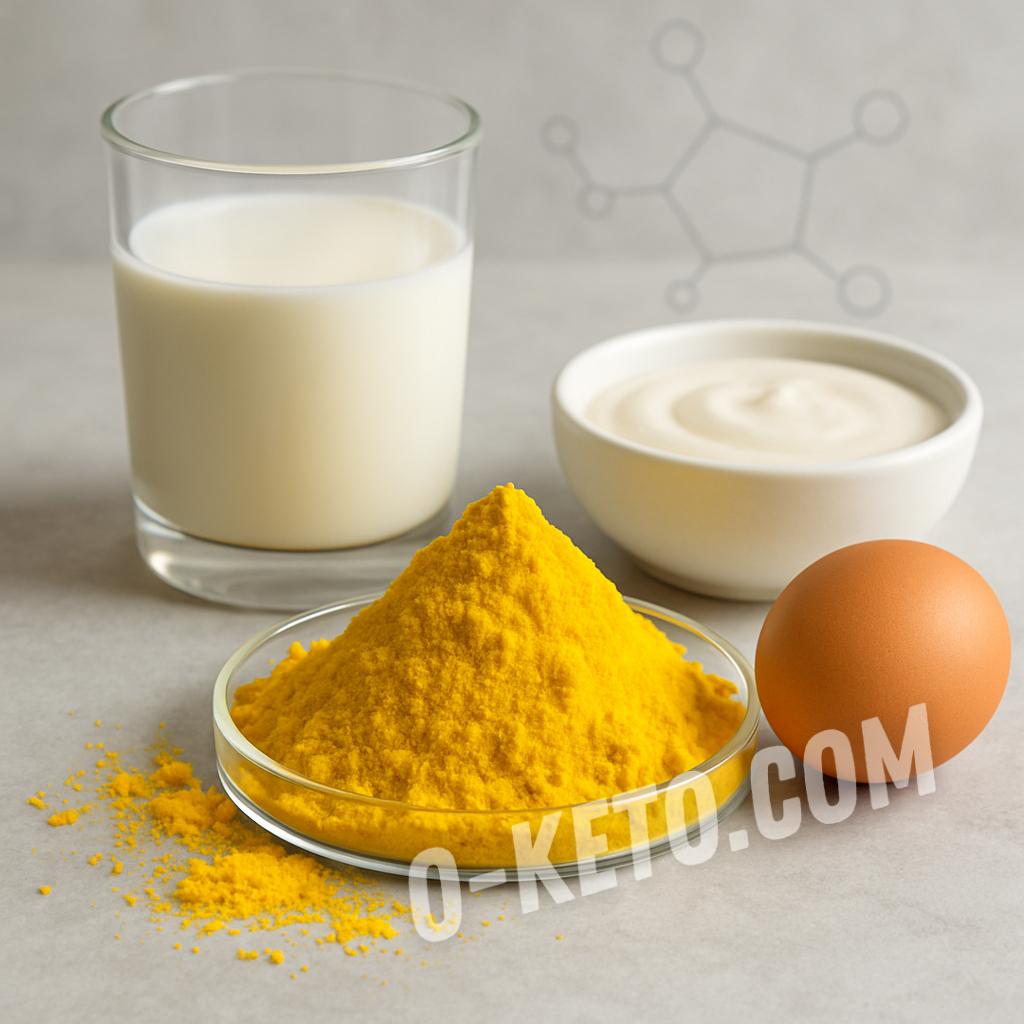
E101 refers to riboflavins, yellow-orange food colorants linked to vitamin B2. The group includes riboflavin and riboflavin-5-phosphate sodium. Riboflavin is indeed a vitamin required for energy metabolism, enzyme function, and healthy mucous membranes. But when E101 appears as an additive in a product, its main technological role is often color rather than nutrient therapy. This distinction matters: a bright yellow shade does not mean the product is a good source of vitamin B2.
What this colorant is
Riboflavin has a characteristic yellow color and can color foods from pale yellow to yellow-orange. It is sensitive to light, so its behavior in a product depends on packaging, environment, and processing. In nature, vitamin B2 is found in eggs, liver, dairy products, meat, fish, some vegetables, and yeast. In food manufacturing, E101 can be produced and standardized to work as a colorant. It is therefore important to separate riboflavin as a nutrient in food from riboflavin as a technological color additive.
Where E101 is found
E101 may appear in drinks, desserts, sauces, dairy products, processed snacks, vitamin products, mixes, and supplements. Yellow color can create the impression of creaminess, egg content, citrus flavor, fortification, or naturalness. Sometimes riboflavin is added both as a vitamin and as a colorant, but this should be confirmed by labeling, dose, and declared nutritional value. If the product is simply colored, it does not become a meaningful B2 source. This is especially important for sweet drinks and desserts where a vitamin-like image can hide sugar or starch.
Relevance for keto and LCHF
Riboflavin itself is not a carbohydrate and does not interfere with ketosis. Vitamin B2 is actually needed for normal energy metabolism, including enzyme systems involved in the oxidation of fats and carbohydrates. But E101 in the ingredient list does not automatically make a product useful for low-carb eating. If the yellow color appears in a sweet yogurt, bar, drink, or dessert, sugar, maltodextrin, syrups, starch, flour, polyols, and serving size matter more. The colorant may be neutral while the surrounding product is poorly suited to the diet.
It does not replace deficiency correction
Riboflavin deficiency may be associated with cracks at the corners of the mouth, tongue inflammation, irritated mucous membranes, fatigue, and other nonspecific signs. But trying to correct a possible deficiency with products where E101 is used as a colorant is not logical. Nutrient correction requires real food sources, diet assessment, digestive status, the broader need for B vitamins, and sometimes a dosed supplement. The amount of colorant in a product may be too small, while the product itself may contain ingredients that do not fit the person’s metabolic goals.
Tolerance and safety
Riboflavin in ordinary food-use amounts is well tolerated by most people. Excess water-soluble vitamin is usually excreted, and bright yellow urine after B2 supplements is a familiar effect. But that relates to the nutrient side, not the quality of a colored product. If symptoms appear after a product containing E101, the more likely causes are sweeteners, dairy components, acids, flavorings, caffeine, or the overall formula. E101 itself is rarely the main irritant, but it can be part of a formula that gives the product a vitamin-like or natural image.
Practical conclusion
E101 is an example of an additive where the vitamin name can mislead. Riboflavin as a vitamin is needed by the body; riboflavin as a colorant is needed by the product for color. For keto and LCHF, it is usually a neutral E number when the whole formula fits. A sweet or starchy product should not be considered good just because it contains a yellow vitamin colorant. It is better to obtain B2 from eggs, meat, liver, fish, and dairy if tolerated, while colored products should be judged by sugar, starch, protein, fat, and real nutritional value.
In practical use, E101 is better understood as a technological colorant, not as a vitamin supplement. If a product is colored with riboflavins, that says nothing about its protein, sugar, starch, sweeteners or overall nutritional value. For a low-carb diet, the decisive point remains the whole formula of the product, not the mere presence of a yellow colorant.
If you have any questions about the term "E101 (riboflavin, vitamin B2)", you can ask them to AI. Please note, a low-cost OpenAI model is used. It may answer questions about disease treatment with errors!


 1 / 4
1 / 4
 1 / 4
1 / 4


 1 / 4
1 / 4
