


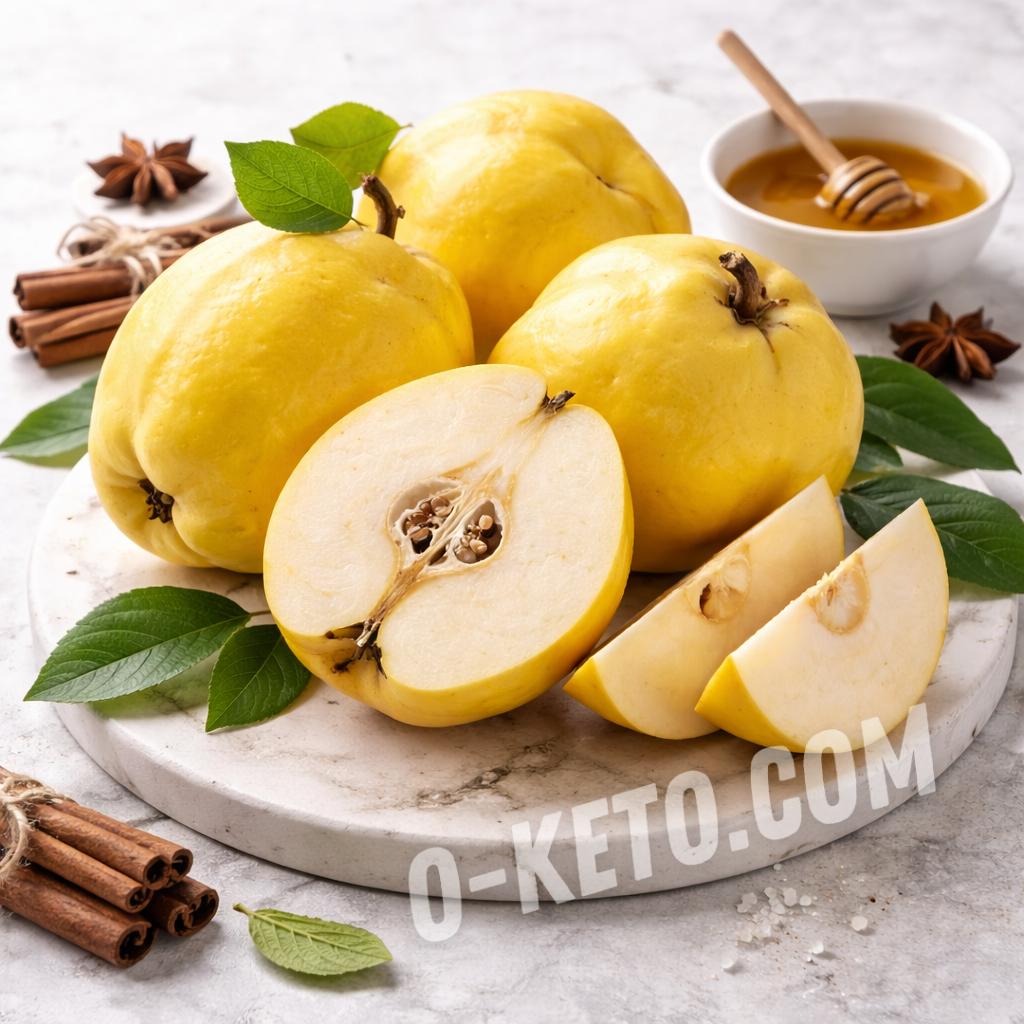

Quince is a dense, fragrant fruit with astringent flesh, rarely eaten raw. Fresh quince is hard, drying on the tongue, and sweet-tart, but after heat it becomes softer, smells brighter, and keeps its shape well. That is why it is more often stewed, roasted, added to meat and poultry, or used in compotes, sauces, jams, and jellies.
The fruit has long been grown in the Caucasus, the Middle East, Central Asia, and the Mediterranean. In cooking, it is valued not only for sweetness but for aroma: even a small piece can change a dish. For a low-carb diet, this matters because quince is usually best used as an accent rather than as a large fruit dessert.
Nutrition
A 100 g portion of fresh quince usually has about 55-60 kcal, roughly 14-15 g of carbohydrates, very little fat, and less than 1 g of protein. Some of the carbohydrates are dietary fiber, including pectins, but natural sugars are present too. Quince is therefore not a free low-carb food, even if it tastes less sweet than pear or apple.
The firm flesh contains a lot of pectin, which is why quince gels well and works in marmalade, thick sauces, and fillings. It also contains organic acids, aromatic compounds, and small amounts of vitamin C, potassium, copper, and other micronutrients. In a normal serving, however, it is best viewed first as a carbohydrate-containing fruit with a strong flavor, not as a main source of individual nutrients.
Is it suitable for keto?
For strict keto, quince fits only in small amounts. A whole fruit can provide too many carbohydrates for one meal, especially if other sources of sugar or starch are present. But 20-40 g of quince in a sauce for meat, an unsweetened filling, or aromatic tea may fit if it is counted within the day.
The common mistake is treating quince as a “not very sweet fruit” and eating a large portion. Astringency masks sweetness, but it does not remove carbohydrates. Jam, fruit paste, candied quince, quince cheese, and syrups need even more caution, because traditional recipes often contain a lot of sugar. For LCHF, cook quince without sugar or with a suitable sweetener and use it as a flavor accent.
How to use
Quince works especially well in dishes with fat, salt, and spices. It can be added to duck, lamb, pork, chicken, mince, stewed cabbage, and butter-based sauces. Its tart taste balances fatty meat, and the dense texture does not fall apart immediately during cooking. For a keto version, stew small pieces with meat, onion, cinnamon, cloves, thyme, or bay leaf without sugar.
In desserts, quince needs a more careful approach. It can be cooked with erythritol, allulose, or stevia, but the texture will differ from classic sugar jam. Pectin opens well with heat, yet without sugar the mixture does not always become as firm. For creams and cottage cheese desserts, a small amount of pre-stewed quince works well as a fragrant layer.
How to choose
Good quince is firm, heavy for its size, and has a clear fruity aroma. The skin may be yellow and sometimes lightly fuzzy, but it should not have soft dark spots, wet cracks, or mold. A very green fruit will be harder and more acidic, while an overripe one darkens inside faster. Small surface scuffs are acceptable if the flesh under them remains firm.
For stews and meat dishes, firmer fruit works better because it keeps its shape. For sauce, puree, or filling, a riper quince with a stronger aroma is useful. Remove the core before cooking, because the flesh around the seeds is especially hard. The peel may be left on or removed depending on the recipe: it carries aroma, but in a delicate dessert it can be distracting.
What to pair it with
Quince pairs well with lamb, duck, pork, chicken, butter, ghee, cinnamon, cloves, cardamom, thyme, rosemary, lemon, and walnuts. In savory dishes, it can be combined with cabbage, onion, celery, mushrooms, and herbs. In a small amount, it gives fruit aroma without needing honey or sugar.
If you want a dessert profile with a smaller carbohydrate load, quince can be paired with cottage cheese, mascarpone, cream, or thick yogurt without sugar, but the fruit portion should stay small. In drinks, a few thin slices are enough: quince has a strong aroma, so a large amount is unnecessary.
Limits and storage
Quince may irritate a sensitive stomach because of its acids and astringency, especially when raw. In low-carb eating, the portion needs to be counted, and with poor tolerance of rough fiber it is better to start with cooked fruit. Seeds are not used as food: remove the core during preparation.
Whole quince should be stored in a cool dry place or in the refrigerator, away from foods that absorb odors easily. Cut fruit darkens quickly, so add a little lemon juice and keep it in a closed container. Cooked quince keeps for 2-3 days in the refrigerator; sweet preserves should be judged by ingredients and storage conditions.
Substitutes
For a similar role in meat dishes, sour apple or pear can work, but their carbohydrates also need counting. If you need acidity without fruity sweetness, use lemon juice, a little apple cider vinegar, or sauerkraut. For aroma in desserts, lemon zest, cinnamon, cardamom, and a small amount of berries can help.


