
Dietary fibers differ in solubility, degree of fermentability by intestinal microflora, and water-holding capacity. These properties determine both their physiological effects on peristalsis, microbiota, and glycemic response and their technological applications such as thickening, gel formation, structure stabilization, and calorie reduction.
In keto and low-carb cooking, fibers are especially important because they often replace some of the functions of flour and starch. Some make a batter more viscous, some retain moisture, and others work mainly as bulky fillers. For that reason, the same weight of two different fibers almost never gives the same result.
Which Fiber Properties Matter in Recipes
For baking and desserts, the key factor is not only whether a fiber dissolves in water. It also matters how much water it can hold, how fast it swells, whether it forms a gel, whether it tightens the mass, whether the crumb stays elastic after cooling, and how consistently it behaves from batch to batch.
One recipe needs a fiber for gentle thickening, another for gluten-like support, and another for reducing moisture and producing a drier slice. Because of that, direct spoon-for-spoon substitution almost always leads to mistakes: the dough may become wet, rubbery, crumbly, or too dense.
| № | Dietary Fiber | Solubility | Fermentability | Water Holding Capacity (times) | Technological Function |
|---|---|---|---|---|---|
| 1 | Inulin | soluble | fermentable | 5 | sweetness, filler |
| 2 | Oligofructose (FOS) | soluble | fermentable | 2 | taste improvement, mild sweetness, texture softening |
| 3 | Polydextrose | soluble | partially fermentable | 3 | filler, calorie reduction, mass stabilization |
| 4 | Soluble Corn Fibers | soluble | fermentable | 2 | structuring syrups, mild thickening |
| 5 | Isomalto-oligosaccharides (IMO) | soluble | partially fermentable | 2 | stickiness, plasticity, syrup replacement |
| 6 | Pectin | soluble | partially fermentable | 10 | gel formation, moisture retention in baking |
| 7 | Agar-agar | soluble | non-fermentable | 20 | powerful gelling agent, thermal stability |
| 8 | Gums (guar, locust bean, acacia) | soluble | partially fermentable | 20 | stabilization, thickening, gluten imitation |
| 9 | Sodium Alginate | soluble | partially fermentable | 10 | gel formation with calcium, stabilization |
| 10 | Carrageenan | soluble | partially fermentable | 10 | gels for dairy systems, cream stabilization |
| 11 | Psyllium | partially soluble | minimally fermentable | 40 | powerful moisture retention, dough structure, gluten imitation |
| 12 | MCC (microcrystalline cellulose) | insoluble | non-fermentable | 6 | structural filler, crumb improvement |
| 13 | Dietary Cellulose | insoluble | non-fermentable | 8 | volume, density, calorie reduction |
| 14 | Bamboo Fiber | insoluble | non-fermentable | 10 | moisture retention, texture improvement, stability |
| 15 | Lignin | insoluble | non-fermentable | 4 | mechanical filler, mass densification |
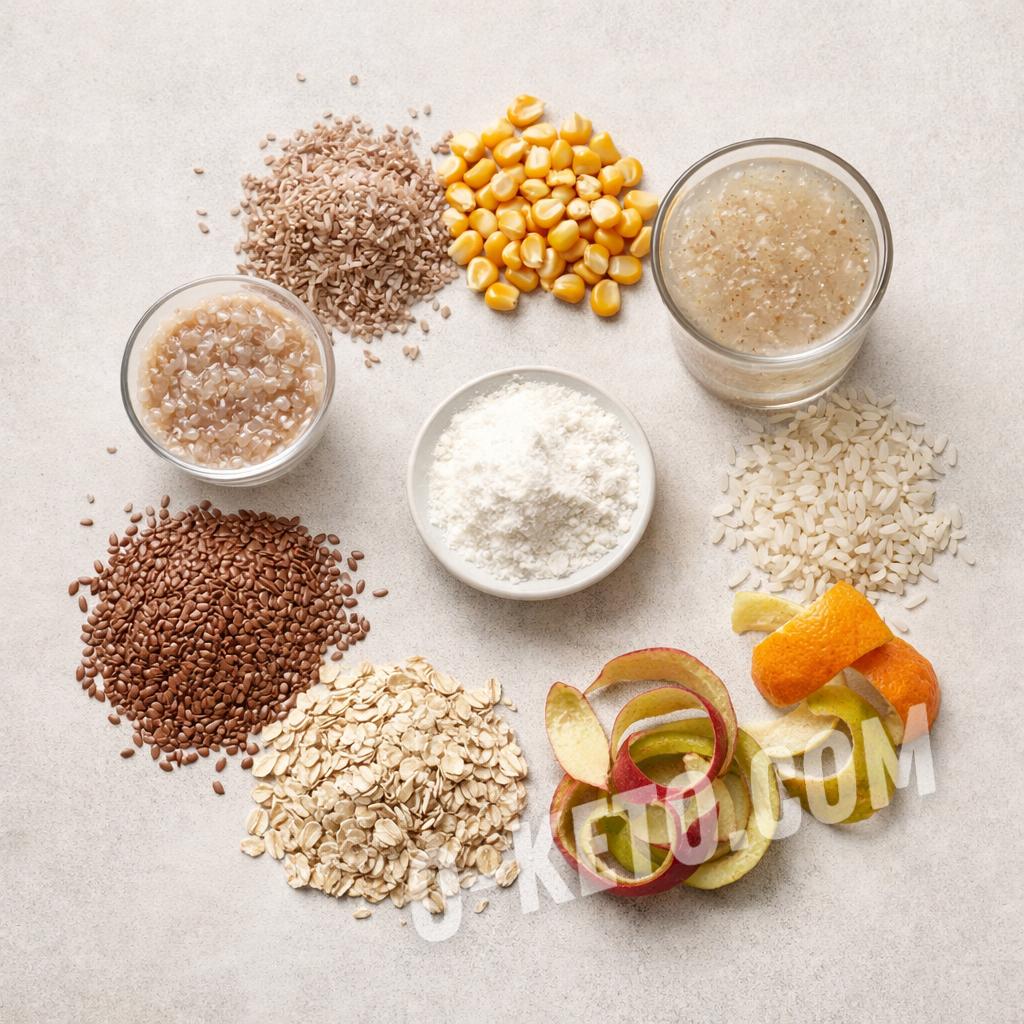
| 16 | Functional Fibers (apple, citrus, oat) | predominantly insoluble | partially fermentable | 6 | moisture regulation, structure |
| 17 | Wheat Fiber | insoluble | partially fermentable | 5 | filler, texture improvement, volume |
| 18 | Rice / Corn Fiber | insoluble | minimally fermentable | 5 | density, moisture reduction in dough |
| 19 | Resistant Starches (RS2/RS3/RS4) | partially soluble | partially fermentable | 3 | structure improvement, low digestibility, flouriness |
| 20 | Glucomannan | soluble | partially fermentable | 2–3 | viscosity, stabilization, sugar replacement |
Why Fibers Are Not Interchangeable
Even if two ingredients are both called dietary fibers, they may behave in opposite ways in a recipe. One may only lightly firm the mixture, while another turns the same formula into a gel. One may dry the dough and make it crumbly, while another retains water so strongly that the crumb stays wet and stretchy after baking.
That is why fiber replacement must be based on function, not only on grams. Bread and buns need one logic, creams and cold desserts another, and syrups or fillings a third. The common mistake looks like “the recipe failed,” while the real problem is that a fiber with a very different water-binding and texture-forming profile was used.
Psyllium: Whole Husk and Powder
Psyllium causes confusion more often than most fibers. Whole husk, ground husk, and industrial fine powder are not the same thing in practical baking. Formally they come from the same fiber source, but the contact area with water and the swelling speed are different.
Whole husk swells more slowly and gives a coarser but often more predictable structure. Powder acts faster and more strongly: it takes up water sooner, thickens the dough faster, and when overused it can make the crumb sticky, wet, or heavy. This is especially obvious in recipes that need airiness.
Industrial psyllium powder is also not perfectly identical from one producer to another. Grind size, residual moisture, and raw material purity all change the result. That is why even within the “psyllium powder” category it is sometimes necessary to adjust water and resting time slightly.
How to Recalculate Psyllium When Grinding It
If a recipe is written for whole husk and you only have a ground version, direct gram-for-gram substitution is usually not the best start. A practical starting point is to use about 80% of the original whole-husk weight if you have ground the husk yourself into a finer form. In other words, 10 g of whole husk is often more safely tested as about 8 g of freshly ground material.
This is not a universal mathematical law, but a safe starting direction. After that adjustment, consistency still matters: how fast the mixture thickens, whether it stays plastic, and whether the dough turns rubbery or sticky. With a ready-made commercial powder, the correction may need to be even stronger because the grind is often finer than in a home-ground version.
How Psyllium Affects Water, Elasticity, and Crumb
In keto baking, psyllium often plays a role close to a replacement for the gluten network. It binds water, helps dough keep its shape, makes it more elastic, and reduces the crumbly feel that is common in almond flour, coconut flour, and other gluten-free mixtures.
But the same strength becomes a problem when too much psyllium is used. Excess psyllium captures water very quickly, makes the dough heavy, and can prevent proper oven expansion. The crumb may become wet, grayish, stretchy, and even slightly sticky on the cut, even when the bake is not actually raw. If there is too little psyllium, the opposite happens: the product crumbles, breaks, and holds its shape poorly after cooling.
In practice, psyllium is almost always tied to the other fibers and liquids in the recipe. If the formula already contains coconut flour, bamboo fiber, flax meal, or a lot of protein, the dough behaves differently. That is why good adjustments involve not only the psyllium itself but also total hydration, resting time, and mixing intensity.
Practical Conclusion for Keto Baking
The more fibers a recipe contains, the more important it is to treat them as separate technological ingredients rather than just as “fiber in general.” Each one has its own water-binding strength, swelling speed, and crumb effect. That is why strong recipes usually do not tolerate random substitutions without recalculation.
If a recipe is built around psyllium, it helps to know which form is meant. If a fiber blend is used, it is worth tracking which component gives elasticity, which one dries the crumb, and which one controls overall density. That approach makes the final result much more predictable than replacing everything with any vaguely similar fiber.
Sources
- Dietary Fibre Consensus from the International Carbohydrate Quality Consortium
- Dietary Fibre in Foods: A Review
- Hydrocolloids as Thickening and Gelling Agents in Food: A Critical Review
- Dietary Fibre in Gastrointestinal Health and Disease
- Impacts of Plant-Derived Hydrocolloids on Technological Characteristics of Gluten-Free Bakery Products: A Comprehensive Review